Blog

  • Dark Venus EA Review: A Free Robot Worth Revisiting in 2026

    Dark Venus EA Review: A Free Robot Worth Revisiting in 2026

    After months of testing various Dark EAs, both free and paid versions, I decided to give Dark Venus another serious look. I’d tested this free expert advisor in the past, but with everything I’ve learned from trading the Dark EA family recently, I went back and ran dozens of backtests with different configurations until I found settings that genuinely look promising.

    Here’s what makes this review different: I’m not sharing just one setup. I’m providing four complete configurations, two optimized for larger $10,000 accounts and two specifically designed for smaller $200 accounts. All settings will be freely available, and I’ll walk through exactly what I changed and why.

    Dark Venus remains one of the top-rated free EAs on the MQL5 marketplace, consistently sitting in the top three spots. But does it actually perform, or is it just popular? Let me show you the backtest results and explain the setup process step by step.

    Why Dark Venus Deserves Another Chance

    The Dark EA family has produced consistent results for me across multiple systems. Dark Moon, Dark Nova, Dark Algo, I’ve tested them all with varying degrees of success. That track record made me think: perhaps Dark Venus, despite being free, deserves a more thorough examination with refined settings.

    Most traders download an EA, run it with default settings, and either celebrate immediate success or abandon it after disappointing results. That’s not testing, that’s gambling. Real testing means systematic experimentation with parameters, understanding what each setting controls, and finding configurations that match your account size and risk tolerance.

    I spent countless hours running backtests, adjusting variables, and comparing results. The four configurations I’m sharing represent the best combinations I found for different account types and risk preferences.

    Getting Started: Download and Installation

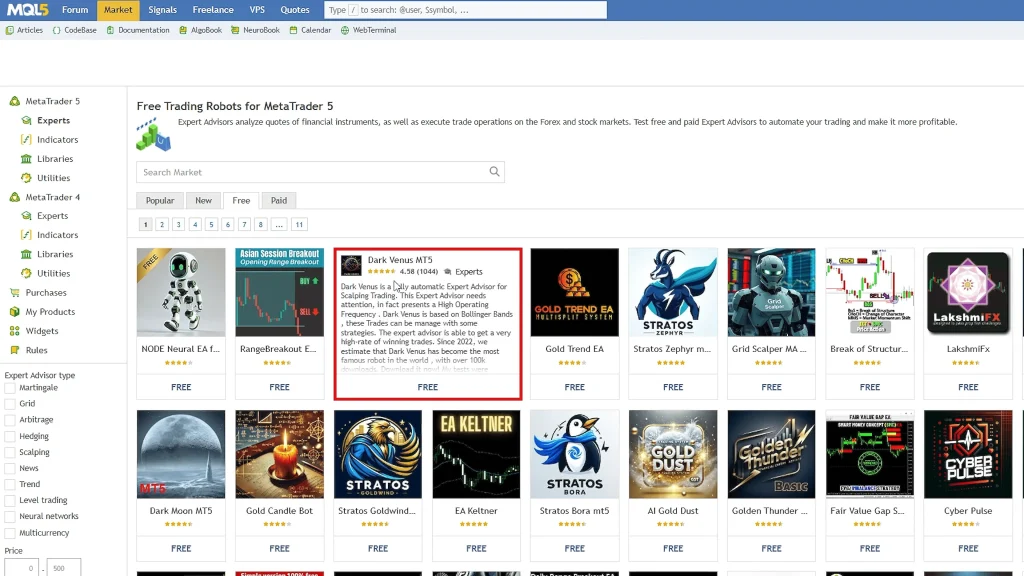
    Dark Venus is completely free on the MQL5 marketplace. Here’s the installation process:

    1. Open MetaTrader and navigate to the Market tab
    2. Click on “Experts” then select “Free.”
    3. Find Dark Venus (it’s typically in the top three rated free EAs)
    4. Click download (you’ll need to be logged into your MQL5 account)
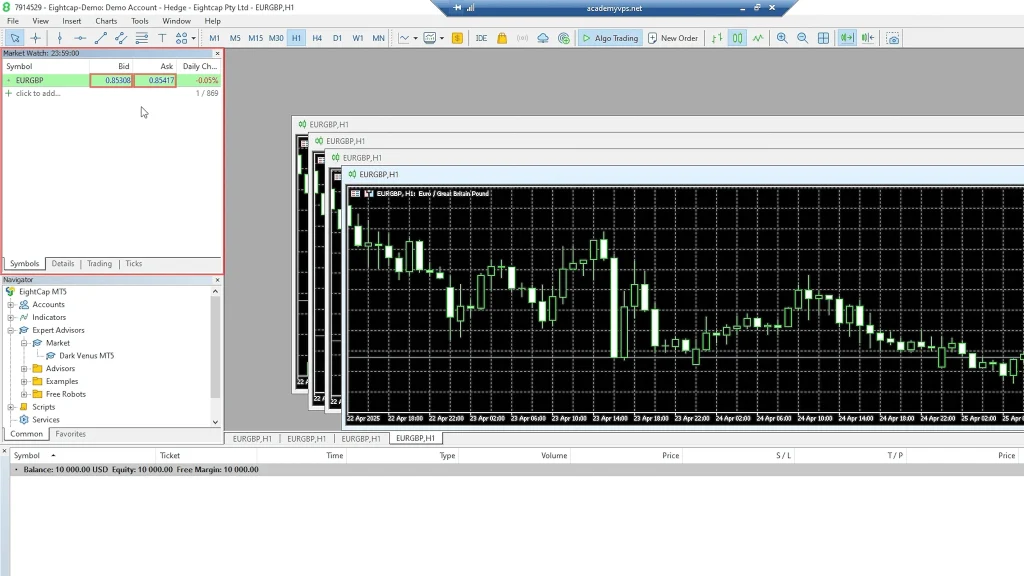
    5. The EA appears in your Navigator panel under Expert Advisors

    Before attaching Dark Venus to any charts, there’s one crucial step many traders skip, enable algo trading in MetaTrader. Without this enabled, the EA won’t execute any trades. Look for the “Algo Trading” button in your toolbar and make sure it’s activated.
    Broker Selection: Why AAP for EUR/GBP

    Dark Venus trades EUR/GBP on the M15 timeframe. That specific currency pair and timeframe combination is important; changing either could produce entirely different results from what I’m showing here.

    I’m using AAP (Australian Accounting Principles broker) for two primary reasons:

    • Regulation and safety: AAP is heavily regulated in Australia, which means deposits and withdrawals are secure. You’re not wondering if your money will disappear overnight.
    • Trading conditions: EUR/GBP is a minor pair with wider spreads than majors like EUR/USD. AAP offers some of the tightest spreads in the industry, which directly impacts profitability when you’re targeting specific pip amounts.

    For grid-based systems like Dark Venus, every pip of spread eats into your edge. Using a broker with 3-pip spreads versus one with 1-pip spreads can mean the difference between profitable and break-even performance.
    The Four Configurations Explained

    I created four distinct setups to accommodate different account sizes and risk appetites. Let me break down each one and show you the backtest results.

    Configuration 1: $10,000 Account with Fixed Lots

    Test parameters:

    • Account size: $10,000
    • Lot size: 0.4 lots (fixed)
    • Timeframe: M15
    • Testing period: January 1, 2024, to January 26, 2025
    • Leverage: 1:100
    • Modeling: Every tick

    Key setting changes from default:

    • Take profit: Increased from 50 to 100
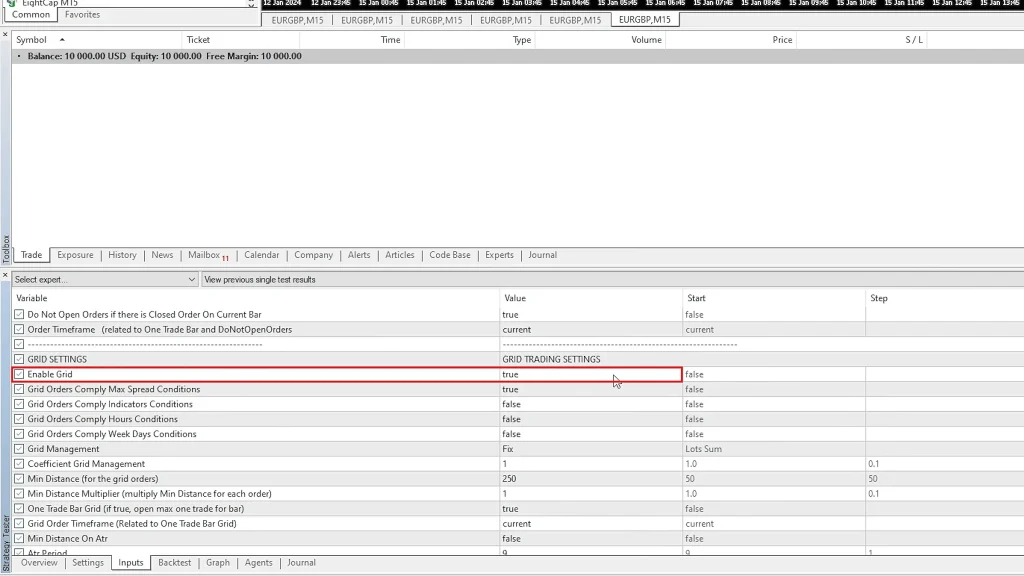
    • Grid mode: Changed from martingale to fixed
    • Lot sizing: Fixed at 0.4 lots

    Backtest results:

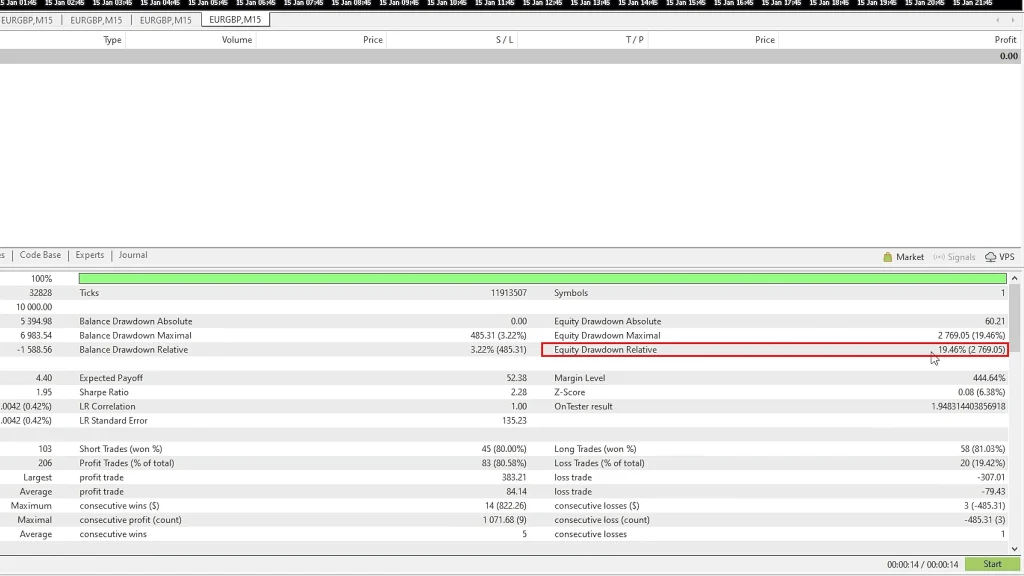
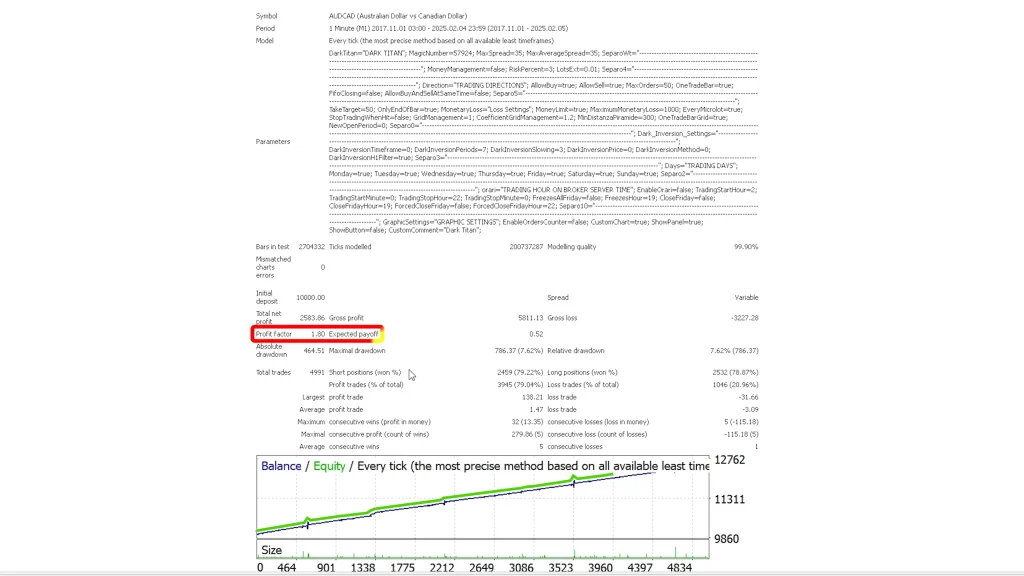
    • Net profit: $5,394 (53.94%)
    • Maximum drawdown: Under 20%
    • Equity curve: Smooth with occasional small drawdowns
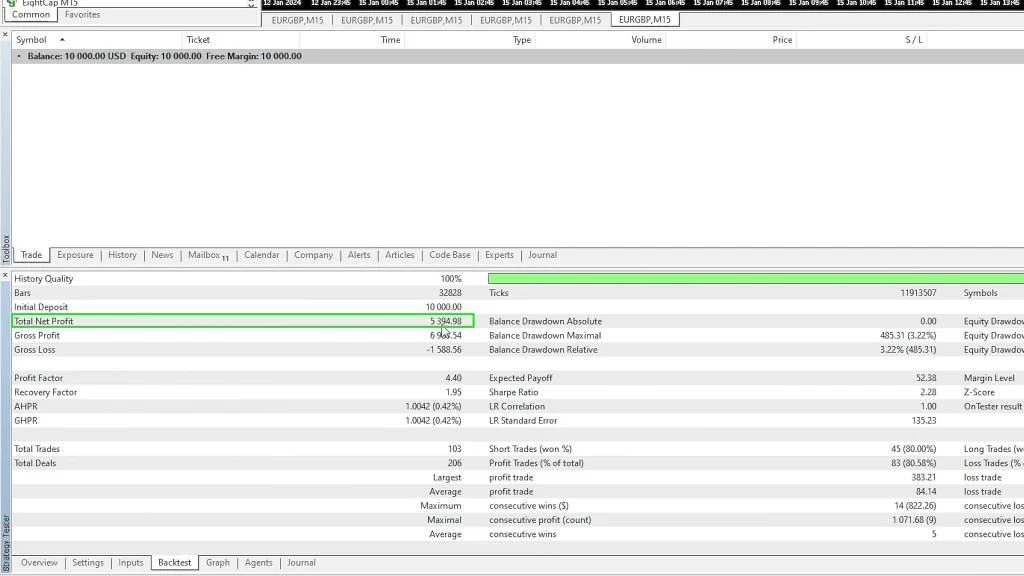
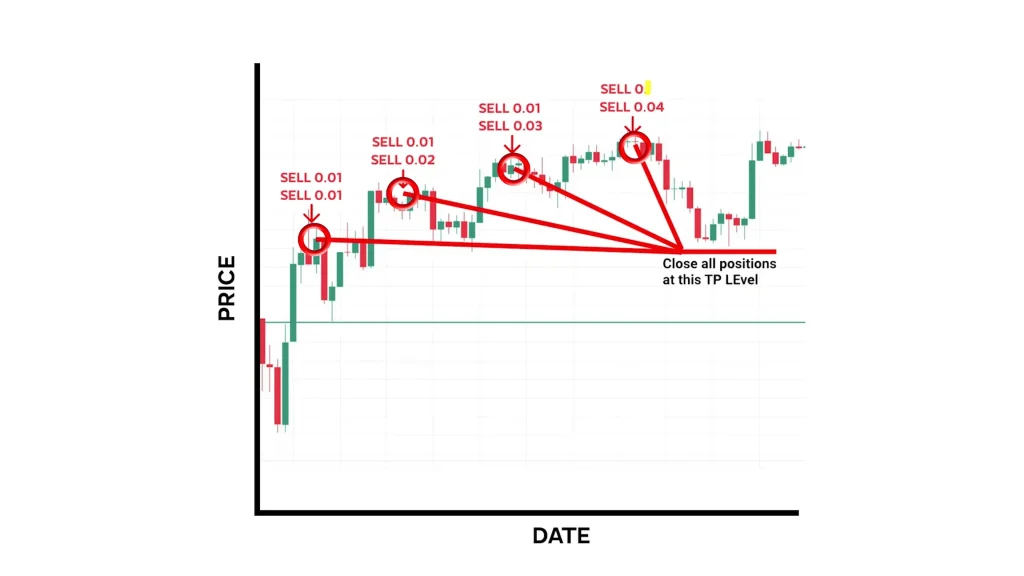
    The critical change here was disabling the martingale. By default, Dark Venus uses martingale position sizing where each grid level doubles the lot size. That’s 0.01, then 0.02, then 0.04, then 0.08, exponential growth that can destroy accounts during adverse moves.

    Switching to a fixed grid means every position uses the same 0.4 lots regardless of grid level. It’s still adding to losing positions (which carries inherent risk), but without the catastrophic exposure martingale creates.
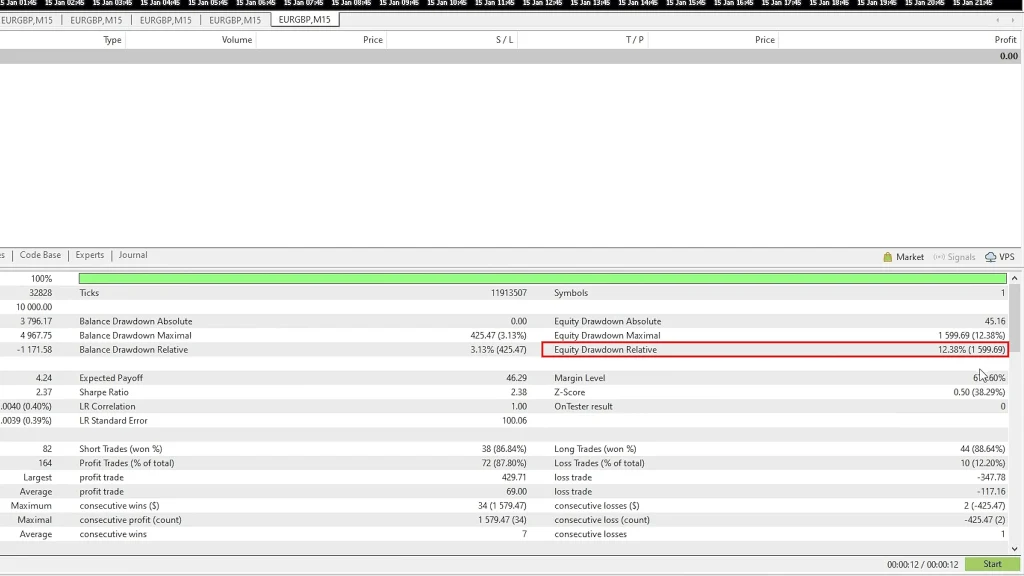
    Configuration 2: $10,000 Account with 3% Risk

    Test parameters:

    • Account size: $10,000
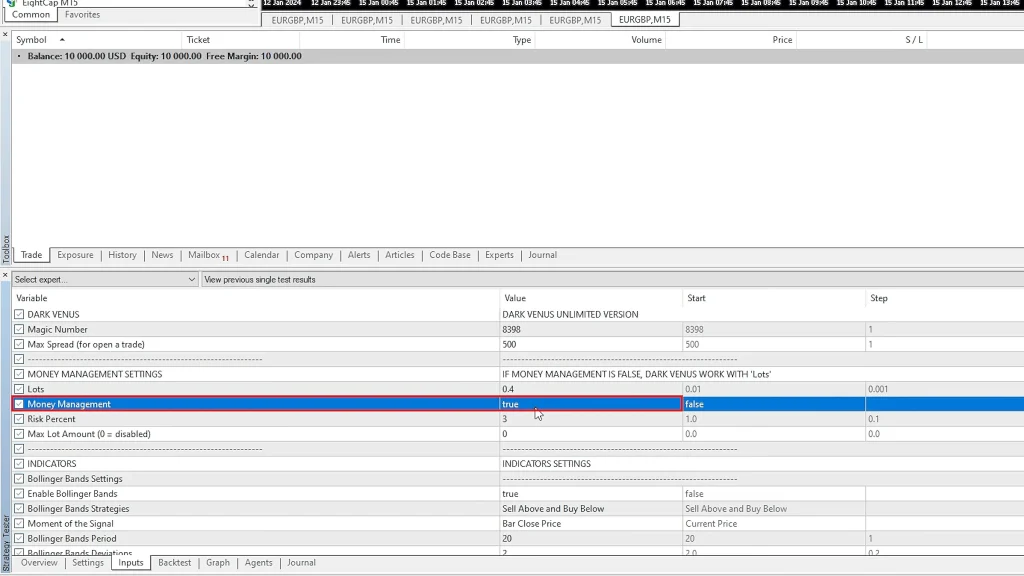
    • Money management: Enabled at 3% risk
    • Other settings: Similar to Configuration 1
    Key differences:

    • Dynamic position sizing based on account equity
    • Risk percentage: 3% per trade sequence

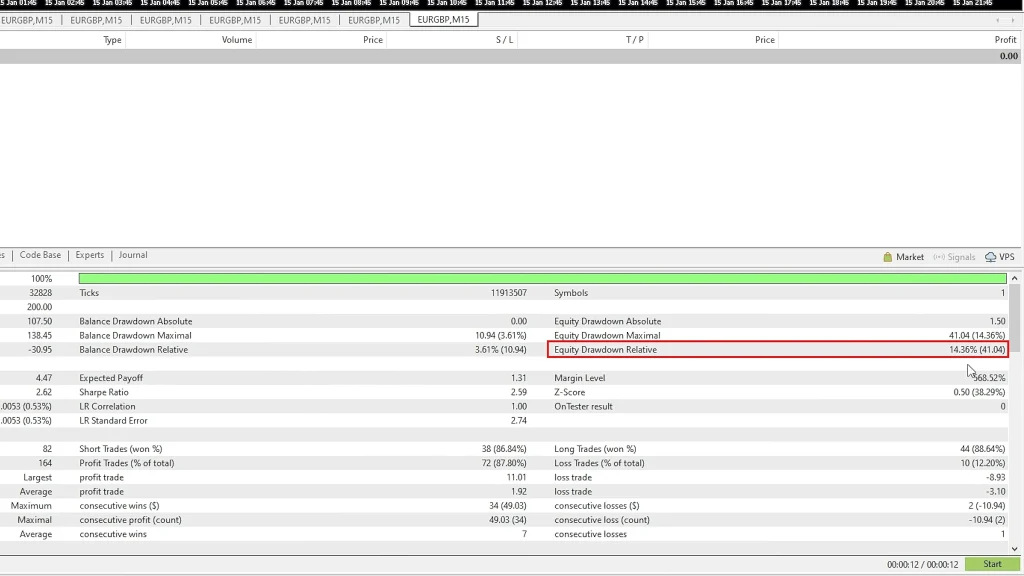
    Backtest results:

    • Net profit: ~$3,800 (38%)
    • Maximum drawdown: ~12%
    • Equity curve: Notably smoother than the fixed lot version

    This configuration sacrifices some profit potential in exchange for significantly lower drawdown. The 12% maximum drawdown versus nearly 20% represents a meaningful reduction in risk exposure.
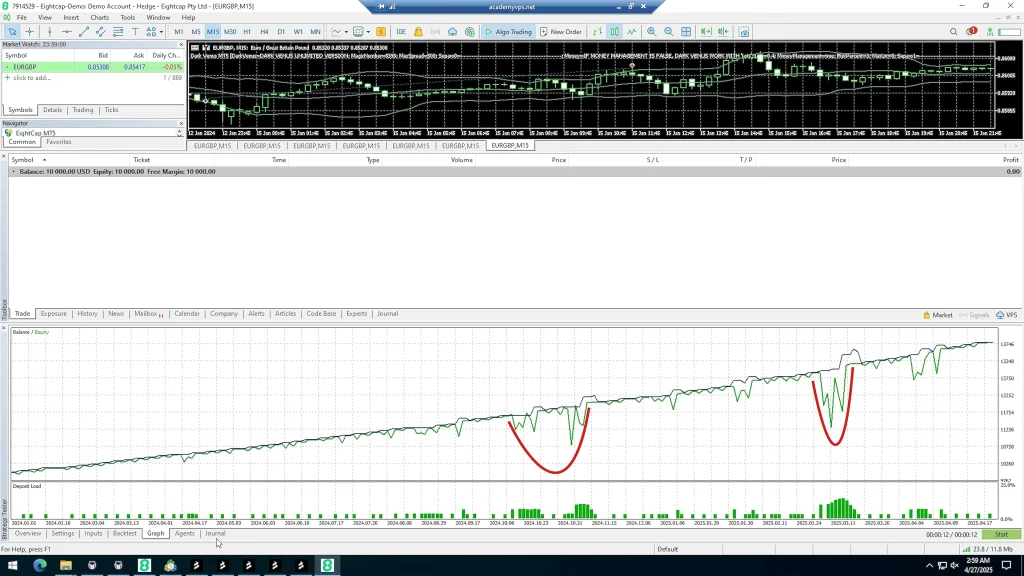
    Which is better? That depends on your goals. Higher returns with higher risk, or moderate returns with exceptional stability? Neither answer is wrong; it’s about matching the EA to your personal risk tolerance.
    Configuration 3: $200 Account with Fixed Lots
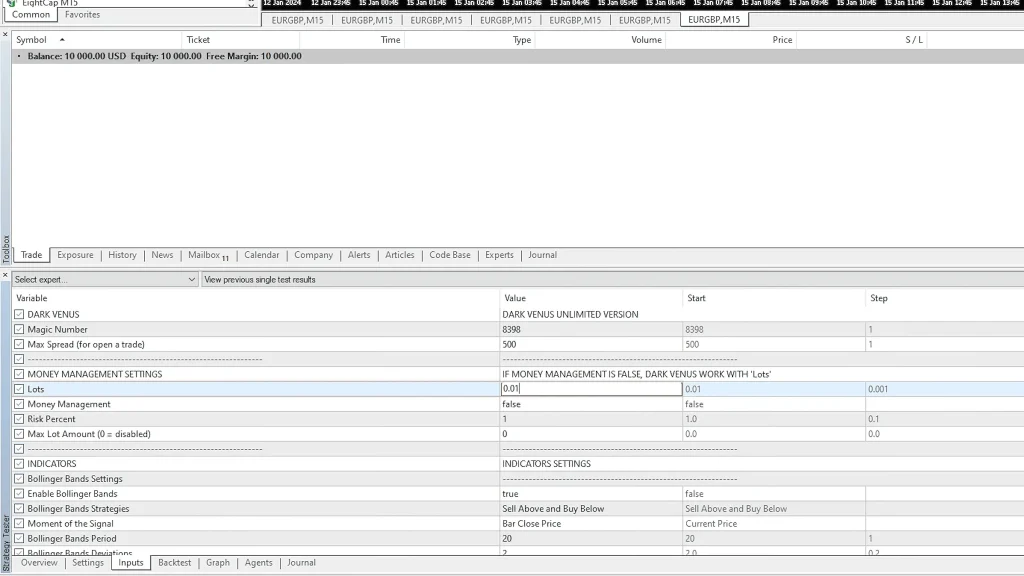
    Test parameters:

    • Account size: $200
    • Lot size: 0.01 lots (minimum)
    • Settings: Based on Configuration 1 but scaled down

    Backtest results:

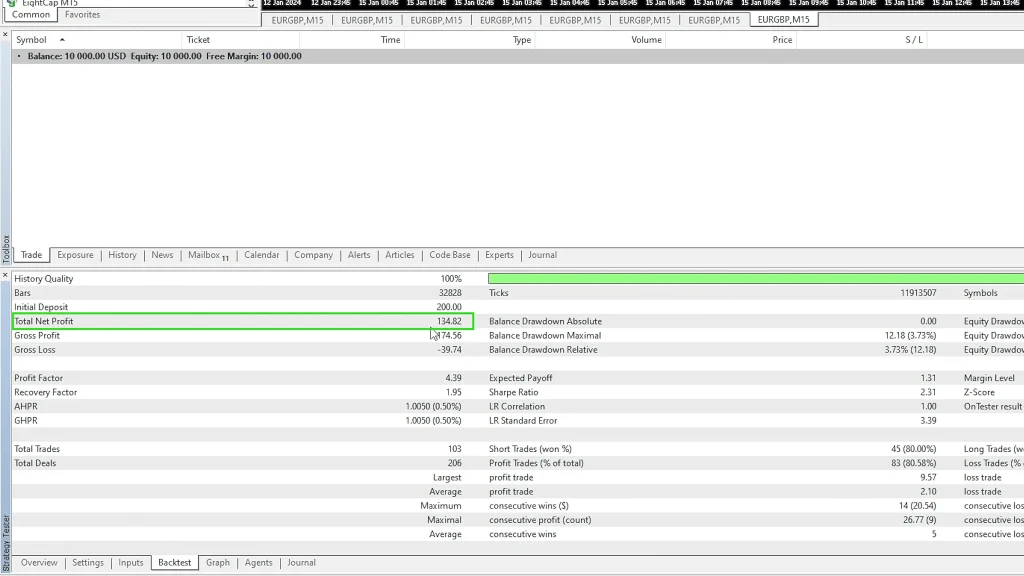
    • Net profit: ~$134 (67%)
    • Maximum drawdown: ~23%

    The 67% return looks impressive, but notice the drawdown increased to 23%. On smaller accounts, fixed lot sizing creates proportionally higher risk since you can’t scale positions down further than broker minimums.
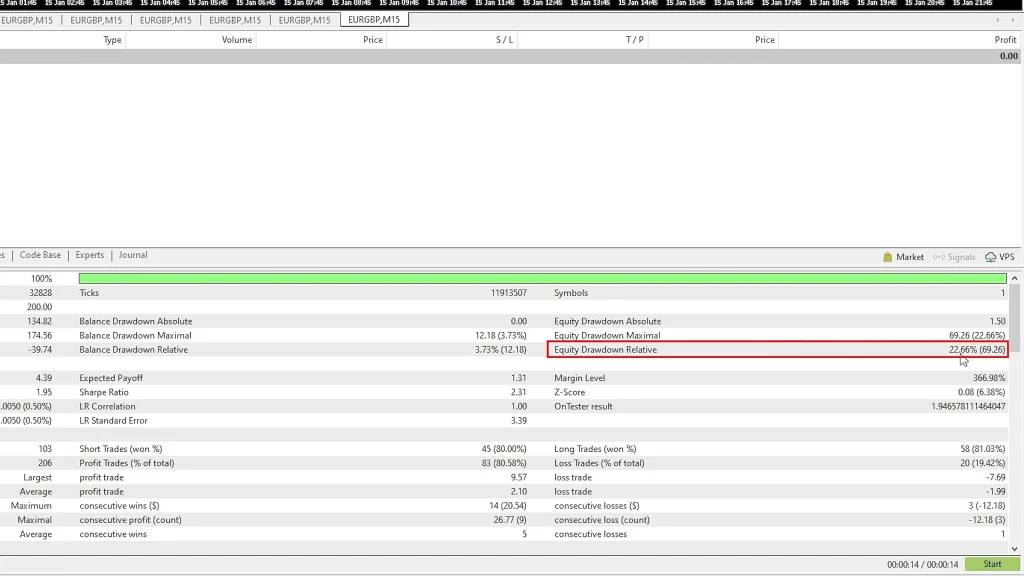
    This configuration works if you’re starting with limited capital and accept higher relative volatility. Just understand that 23% drawdown on a $200 account is $46, not catastrophic in absolute terms, but it feels significant when you’re watching your small account fluctuate.

    Configuration 4: $200 Account with 3% Risk

    Test parameters:

    • Account size: $200
    • Money management: Enabled at 3% risk
    • Settings: Risk-based version for small accounts

    Backtest results:

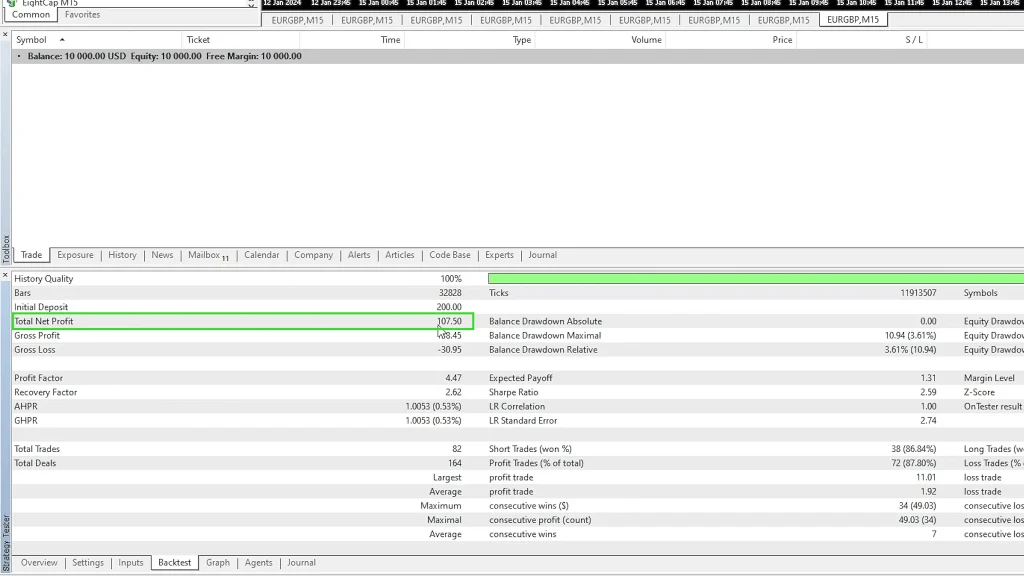
    • Net profit: ~$100 (50%)
    • Maximum drawdown: ~14%

    Again, we see the pattern, enabling percentage-based risk management reduces both returns and drawdown. For small accounts where every dollar counts, that 14% maximum drawdown might be worth accepting 50% returns instead of 67%.
    Critical Setting Changes That Made the Difference

    Let me explain the specific adjustments I made and why they matter:

    Take Profit Adjustment (50 → 100)

    Increasing the take profit from 50 to 100 pips allows winning trades more room to run. The tradeoff is you’re exposed longer, but the backtest results show this change improved overall profitability.

    Grid Mode (Martingale → Fixed)

    This is the single most important safety modification. Martingale grid systems are profitable until they’re not; then they’re catastrophic. Fixed grid maintains consistent position sizing, which caps your maximum exposure even during extended drawdowns.

    Money Management Toggle

    Enabling percentage-based risk (3% in my configurations) creates dynamic position sizing. As your account grows, position sizes increase proportionally. As it shrinks during drawdowns, positions decrease automatically. This built-in risk management prevents overleveraging.

    Setting Up the Four Charts
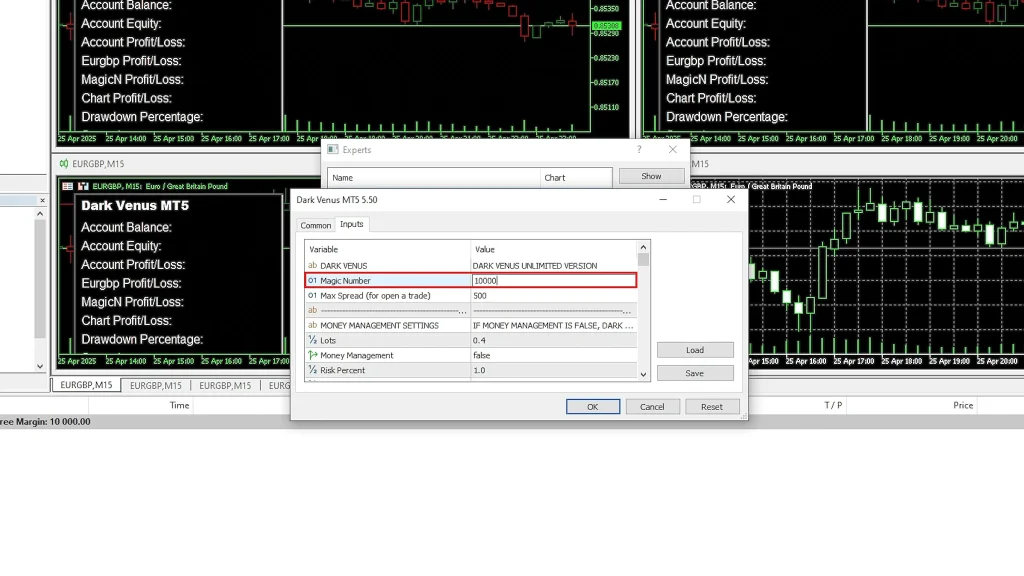
    Here’s the practical workflow for running all four configurations simultaneously:

    1. Open four EUR/GBP M15 charts in MetaTrader
    2. Hide unnecessary symbols from Market Watch (saves system resources)
    3. Attach Dark Venus EA to each chart
    4. Load the appropriate set file for each chart
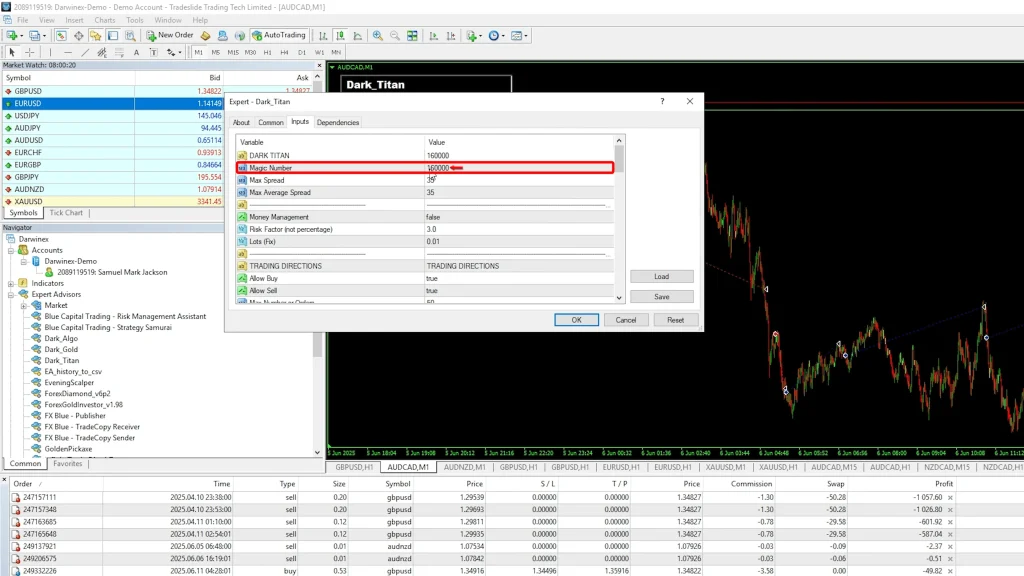
    5. Assign unique magic numbers to track performance separately

    The magic number step is crucial for FXBlue tracking. I used:

    • Chart 1: Magic number 100001 ($10K fixed lots)
    • Chart 2: Magic number 100002 ($10K 3% risk)
    • Chart 3: Magic number 2001 ($200 fixed lots)
    • Chart 4: Magic number 2002 ($200 3% risk)

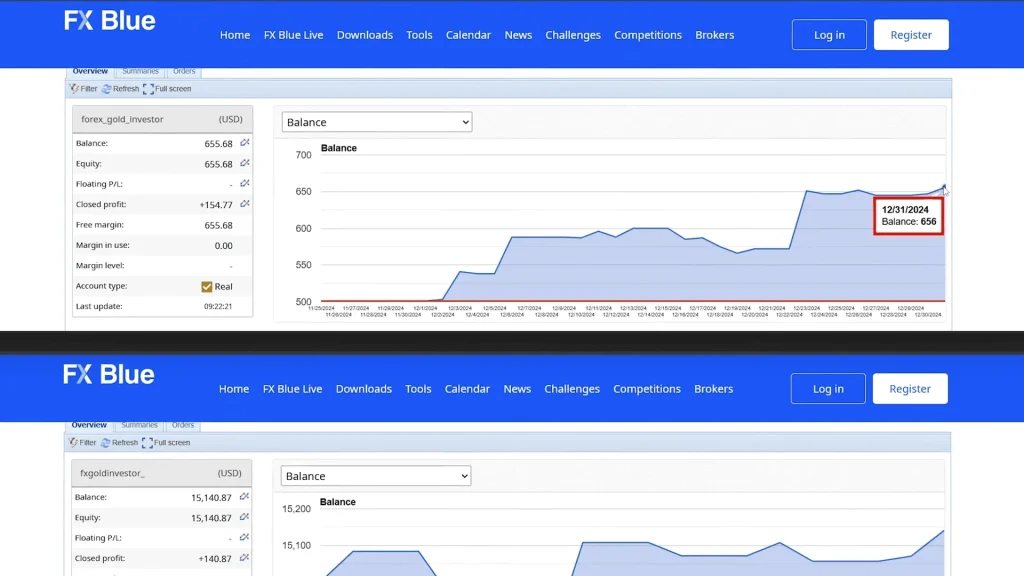
    With distinct magic numbers, FXBlue can separate each EA’s trades even though they’re all running on the same account. This lets me compare performance across all four configurations independently.

    Simulating Small Accounts on Large Capital

    There’s a technical detail worth explaining. To test the $200 configurations on a $10,000 account, I had to adjust the risk percentage proportionally.

    If you’re running 3% risk on a $200 account, that’s $6 per trade. On a $10,000 account, 3% risk is $300, completely different exposure. To simulate a $200 account behavior on the larger account, I calculated: (200 / 10,000) × 3% = 0.06% risk.

    Setting the risk to 0.06% on the $10,000 account produces identical position sizing as 3% on $200. This lets me test all four configurations simultaneously without needing four separate broker accounts.

    Performance Comparison Table

    ConfigurationAccount SizeLot TypeNet ProfitMax DrawdownRisk Level
    Config 1$10,000Fixed 0.453.94%~20%Higher
    Config 2$10,0003% Risk38%~12%Lower
    Config 3$200Fixed 0.0167%~23%Higher
    Config 4$2003% Risk50%~14%Lower

    The pattern is consistent; fixed lot sizing produces higher returns with higher drawdown, while percentage-based risk management provides smoother equity curves at the cost of some profit potential.

    The Demo Testing Phase

    I’m not putting any configuration directly onto live accounts yet. Each setup needs to prove itself in demo trading first, monitored through FXBlue for complete transparency.

    Backtests show what would have happened. Forward testing on the demo shows what actually happens with real spreads, real execution, and real slippage. Only after sufficient demo performance will I graduate the best-performing configuration to live capital.

    This might seem overly cautious, but it’s how you avoid blowing accounts. Backtests lie sometimes, not intentionally, but because they can’t perfectly replicate every real-world variable. Demo testing catches issues before they cost real money.

    Why EUR/GBP Specifically

    Dark Venus is optimized for EUR/GBP on M15. I haven’t tested it extensively on other pairs or timeframes. Perhaps it works elsewhere, but I can only speak to what I’ve actually verified.

    EUR/GBP has specific volatility characteristics and trading hour patterns that the EA’s logic appears tuned for. Switching to EUR/USD or GBP/USD might produce entirely different results, better or worse, I genuinely don’t know without testing.

    When sharing settings and results, I want to be precise about what I tested. These configurations work for EUR/GBP M15 based on my backtests. Applying them elsewhere is your decision, but don’t assume identical performance.

    The Grid System Reality Check

    Dark Venus uses grid trading, which means it adds positions when the price moves against the initial entry. Even with the martingale disabled, this approach carries inherent risk.

    If EUR/GBP trends strongly in one direction for an extended period, the EA will accumulate multiple losing positions. Eventually, one of two things happens: price reverses, and all positions close profitably, or drawdown becomes unsustainable.

    The backtests show successful recovery in most scenarios over the testing period. But “most” isn’t “all,” and past performance doesn’t guarantee future results, especially with grid systems that depend on mean reversion behavior.

    Understand what you’re running. Grid EAs aren’t inherently bad, but they require proper capitalization, appropriate lot sizing, and realistic expectations about drawdown potential.

    Community Knowledge Sharing

    If you’re running Dark Venus with different settings that produce better results than mine, please share them. The goal here isn’t protecting some secret configuration, it’s building collective knowledge that benefits everyone.

    Maybe you found that 75 take profit works better than my 100. Perhaps you’re using different risk percentages. Or you’ve tested it successfully on GBP/JPY. That information helps the community make better decisions.

    Trading doesn’t have to be secretive. When we share what works (and what doesn’t), we all improve faster than working in isolation.

    Where to Access Dark Venus and Additional Resources

    Dark Venus EA is completely free on the MQL5 marketplace and also available through Algo Trading Space, which provides additional resources and trading insights. Full disclosure: we may earn a small commission through our links, though this doesn’t affect the price (it’s free) or the honest assessment in this review.

    For traders building portfolios across multiple expert advisors, the Algo Trading Space VIP club offers exclusive access to verified trading results from various systems, early insights into new EAs, and priority support. If you want ongoing performance data and community access beyond individual reviews, it’s worth exploring.

    I’ll continue monitoring all four Dark Venus configurations through FXBlue with public tracking, so you can follow results as they develop beyond these initial backtests.

    Frequently Asked Questions

    Why did you change the take profit from 50 to 100 pips, and how does this affect the trading approach?

    Increasing the take profit to 100 pips allows Dark Venus more room to capture larger price movements rather than closing positions prematurely at 50 pips. The backtest data showed improved overall profitability with the higher target, suggesting EUR/GBP’s volatility on M15 frequently produces moves exceeding 50 pips.

    The tradeoff is longer trade duration and more exposure time to adverse movements, but the risk appears justified based on the 13-month backtest results showing this adjustment improved returns across all four configurations.

    What’s the practical difference between fixed lot sizing and percentage-based risk management for Dark Venus?

    Fixed lot sizing maintains constant position sizes regardless of account growth or drawdown, which creates predictable exposure but doesn’t adapt to changing account equity. Percentage-based risk (3% in my configs) dynamically adjusts position sizes, larger as the account grows, smaller during drawdowns.

    My backtests showed percentage-based approaches reduced maximum drawdown by roughly 6-8% while sacrificing 12-17% of net profit. For risk-averse traders or funded accounts with strict drawdown limits, the percentage method provides better capital preservation at the cost of slower growth.

    Can I run Dark Venus on currency pairs other than EUR/GBP or different timeframes?

    Dark Venus is specifically optimized for EUR/GBP on M15 timeframe, that’s what I tested and what my shared settings target. Running it on other pairs like EUR/USD or GBP/JPY would require independent backtesting to verify performance, as different pairs have unique volatility patterns and spread characteristics.

    Similarly, changing from M15 to M5 or H1 alters the signal generation completely. You can experiment with other pairs, but don’t assume my settings will perform identically. Always backtest thoroughly before risking real capital on untested configurations.

    Why disable the martingale feature when it’s part of Dark Venus’s default strategy?

    Martingale position sizing doubles lot sizes at each grid level (0.01, 0.02, 0.04, 0.08), creating exponential exposure during drawdowns. While this can produce faster recovery when price reverses, it risks catastrophic losses during extended adverse moves; one bad sequence can eliminate all prior gains. Switching to a fixed grid maintains consistent position sizing across all levels, capping maximum exposure even during worst-case scenarios.

    My backtests showed fixed grid configurations still achieved 38-67% annual returns with substantially lower maximum drawdown, making them safer for long-term sustainability.

    How long should I run Dark Venus on demo before moving to a live account?

    I recommend a minimum of 2-3 months of forward demo testing with full FXBlue tracking before considering live deployment. Backtests show historical performance, but demo testing reveals how the EA handles current market conditions, real spreads, actual execution speeds, and slippage.

    Watch for consistency between backtest projections and demo results, if demo performance significantly deviates (either better or worse), investigate why before risking real capital. Only move the best-performing configuration to live trading, and start with conservative position sizing, even then.

    What’s the significance of using unique magic numbers for each Dark Venus instance?

    Magic numbers allow FXBlue and other tracking platforms to separate trades from different EA instances running on the same account. Without unique magic numbers (like my 100001, 100002, 2001, 2002 assignments), all trades appear combined, and you can’t identify which configuration generated which results.

    This granular tracking lets you compare performance across different setups, identify which works best, and make data-driven decisions about which configuration deserves live capital. It’s essential for systematic testing rather than guessing which setup produced your profits or losses.
  • Testing The Happy Forex Trading Robot: Performance, Setup & Honest Insights In 2026

    Testing The Happy Forex Trading Robot: Performance, Setup & Honest Insights In 2026

    After watching Happy Gold EA automatically pass a $100K prop firm challenge, I knew I had to test other systems from the same developer. That’s how I found Happy Forex EA, a robot that trades AUD/USD and EUR/CHF on the H1 timeframe with a recovery approach that’s different from typical grid-martingale systems.

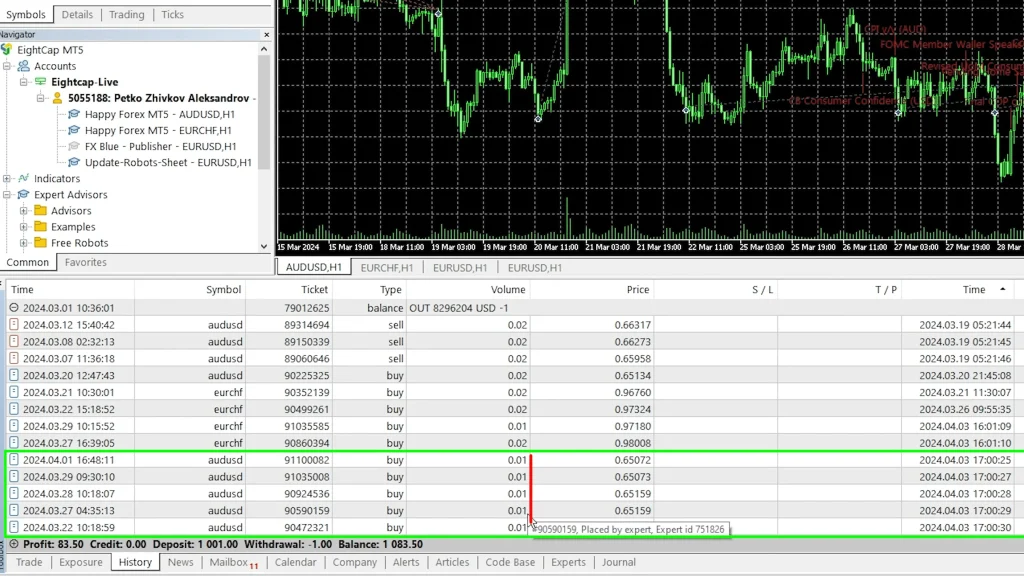
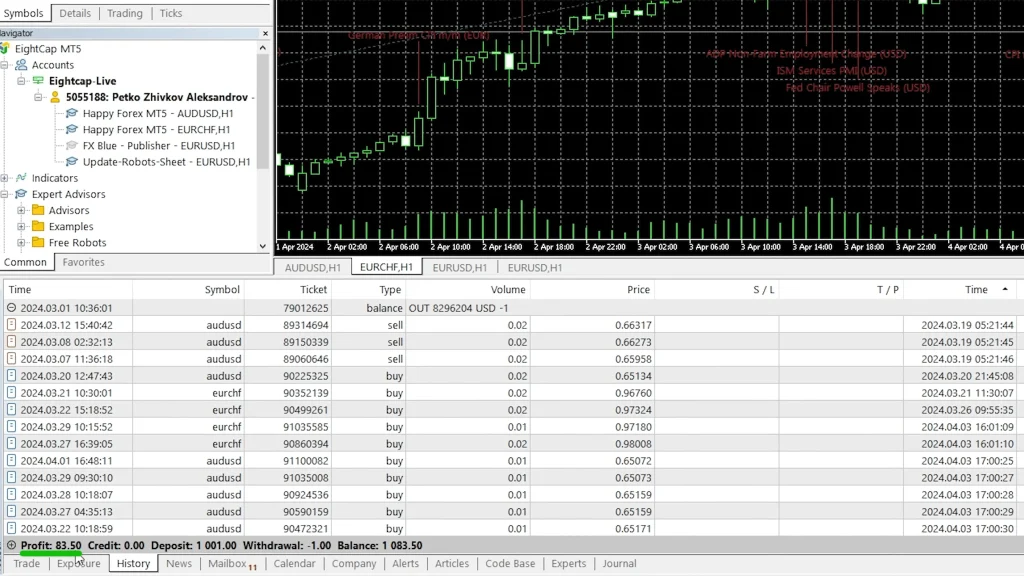
    I’ve been running Happy Forex on a $1,000 live account with Eightcap since mid-March, and it’s already up $83.50. More importantly, the equity curve shows exactly what the vendor’s track record promised: steady, consistent growth without dramatic spikes or crashes.

    Let me walk through how this EA actually works, why its position management differs from aggressive grid systems, and what makes it stand out compared to Happy Gold from the same developer.

    Live Account Results: Real Money Performance

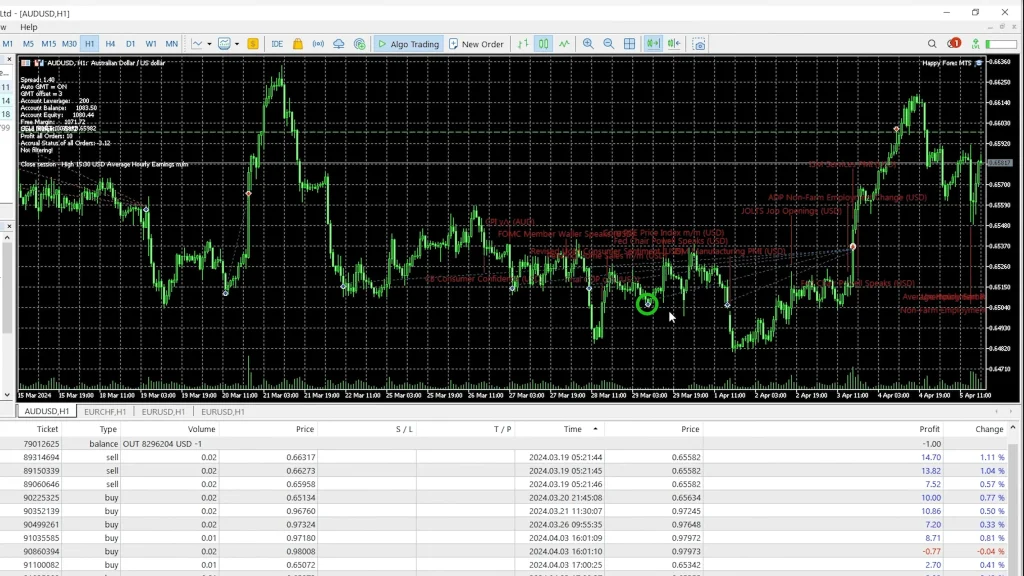
    My Eightcap live account started with $1,000 on March 18th. As of early April, the balance sits at $1,083.50, over 8% gain in less than a month.

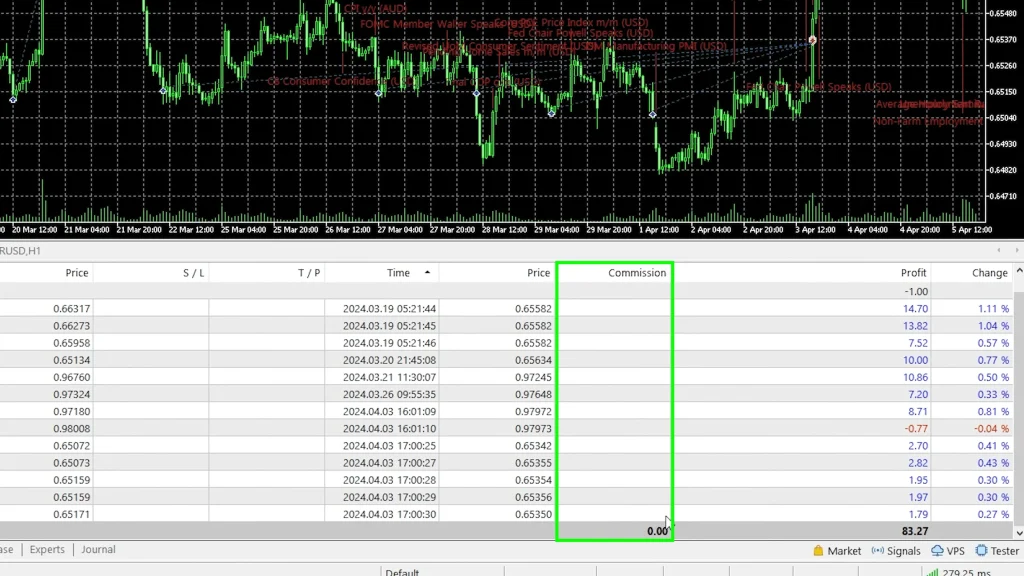
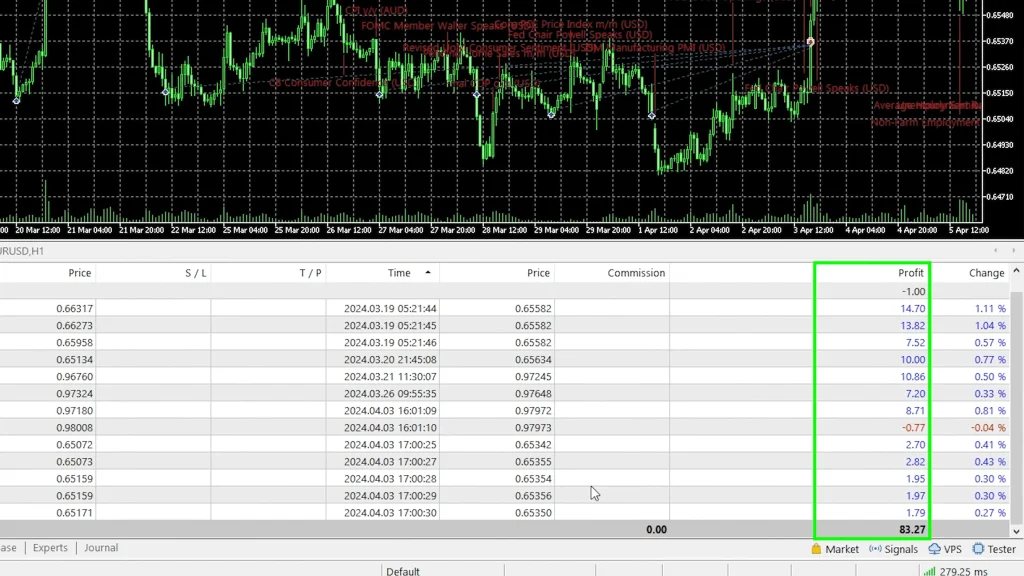
    Looking at the FXBlue tracking, the account shows steady upward progression with only one losing trade so far. That single loss? Negative 77 cents. Not exactly catastrophic.

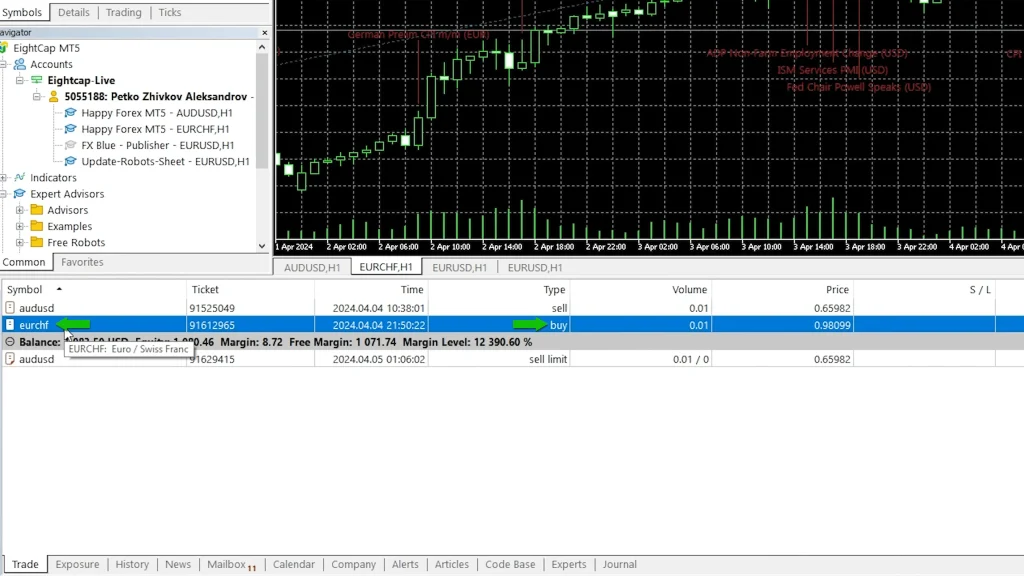
    Currently, I have two open positions:

    • One short trade on AUD/USD
    • One long trade on EUR/CHF

    The EA operates on both pairs simultaneously, which provides some diversification. EUR/CHF and AUD/USD don’t move in lockstep, so having exposure to both reduces the likelihood of both positions moving against you at the same time.

    Position Management: Same Lot Addition

    Here’s what caught my attention about Happy Forex’s approach. Looking back through the AUD/USD trade history, I noticed a sequence where the EA opened five consecutive long positions, then closed all of them simultaneously for combined profit.

    But here’s the key difference from typical martingale systems: each additional position used the same lot size as the first entry. There was no doubling, no lot scaling, no exponential position growth.

    Compare that to traditional grid-martingale EAs that might go: 0.01, 0.02, 0.04, 0.08 lots. Those systems can blow accounts during extended adverse moves because position sizes escalate so quickly.

    Happy Forex’s approach is: 0.01, 0.01, 0.01, 0.01, 0.01. It’s still adding to losing positions (which carries risk), but without the exponential capital requirement of doubling lot sizes.

    Earlier in history, there was an example of three short trades all closing profitably. Same pattern, consistent lot sizing across the sequence.

    Lot Size Recommendations and Risk Settings

    I initially started trading Happy Forex with 0.02 lots on the $1,000 account. After discussing this with the vendor, they suggested reducing it to 0.01 lots for that account size.

    I want to be clear, this isn’t my recommendation to you. I’m sharing what the developer suggested and what I’m currently testing. Your risk tolerance, account size, and trading goals will differ.

    The 0.01 lot recommendation on $1,000 represents conservative position sizing. At that level, even if the EA adds five positions (5 x 0.01 = 0.05 total lots), you’re not putting excessive capital at risk relative to account equity.

    More aggressive traders might use larger lots to generate higher returns faster, but that proportionally increases drawdown risk. The vendor’s conservative suggestion aligns with the system’s design philosophy, steady growth over time rather than rapid gains with corresponding volatility.

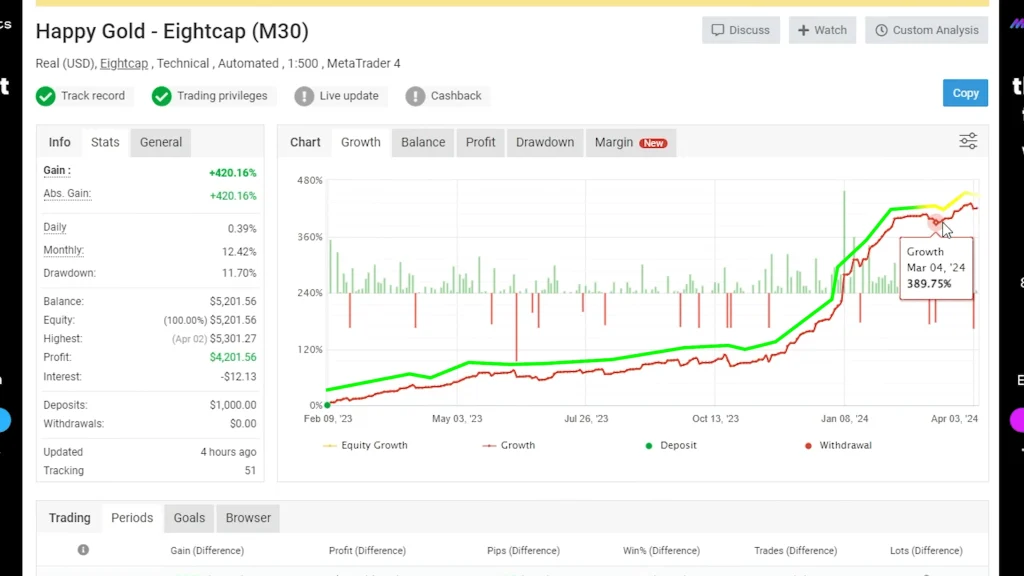
    Vendor Track Record: 75% Since August 2022

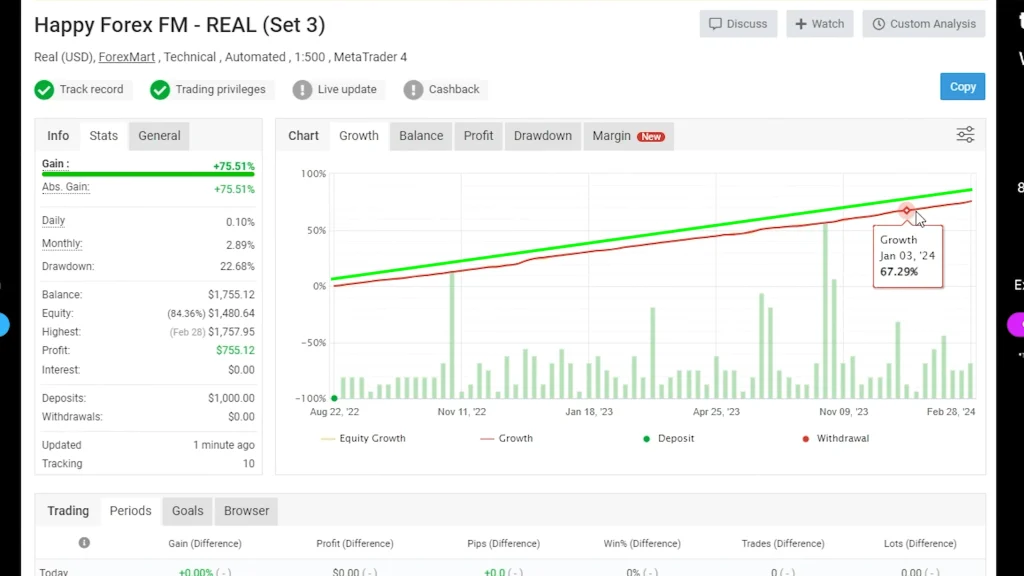
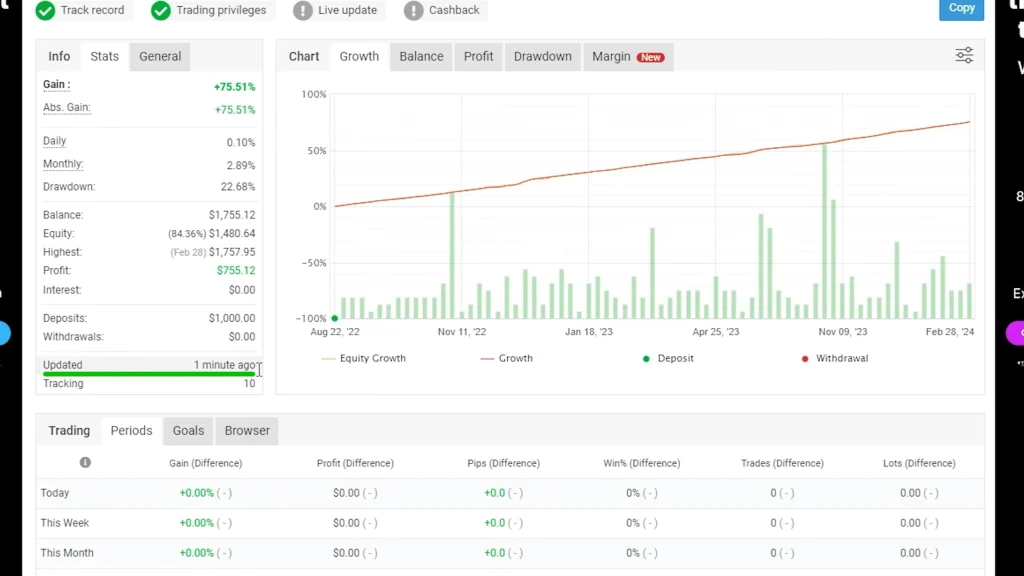
    The developer maintains a verified track record on a $1,000 live account dating back to August 2022. The results are striking:

    • Total gain: 75% from August 2022 to late February 2025
    • Equity curve: Remarkably smooth and steady
    • 2023 performance: No losing months
    • 2022 performance: No losing months
    • Recent monthly returns: 2.11% (February), 3.91% (January)

    That equity curve is what really stands out. It looks like a gentle slope upward with minimal deviation, exactly what you want to see from a consistent system.

    However, there’s something I need to mention. The vendor’s track record shows the last trades executed in late February. I’m recording my testing in early April, and my account has trades from March and early April. I’m not sure why their public track record hasn’t updated with March activity, even though the MyFXBook page shows it was updated recently.

    The vendor runs multiple accounts, so I’ll try to find another track record showing more recent performance and link it in the description. But this is exactly why I don’t just rely on vendor statistics, I run my own live tests with public FXBlue tracking so you can verify independently.

    Happy Forex vs Happy Gold: Different Approaches

    The same developer offers the Happy Gold EA, which I previously tested and used to pass the $100K prop firm challenge. The two systems have completely different performance characteristics.

    Happy Gold:

    • Scalping strategy on gold
    • Opens one trade at a time
    • Higher frequency trading
    • More volatile equity curves with visible drawdowns and stagnant periods
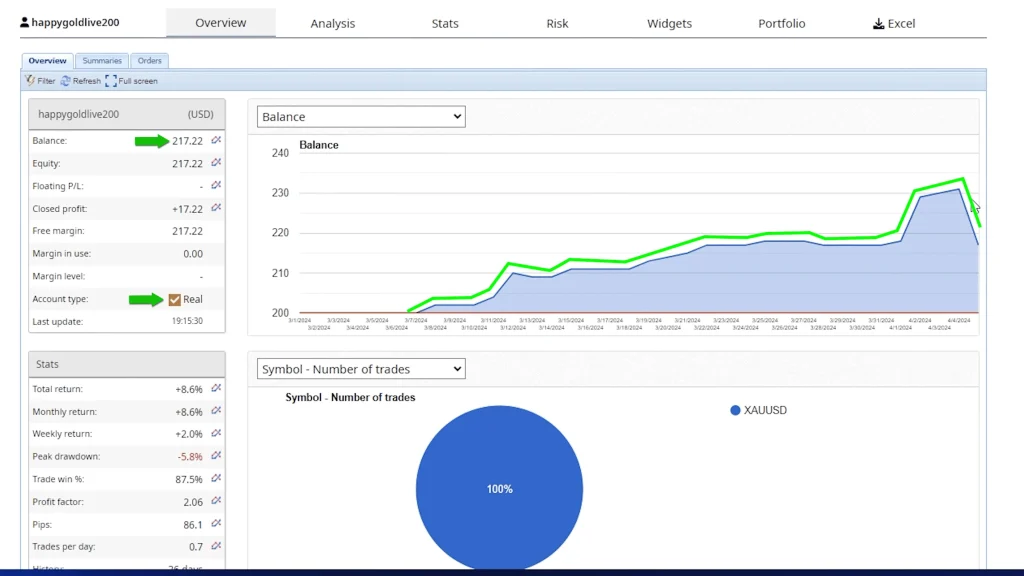
    • 8%+ gain in 30 days on my $200 live account

    Happy Forex:

    • Recovery system on currency pairs (AUD/USD, EUR/CHF)
    • Adds multiple positions with the same lot sizing
    • Lower frequency compared to scalping
    • Smoother equity progression
    • 8%+ gain in 30 days on my $1,000 live account

    Both are profitable, but they serve different purposes in a portfolio. Happy Gold provides the potential for quicker gains but with more equity curve volatility. Happy Forex offers steadier, more predictable growth.

    Having both running simultaneously creates diversification; one is a scalper on metals, the other uses recovery logic on currencies. Different market conditions favor different approaches.

    Why Broker Selection Matters for These EAs

    I’m running Happy Forex on Eightcap specifically because of what scalping and recovery systems require from a broker. While Happy Forex isn’t pure scalping like Happy Gold, execution quality still matters significantly.

    Eightcap offers two account types:

    Account TypeSpreadCommissionMinimum Deposit
    Raw AccountFrom 0 pipsYes$100
    Standard AccountFrom 1 pipNo$100

    I’m using the Standard account, which means I pay no commissions but accept slightly wider spreads starting from one pip. Even with this cost structure, Happy Forex remains profitable; the 8% monthly gain proves the spread isn’t eating all the edge.

    For scalping systems like Happy Gold, those tight spreads become even more critical. When you’re taking 5-10 pip profits repeatedly, a two-pip spread difference between brokers can mean the difference between profitability and slowly bleeding capital.

    Why Regulation Matters

    Eightcap is regulated by multiple entities, which provide several layers of oversight and client protection. This isn’t just a checkbox; it’s essential when you’re trusting a broker with real money.

    Regulated brokers face stricter operational requirements, capital reserves, and client fund segregation rules. If something goes wrong, you have recourse through regulatory bodies. With unregulated brokers, you’re basically hoping they’re honest.

    For algorithmic trading where positions might be opened or closed while you’re asleep, broker reliability becomes even more important. You need confidence that orders will execute properly, spreads won’t suddenly widen to absurd levels, and withdrawals will process without games.

    The Happy EA Family: Growing Lineup

    Beyond Happy Gold and Happy Forex, the developer recently released Happy Brexit EA. I’ve started testing it on another live account, though it’s too early to draw conclusions with only one open trade so far.

    This expanding lineup suggests the developer is actively creating new systems rather than abandoning old ones. That’s a positive sign, vendors who continue developing and supporting multiple products tend to be more reliable than one-hit wonders who disappear after initial sales.

    All my live testing across these Happy EAs is publicly tracked on the EA Trading Academy website, where you can see real-time performance, including:

    • Happy Gold: 8%+ in the last 30 days
    • Happy Forex: 8%+ in the last 30 days
    • Happy Brexit: Just started testing

    The transparency matters. Anyone can verify these results aren’t cherry-picked or manipulated; it’s all live data updated automatically.

    Recovery Systems: Understanding the Risk

    Let me be direct about what Happy Forex is doing. It’s adding to losing positions. When the first trade doesn’t immediately profit, it opens additional positions in the same direction.

    This is fundamentally a recovery approach, averaging into positions to lower the breakeven point. If the price eventually reverses in your favor, all positions close profitably. That’s what I’ve seen in my trade history repeatedly.

    But there’s an inherent risk. If the price continues moving against you indefinitely, those multiple positions accumulate unrealized losses. Even though Happy Forex doesn’t use martingale lot doubling (which would make this worse), multiple same-sized positions still create exposure.

    The difference between Happy Forex and aggressive grid-martingale systems is in degree, not kind. Both are recovery-based. Happy Forex just does it more conservatively by maintaining consistent lot sizes rather than escalating them.

    For this approach to work long-term, you need:

    1. Sufficient account capital to handle multiple simultaneous positions
    2. Markets that eventually mean-revert rather than trending indefinitely
    3. Proper lot sizing relative to account equity
    4. Patience to let the system work through temporary drawdowns

    The vendor’s track record showing no losing months in 2022 and 2023 suggests the system navigates these challenges successfully under normal market conditions.

    Trade Frequency and Time Commitment

    Happy Forex doesn’t trade constantly. Looking at my account activity, there are periods of multiple days between trade sequences. This is a lower frequency than many EAs, which means you’re not constantly monitoring positions.

    The H1 timeframe contributes to this pace. Hourly charts move more slowly than M1 or M5, so signals trigger less frequently. That’s actually an advantage; it reduces exposure to execution quality issues and gives each setup time to develop properly.

    From a practical standpoint, you can run Happy Forex on a VPS and check it weekly without obsessing over every tick. The system doesn’t require constant intervention or adjustment.

    Performance Comparison: Demo vs Live

    I tested Happy Forex on demo before committing real capital. The demo results aligned well enough with live performance to give me confidence in proceeding.

    However, there are always differences between demo and live:

    • Execution speed can vary
    • Slippage in live environments affects entry and exit prices
    • Spread widening during news or low liquidity impacts costs
    • Psychological pressure of real money changes how you react to drawdowns

    So far, my live account performance matches what I saw in demo testing. The 8% monthly gain is sustainable based on the vendor’s long-term track record, showing a similar pace.

    But I’m still in the early stages, with less than one month of live trading. Extended testing over six months or more will provide better confidence in whether results remain consistent across different market conditions.

    Realistic Expectations for Monthly Returns

    The vendor’s track record shows monthly returns typically in the 2-4% range. My first partial month hit 8%, which is higher than average. That could be luck, favorable market conditions, or just natural variance.

    Setting realistic expectations: 2-3% monthly is probably more sustainable long-term based on the 75% gain over roughly 2.5 years in the vendor’s account. That averages to about 2.5% per month, which aligns with their individual monthly statistics.

    An 8% month is great, but expecting that every month would be setting yourself up for disappointment. Better to anticipate a 2-3% average with some months higher, some lower, and occasional flat or negative periods.

    At 2.5% monthly compounded, a $1,000 account becomes roughly $1,350 after one year. Not a get-rich-quick territory, but solid returns if achieved with low drawdown and minimal stress.

    Where to Access Happy Forex and Additional Resources

    Happy Forex EA is available through Algo Trading Space, which provides access to the system along with additional automated trading resources. Full disclosure: we may earn a small commission if you purchase through our links, though this doesn’t affect the price you pay or the honest assessment in this review.

    For traders building portfolios across multiple expert advisors, the Algo Trading Space VIP club offers exclusive access to verified trading results from various systems, early insights into new EAs, and priority support. If you want ongoing performance data and community access beyond individual reviews, it’s worth exploring.

    I’ll continue running Happy Forex on my live account with public FXBlue tracking, so you can follow results as they develop beyond this initial testing period.

    Frequently Asked Questions

    How does Happy Forex’s position averaging differ from dangerous martingale systems?

    Happy Forex adds to losing positions using the same lot size for each additional entry rather than doubling position sizes like traditional martingale systems. If the first trade is 0.01 lots, subsequent positions are also 0.01 lots instead of 0.02, 0.04, 0.08.

    This conservative approach still carries recovery system risks but avoids the exponential capital requirements that blow accounts during extended adverse moves. The vendor’s track record showing no losing months in 2022-2023 suggests this measured approach handles normal market conditions effectively.

    What currency pairs does Happy Forex trade, and can I add others?

    Happy Forex trades AUD/USD and EUR/CHF exclusively on the H1 timeframe. These pairs were specifically chosen and optimized by the developer, so adding other currencies would require independent backtesting and forward testing to verify performance.

    The two-pair setup provides some diversification since AUD/USD and EUR/CHF don’t move identically. Running the EA on non-tested pairs could produce different results than the verified track record, so stick with the developer’s recommendations unless you’re willing to test alternatives thoroughly.

    What’s the minimum account size to run Happy Forex safely?

    Based on the vendor’s recommendation of 0.01 lots for a $1,000 account, that represents the conservative minimum. You could potentially run it on $500 with 0.005 lots (if your broker offers micro lots), but smaller accounts provide less margin buffer for the position averaging system to work.

    Since Happy Forex can open multiple same-sized positions, you need sufficient equity to handle 3-5 simultaneous entries without approaching margin calls. I’d recommend $1,000 minimum for comfortable operation with standard lot sizing.

    How does Happy Forex compare to Happy Gold from the same developer?

    Happy Forex uses a position averaging recovery system on currency pairs (AUD/USD, EUR/CHF) with smoother equity curves, while Happy Gold is a pure scalping strategy on gold with higher frequency trading and more volatile performance.

    Both have achieved similar monthly returns in my testing (8%+ in 30 days), but Happy Forex provides steadier growth while Happy Gold produces quicker moves with corresponding drawdowns. They complement each other well in a portfolio, with different strategies for different market conditions.

    Why doesn’t the vendor’s track record show recent March/April trades when your live account does?

    I noticed the same discrepancy, the vendor’s public MyFXBook shows last trades in late February despite claiming recent updates, while my account executed trades throughout March and early April. The developer runs multiple accounts, so this might be a specific account that’s paused or experiencing technical issues with the tracking feed.

    This is precisely why I maintain my own independent FXBlue tracking rather than relying solely on vendor statistics. You can verify my live results directly rather than trusting potentially outdated vendor data.

  • Testing The Ranger Trading Robot In 2026: A Strategy That Hasn’t Lost in Years

    Testing The Ranger Trading Robot In 2026: A Strategy That Hasn’t Lost in Years

    What if I told you there’s an expert advisor where one of its currency pair configurations hasn’t had a losing basket of trades since 2015? That’s nearly a decade of consistent profitability on a single asset. Ranger EA, part of the Powerhouse Bundle from Responsible Forex Trading, might be one of the most reliable systems you’ve ever heard about.

    I’ve been testing Ranger on both live and demo accounts for over four months now, and the results align with that bold claim. This isn’t about massive monthly returns or aggressive trading; it’s about steady, sustainable growth with remarkably low drawdown.

    Let me show you real money results from my BlackBull Markets account, explain the strategy mechanics, and walk through why this conservative approach might actually be its greatest strength.

    Live Account Performance: Four Months of Real Trading

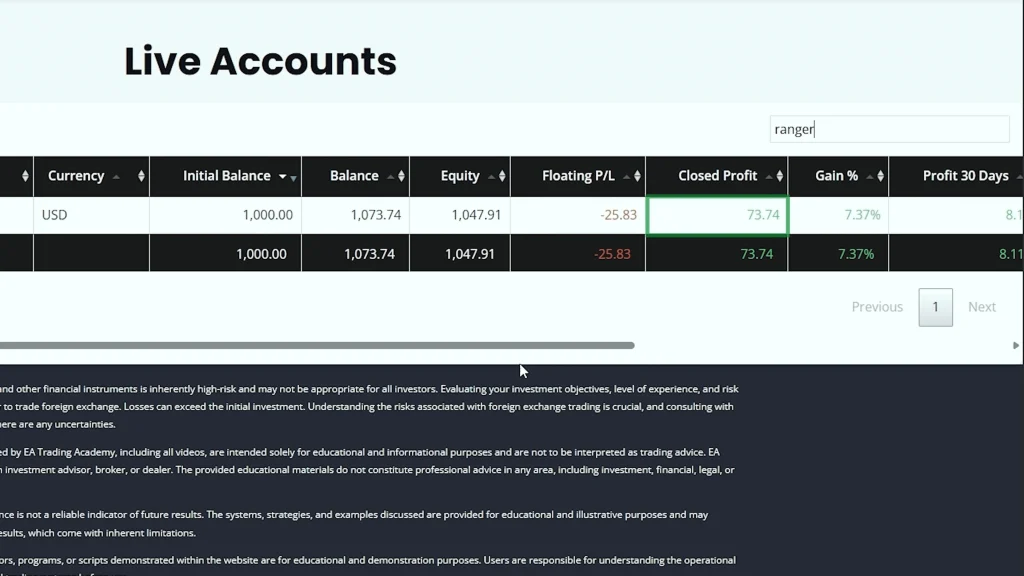
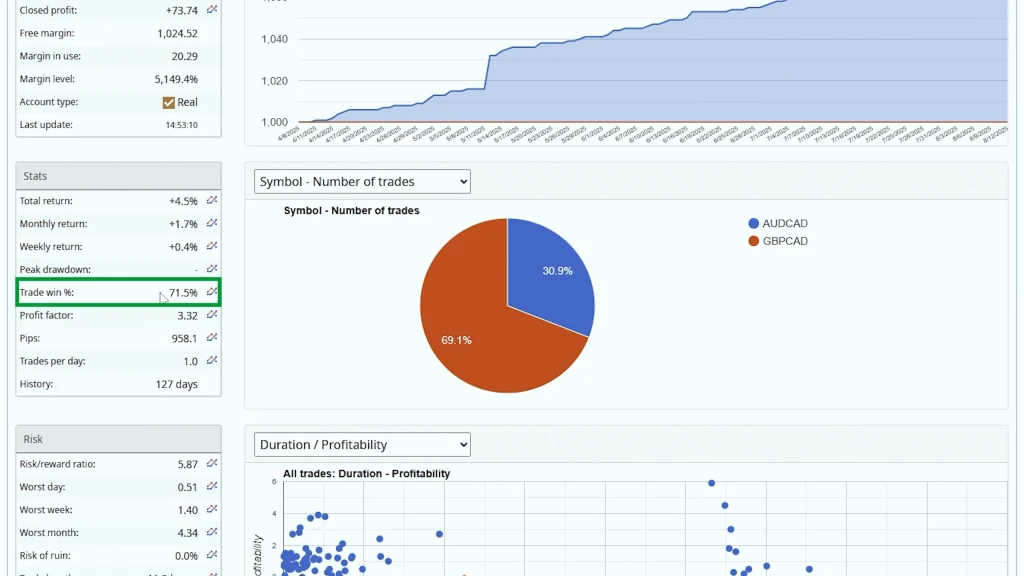
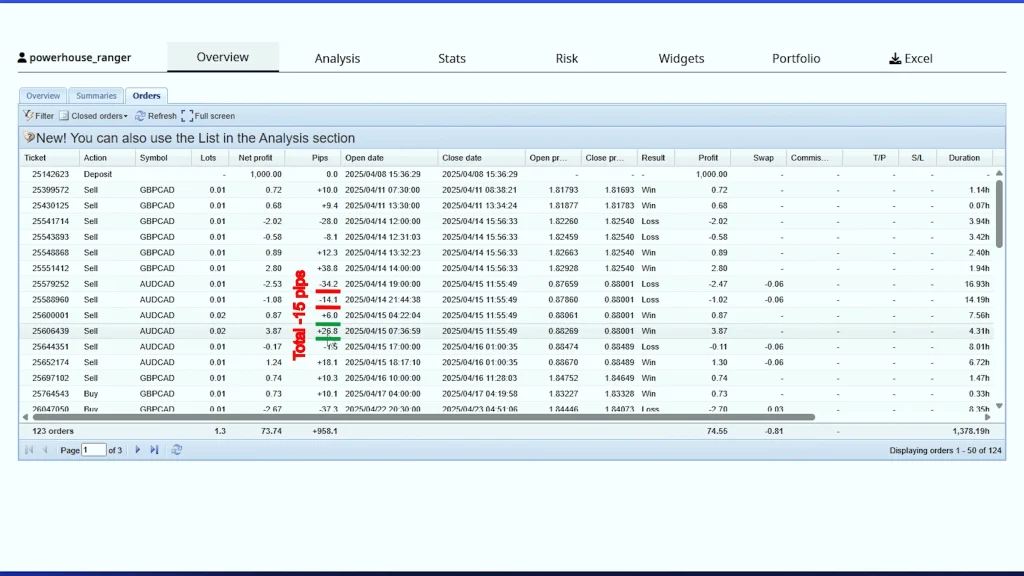
    My BlackBull Markets live account started on April 9th with $1,000. After four months and approximately 120 trades, the account sits at 7% gain with a gross profit of $73.74.

    That’s an average monthly return of 1.7%. Not explosive. Not flashy. But here’s what matters more: the maximum drawdown over those four months has never reached minus 1%. Even now, with open trades in small floating loss, the peak drawdown remains under 1%.

    Think about that for a moment. Four months of live trading with less than 1% peak drawdown. I’ve tested dozens of expert advisors, and that level of stability is exceptional.

    Performance Breakdown by Month

    MonthReturnNotes
    April (partial)~1%Account started mid-month
    May3%Strong performance
    June0.5%Slower period
    July0.5%Consistent with June
    August (partial)0.5%On pace for full month

    The trade win rate sits above 70%, which contributes to the smooth equity curve. Looking at the floating profit and loss chart, you’ll see remarkable stability, no dramatic spikes or crashes, just steady progression.

    How Ranger Actually Trades

    Ranger operates on two currency pairs: AUD/CAD and GBP/CAD. The majority of trades come from GBP/CAD, which makes sense once you understand the strategy differences between the two pairs.

    The system uses only two indicators:

    • Average True Range (ATR): Measures market volatility to adapt position sizing and grid spacing.
    • Relative Momentum Index (RMI): Identifies momentum shifts and potential reversal points.

    This simplicity is intentional. Complex multi-indicator systems often break when market conditions change. Ranger’s minimalist approach has remained unchanged since its creation in 2015, nearly a decade without strategy modifications. That longevity suggests robust logic rather than curve-fitted optimization.

    The 20-Pip Flex Grid System

    Ranger targets 10-15 pips profit per trade sequence, but here’s where it gets interesting: the grid system isn’t fixed. It adapts grid spacing based on ATR readings, which means position intervals expand or contract depending on current volatility.

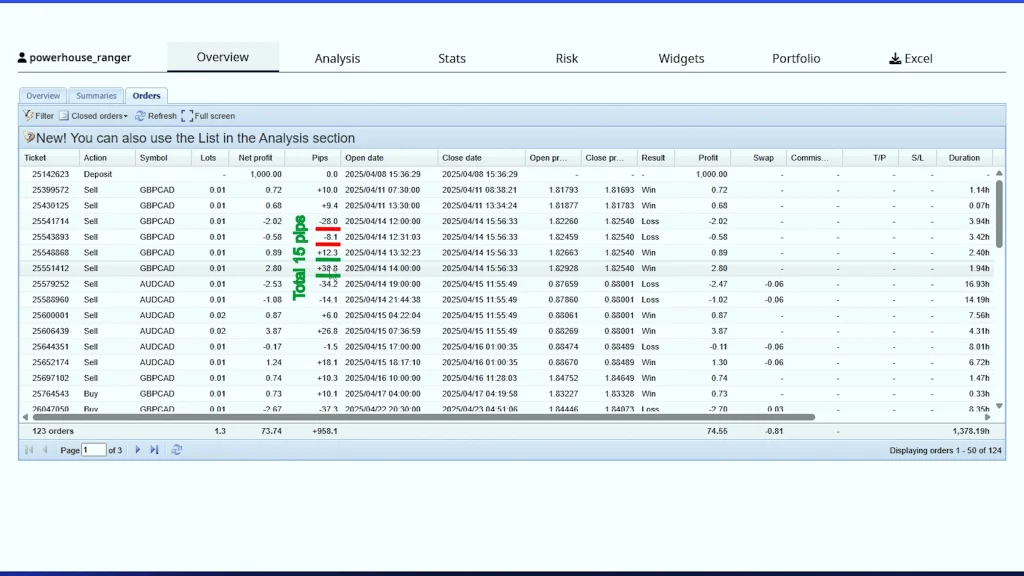
    Looking through my closed trades, you’ll see:

    • Single trades closing for 10 pips profit
    • Trade sequences closing for 15 pips combined
    • Occasional sequences hitting 20-25 pips when the flex grid activates

    That flexibility helps the system handle both calm and volatile market conditions without requiring constant manual adjustment.

    Counter-Trend Approach: Finding Reversals

    Unlike trend-following systems that jump on momentum, Ranger specifically looks for reversals at market tops and bottoms. This counter-trend methodology sounds risky on the surface, but the track record demonstrates it works when executed properly.

    The system doesn’t use trend filters. Instead, it relies on RMI readings to identify when momentum is exhausting and reversal probability increases. Combined with ATR-based grid spacing, this creates a system that enters against short-term moves while protecting itself through adaptive position management.

    I can see this playing out in my trade history. Sequences often show multiple entries as price initially moves against the position, then all close profitably when the anticipated reversal occurs. The key is having sufficient margin to handle those intermediate drawdowns, which brings us to an important distinction between the two pairs.

    GBP/CAD vs AUD/CAD: Critical Differences

    After testing both pairs and discussing specifics with Ryan, the developer, I learned something crucial: GBP/CAD and AUD/CAD don’t use identical logic.

    • GBP/CAD: Pure grid strategy with consistent lot sizing across all positions in a sequence.
    • AUD/CAD: Grid strategy with martingale elements, meaning lot sizes can increase with additional positions.

    Looking at my trade history confirms this. GBP/CAD sequences always show the same lot size across multiple entries. AUD/CAD sequences sometimes show position scaling.

    This distinction matters for risk management. The martingale component in AUD/CAD means slightly higher drawdown potential during extended adverse moves, though the ATR-based flex grid helps mitigate this risk.

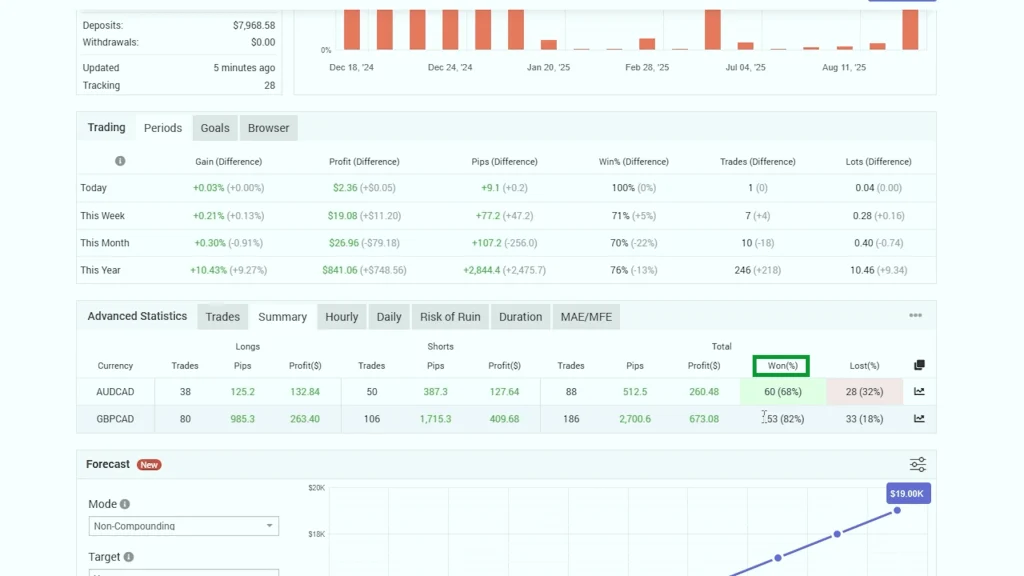
    Interestingly, GBP/CAD produces the majority of my trades and maintains an above 80% win rate. Perhaps that’s why the developer claims this specific pair configuration hasn’t had a losing basket since 2015; the pure grid approach without martingale scaling appears more stable.

    Vendor Track Record: Limited But Compelling

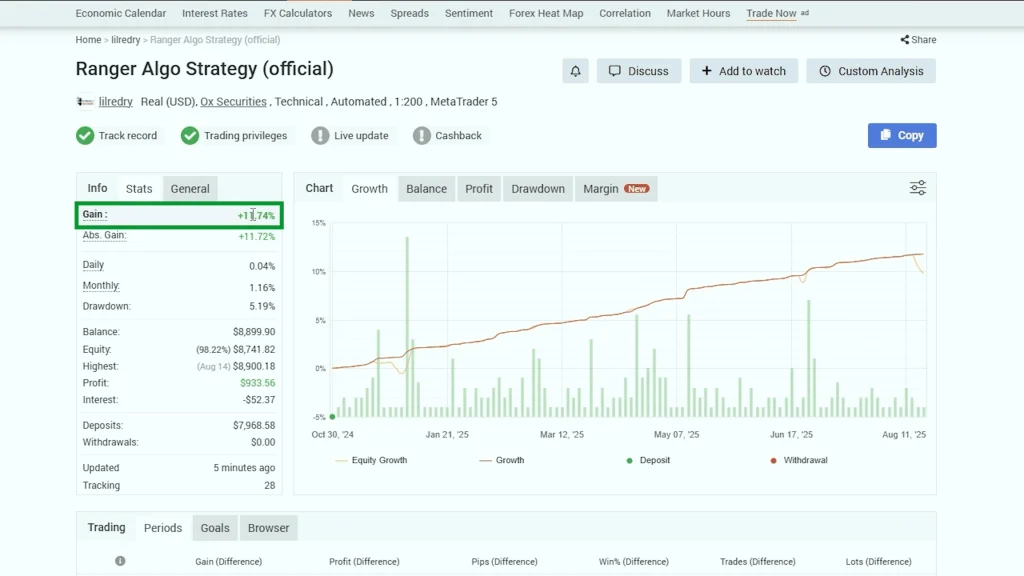
    Responsible Forex Trading maintains a verified track record for Ranger, though it only dates back to October 30th of last year, less than one year of public data.

    Here’s the frustrating part: Ryan confirmed they’ve never run Ranger on its own dedicated tracking account throughout its 10-year existence. We know GBP/CAD hasn’t had a losing basket since 2015 based on the developer’s internal records, but there’s no publicly verified decade-long track record to examine.

    That’s genuinely disappointing. Having verifiable 10-year performance data would be incredible social proof for the strategy’s effectiveness.

    What we do have shows consistent results:

    • Starting date: October 30th, 2024
    • Total return: ~12% in under one year
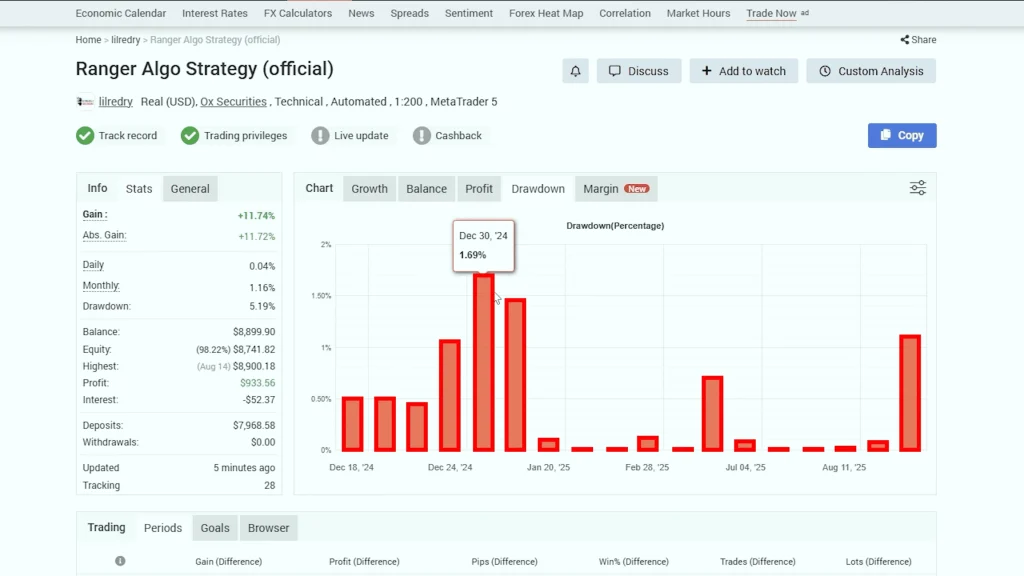
    • Peak drawdown: Less than 2% (occurred December 30th)
    • Current drawdown: ~1%
    • Pairs traded: AUD/CAD and GBP/CAD

    The vendor’s stats show GBP/CAD maintaining over 80% profitable trades, which aligns with what I’m seeing in my own live account. The developer’s equity curve mirrors mine, steady growth with minimal volatility.

    Demo Account Experiments: Testing Beyond Defaults

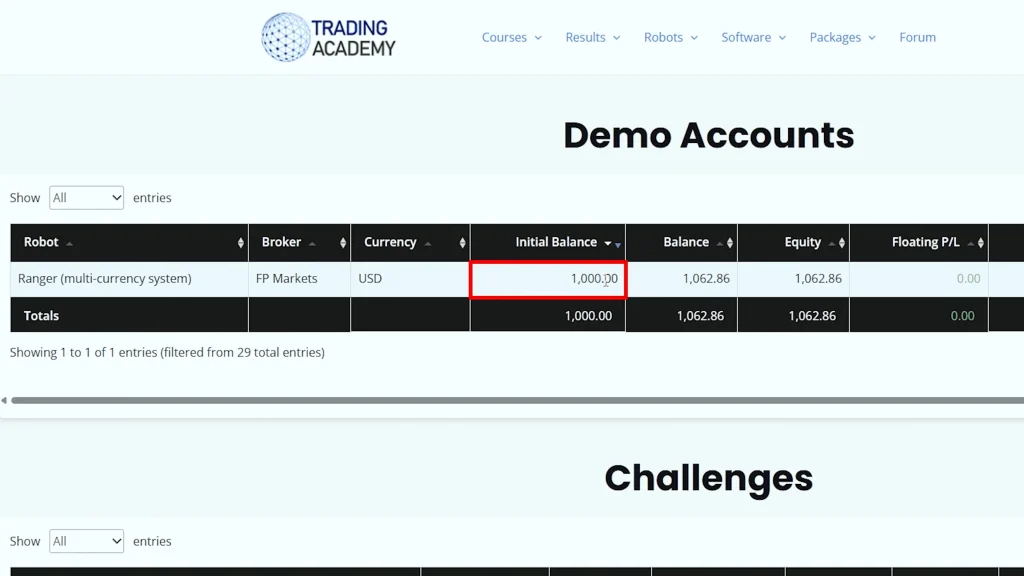
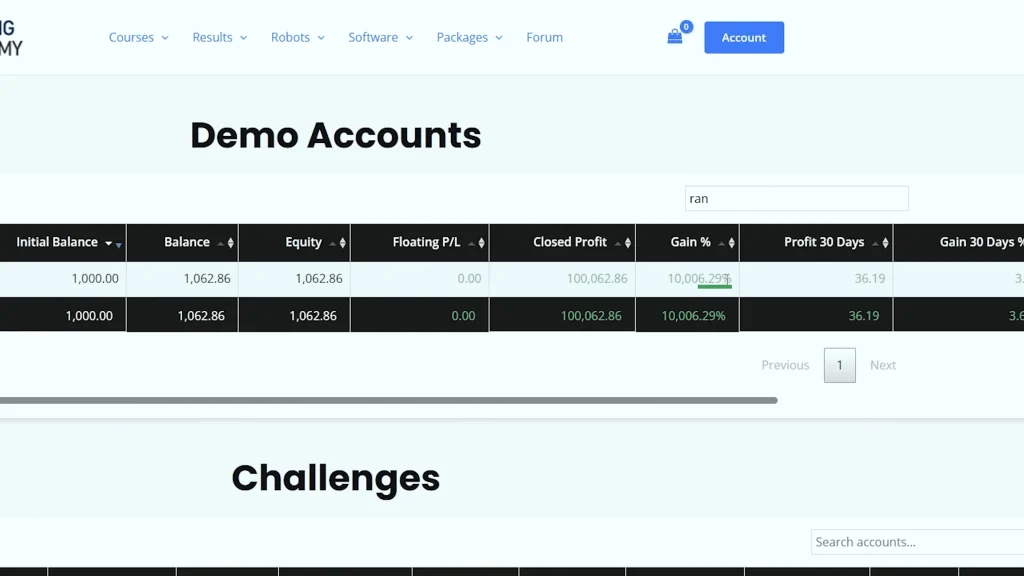
    Beyond the live account, I’m running Ranger on a demo account where I’ve been experimenting with non-standard configurations. This account started with $1,000 (technically $100,000 with $99,000 withdrawn to simulate a smaller capital) and currently shows 6.29% profit after 70 days and nearly 100 trades.

    Here’s where things get interesting, and a bit messy. I’ve been testing Ranger on EUR/AUD, which isn’t a default pair for this system. I’ve also experimented with running the GBP/CAD M30 configuration on AUD/CAD M30 instead of the standard H1 timeframe.

    The results? Mixed. The EUR/AUD experiment produced an 8% floating drawdown at one point. When I filter to show only the standard pairs (GBP/CAD and AUD/CAD), drawdown drops to 3-4%, and even that’s inflated because I’m testing AUD/CAD on M30 instead of H1.

    Important note: Don’t take any of these experiments as recommendations. I’m deliberately testing unusual configurations to see what breaks and what works. The default setup, GBP/CAD on M30 and AUD/CAD on H1, represents the developer’s tested and verified approach.

    The backtests for Ranger show positive results on various currency pairs and timeframes, but there are subtle strategy differences between pairs that affect performance. Sticking with the developer’s recommended configurations makes sense unless you have substantial testing time to validate alternatives.

    Why BlackBull Markets for This EA

    I’m running Ranger on BlackBull Markets for specific reasons related to how grid strategies function. Full disclosure: this is a sponsored partnership, but I only work with brokers I actually use for my own trading.

    BlackBull offered our community institutional-grade accounts for $2,000 instead of the typical $20,000 minimum. That’s significant because institutional accounts provide:

    • Tighter spreads on minor pairs like GBP/CAD and AUD/CAD
    • Lower commissions that directly impact profitability
    • Professional execution quality
    • No restrictions on automated trading or grid strategies

    For grid-based systems like Ranger, trading costs accumulate quickly. Those 10-15 pip profit targets get eaten away if spreads are too wide or commissions are too high. BlackBull’s institutional pricing helps preserve those gains.

    The broker is fully regulated and supports both MetaTrader 4 and MetaTrader 5 with no algorithmic trading restrictions. Their platform handles grid position management smoothly without requotes or rejection issues I’ve experienced with some other brokers.

    When you’re running strategies that place multiple related positions, stable execution matters more than marketing promises. BlackBull delivers that reliability.

    The Powerhouse Bundle Context

    Ranger is one of six strategies included in the Powerhouse EA Bundle from Responsible Forex Trading. The other strategies include:

    • Sharpshooter (which I’ve reviewed separately)
    • Vigorous EA
    • Three additional systems

    You can purchase Ranger individually or get the entire Powerhouse package, which combines all six strategies in one expert advisor. I’m running the individual versions to track each system’s performance separately, but the bundled approach makes sense for traders wanting simplicity.

    The developer’s website shows track records for each Powerhouse strategy. Sharpshooter recently experienced a drawdown that I documented in another video. Vigorous has its own performance characteristics. Each system operates differently, which creates portfolio diversification when running multiple strategies simultaneously.

    Ranger’s role in that portfolio is clear; it’s the ultra-stable, low-drawdown component that provides consistent baseline returns while other strategies might experience higher volatility.

    Realistic Expectations: Marathon, Not a Sprint

    Let me be direct about what Ranger isn’t. This isn’t a get-rich-quick system. You’re not going to double your account in a month. The 1.7% average monthly return translates to roughly 20% annually if sustained, solid performance, but not spectacular.

    What you get instead is remarkable consistency. Less than 1% peak drawdown over four months. Win rates above 70%. Equity curves that look like gentle slopes rather than jagged mountains.

    For traders managing funded accounts with strict drawdown limits, that profile is actually more valuable than higher returns with proportionally higher volatility. A prop firm account with 5% maximum drawdown can run Ranger comfortably. An aggressive EA promising 10% monthly but risking 15% drawdown would get that same account terminated quickly.

    Ranger is ideal for:

    • Live trading accounts without daily drawdown restrictions, where grid strategies have room to work
    • Long-term growth portfolios prioritizing capital preservation
    • Traders willing to accept modest returns in exchange for exceptional stability
    • Accounts that needa  reliable baseline performance to balance more aggressive systems

    It’s not ideal for traders chasing maximum returns regardless of risk or those needing quick account growth.

    What Works and What Doesn’t

    After months of testing, here’s my honest assessment of Ranger’s strengths and limitations:

    What I Appreciate

    • Simplicity breeds reliability: Only two indicators mean fewer components that can break when market conditions shift.
    • Realistic profit targets: Taking 15 pips per sequence is sustainable long-term, unlike systems promising unrealistic returns.
    • Developer discipline: Reducing profit targets over time to protect strategy longevity shows they prioritize sustainability over marketing hype.
    • Perfect for live accounts: Grid strategies need margin breathing room, and standard broker accounts provide that without the daily restrictions prop firms impose.

    The Limitations

    • Still a grid system: Despite the flex grid adaptation, extended trending markets can create drawdowns. No grid system is completely immune to strong directional moves.
    • Modest returns: If you need aggressive growth, this isn’t your solution. Ranger trades patience for consistency.
    • Limited currency pair selection: Only two pairs by default (though you can experiment with others if you’re willing to test thoroughly).
    • Missing long-term verification: The lack of a public 10-year track record is genuinely frustrating given the developer’s internal data claims.

    The biggest disappointment remains that long-term track record gap. Knowing GBP/CAD hasn’t had a losing basket since 2015, but not being able to verify it publicly feels like a missed opportunity for demonstrating the strategy’s robustness.

    Where to Access Ranger and Additional Resources

    Ranger EA is available through Algo Trading Space, which provides access to the system along with additional automated trading resources. Full disclosure: we may earn a small commission if you purchase through our links, though this doesn’t affect the price you pay or the honest assessment in this review.

    For traders building portfolios across multiple expert advisors, the Algo Trading Space VIP club offers exclusive access to verified trading results from various systems, early insights into new EAs, and priority support. If you want ongoing performance data and community access beyond individual reviews, it’s worth exploring.

    I’ll continue running Ranger on both live and demo accounts with public tracking, so you can follow results as they develop beyond this initial review period.

    Frequently Asked Questions

    Ranger’s counter-trend methodology does face challenges during extended directional moves, but the flex grid system helps mitigate this risk by adapting position spacing based on ATR volatility readings.

    In my four months of live testing, even when positions moved against the initial entry, the grid recovery mechanism and reversal identification worked as designed. The key is having sufficient margin; grid strategies need breathing room.

    Peak drawdown staying under 1% suggests the ATR-based adaptation is effective, though no grid system is completely immune to sustained trends.

    What’s the difference between running GBP/CAD versus AUD/CAD configurations?

    GBP/CAD uses a pure grid approach with consistent lot sizing across all positions in a sequence, while AUD/CAD incorporates martingale elements where lot sizes can increase with additional grid levels.

    This makes GBP/CAD more stable with lower drawdown potential; it maintains above 80% win rate in my testing and reportedly hasn’t had a losing basket since 2015. AUD/CAD still performs well but carries a slightly higher risk due to position scaling. Most of my live trades come from GBP/CAD, which aligns with the developer’s recommendations.

    Can I run Ranger on currency pairs other than the default GBP/CAD and AUD/CAD?

    You can experiment with other pairs, but proceed cautiously. My demo account testing EUR/AUD produced 8% floating drawdown compared to 3-4% on standard pairs. Backtests show positive results on various currencies, but the strategy has subtle optimization differences between pairs.

    The developer spent years refining GBP/CAD and AUD/CAD configurations; deviating from those defaults requires thorough independent testing. If you experiment with alternative pairs, start with small position sizes and expect different performance characteristics than the verified track records.

    What account size do I need to run Ranger EA safely?

    I’m running Ranger on a $1,000 live account successfully, but $2,000-$3,000 provides a more comfortable margin for the grid system to operate without stress. The critical factor is ensuring sufficient margin to handle multiple grid positions simultaneously, especially on AUD/CAD, which uses martingale scaling.

    Smaller accounts around $500 might work with very conservative lot sizing, but grid strategies need room to breathe. If you’re using institutional accounts with lower spreads (like BlackBull’s $2,000 minimum), that’s ideal for preserving the 10-15 pip profit targets.

    How does Ranger compare to other strategies in the Powerhouse Bundle, like Sharpshooter and Vigorous?

    Ranger fills the ultra-stable, low-drawdown role in the Powerhouse portfolio. Where Sharpshooter might generate higher monthly returns with proportionally higher volatility, and Vigorous offers its own risk-reward profile, Ranger provides baseline consistency with less than 1% peak drawdown.

    Running multiple Powerhouse strategies together creates diversification, and different systems perform better in different market conditions. My live account data shows each EA contributing at different times, with Ranger’s role being reliable, steady growth rather than occasional large gains.

  • Testing The Sharpshooter Trading Robot: Performance, Setup & Honest Insights In 2026

    Testing The Sharpshooter Trading Robot: Performance, Setup & Honest Insights In 2026

    Some expert advisors promise the world but crumble when real money hits the table. Sharpshooter EA isn’t one of them. I’ve been running this system on both funded accounts and live capital for months now, and I just withdrew over $1,000 in profits from my iFunds account, not the first withdrawal, and based on current performance, probably not the last.

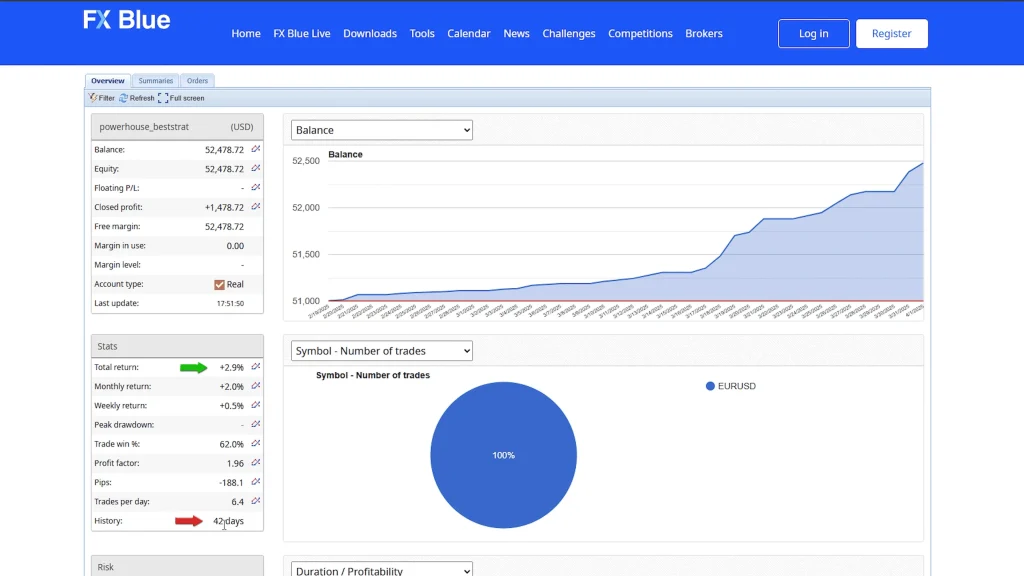
    This review covers real results from actual trading, including the 42-day track record on my funded account, performance on a $5,000 live account running since mid-November, and what makes Sharpshooter consistently profitable enough to generate withdrawable income month after month.

    Let me walk through the setup, configuration choices, and exactly how this EA has been performing across different account types.

    How Sharpshooter Trades EUR/USD

    Sharpshooter operates on EUR/USD using the M15 timeframe. That’s a 15-minute chart, which sits in the middle ground between rapid-fire scalping and longer-term position trading.

    Looking at the MetaTrader platform where I’m running it, the trade history shows high activity. This isn’t a system that places one or two trades per week; it’s actively scanning for setups and executing frequently.

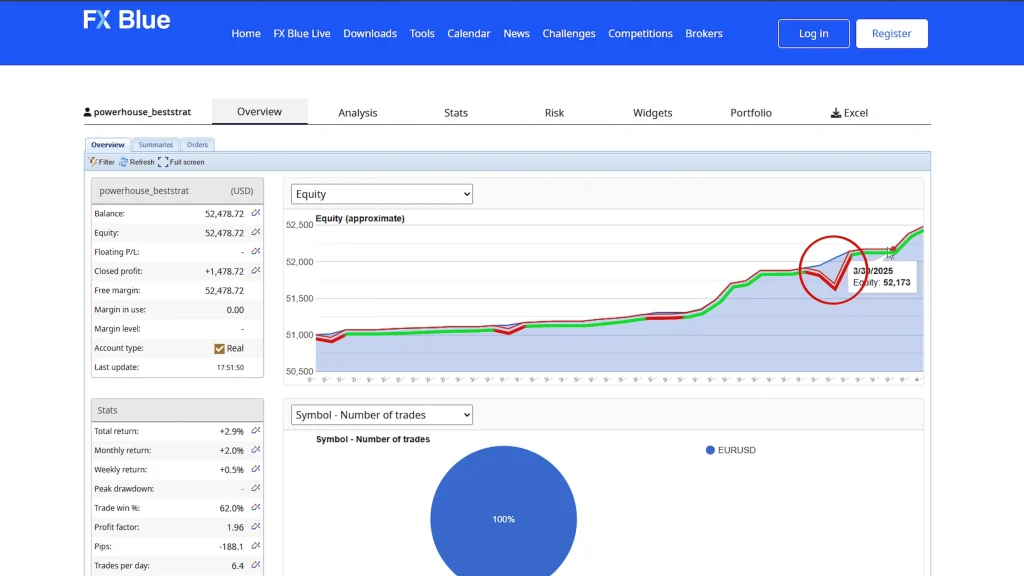
    I started the iFunds account on February 19th, and by April 1st (42 days of trading), the account had generated nearly 3% total return. That might not sound explosive, but context matters. This is a funded account with strict drawdown limits, and 3% in six weeks translates to roughly 5-6% monthly at this pace.

    The equity curve shows mostly smooth growth with one minor drawdown that recovered quickly. Nothing alarming. No dramatic spikes or crashes, just steady accumulation.

    Configuration Settings and Risk Management

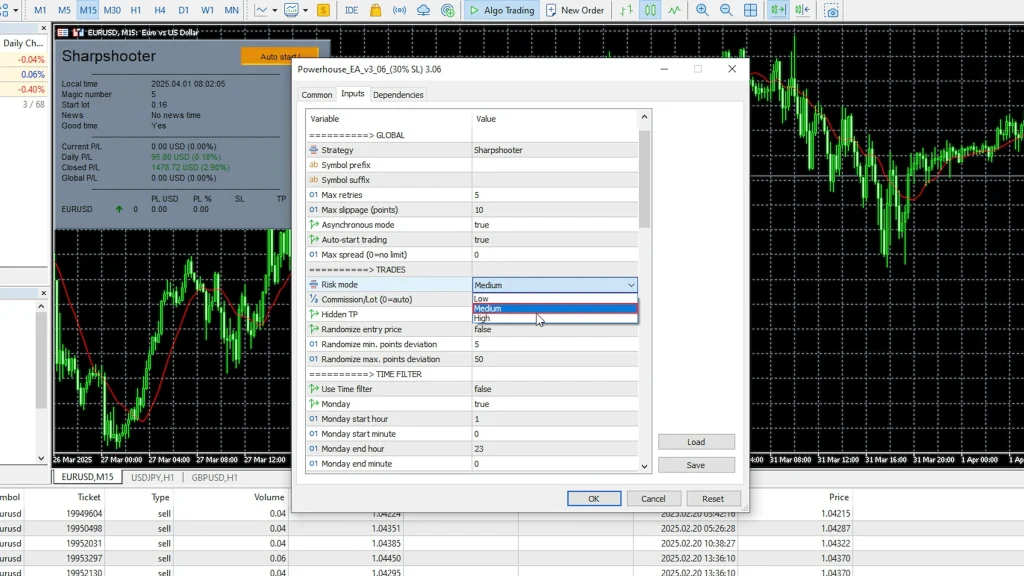
    I’m running Sharpshooter at medium risk. The EA offers three risk levels:

    • Low risk: Conservative position sizing
    • Medium risk: Balanced approach
    • High risk: Aggressive position sizing

    Initially, I traded with lower risk to see how the system behaved. After confirming consistent performance, I increased the risk to medium, which has been working well.

    Additional Configuration Options

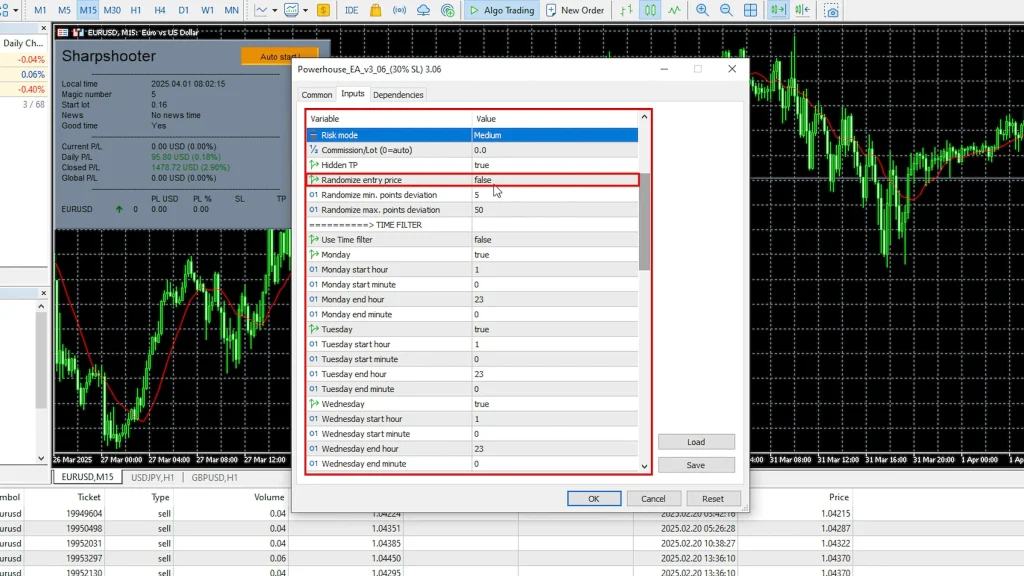
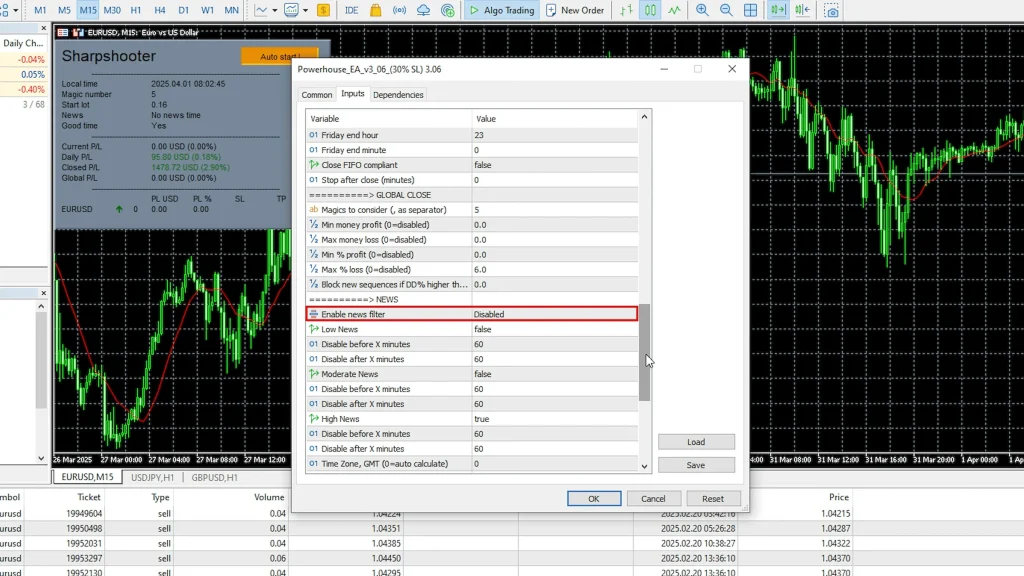
    • Randomization Feature: Useful if you’re trading on prop firms where multiple traders can’t use identical settings. iFunds doesn’t restrict this, so I left randomization off.
    • Time Filter: Allows you to restrict trading to specific hours. I haven’t enabled this.
    • News Filter: Can pause trading around major economic releases. Again, iFunds doesn’t prohibit news trading, so I’m running without this filter.

    The flexibility to adjust these parameters means you can tailor Sharpshooter to different broker requirements or prop firm rules. That versatility matters when you’re managing multiple accounts with different restrictions.

    The iFunds Withdrawal: $1,035 in Profits

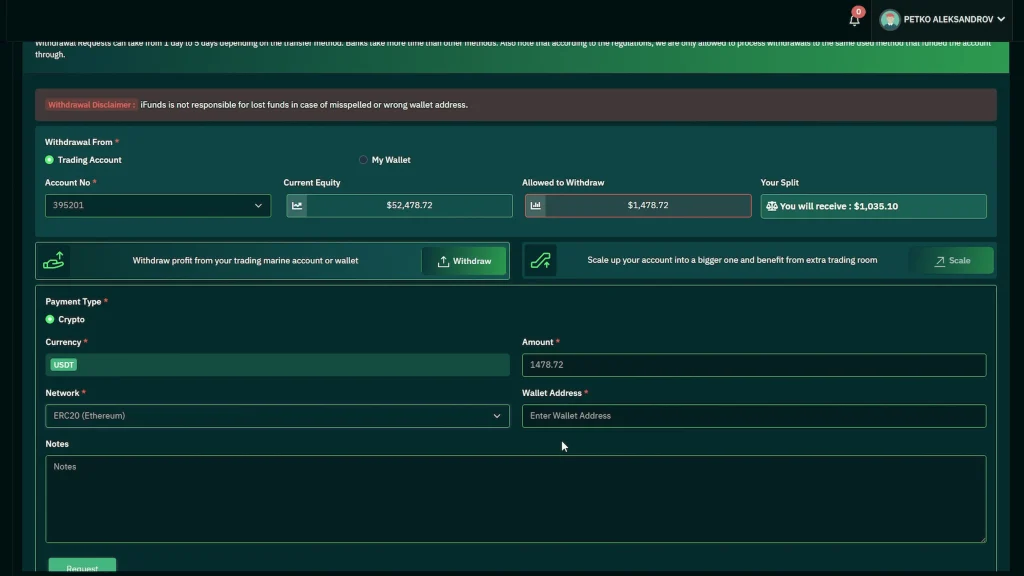
    My iFunds account uses their Advanced 50K Expert setup, which starts with $50,000 equity. The account cost $3,000 to purchase, but I used a registration coupon that added an extra $1,000 in capital.

    Here’s where it gets interesting. iFunds lets you adjust your profit split percentage, but there’s a tradeoff with maximum drawdown limits:

    Profit SplitMax DrawdownMy Choice
    50%10%Not selected
    70%7%Selected

    I chose the 70% profit split with the tighter 7% drawdown limit. Why? Because I’ve been trading Sharpshooter long enough on other accounts to know it operates with low risk. The system hasn’t come close to 7% drawdown in my testing, so taking the higher profit split made sense.

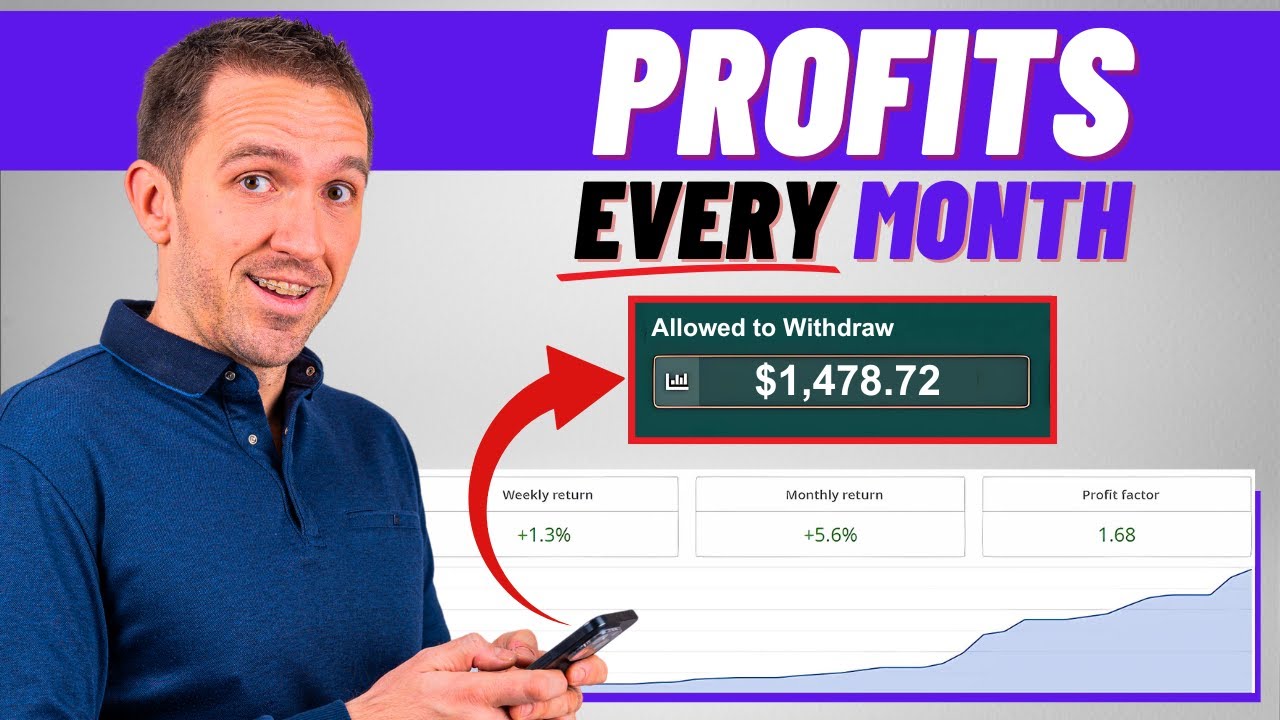
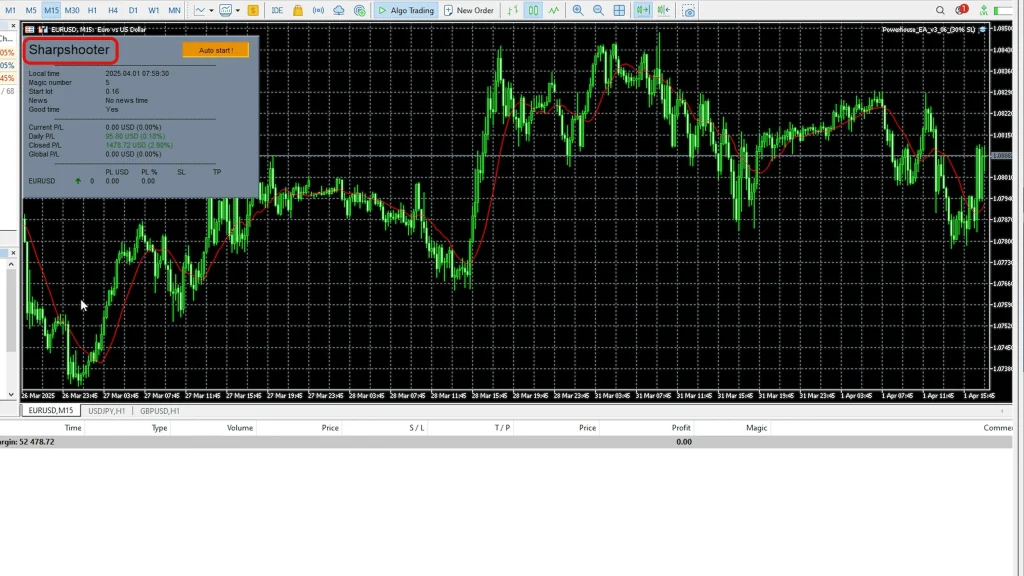
    The account showed $1,478.72 in total profits. At 70% split, that’s exactly $1,035 available for withdrawal. I requested the full amount via the ERC20 network to my wallet; the process took literally seconds.

    iFunds typically processes withdrawals within a few hours. I’ve made multiple withdrawals from them, and my team has also tested their payout reliability. So far, no issues.

    Live Account Performance: Three EAs Working Together

    Beyond the funded account, I’m also running Sharpshooter on a $5,000 live account alongside two other systems from the same developer: Vigorous EA and Ranger EA.

    This account started in mid-November last year. By the time it reached $6,300, I withdrew profits back down to $5,000. Now it’s climbing again.

    The combined statistics across all three EAs show:

    • Average monthly return: 5.6-6%
    • Profit factor: 1.68
    • Consistent equity growth over multiple months

    When I filter the stats to show only the last 30 days and sort by net profit, Sharpshooter (identified by magic number 5) generated the highest returns among the three systems. It’s not just performing well; it’s outperforming the other two profitable EAs running simultaneously.

    That kind of relative performance gives me confidence to keep allocating capital to Sharpshooter specifically.

    The Powerhouse Bundle Option

    The developer who created Sharpshooter offers several purchasing options:

    Individual EAs: You can buy Sharpshooter, Vigorous, or Ranger separately.

    Powerhouse EA: A combined package containing six different strategies in one expert advisor, including Sharpshooter’s logic.

    I’m running the individual versions, but the Powerhouse option makes sense for traders who want everything in a single installation. The developer’s demo account for Powerhouse has achieved over 100% returns, though demo performance always needs live validation.

    My approach has been to test the individual systems separately so I can track each one’s contribution to overall account performance. That’s how I know Sharpshooter is currently the top performer among the three I’m running.

    Why I Trust These Results

    I’ve been burned by prop firms before. The industry has reliability issues; some platforms make it difficult to withdraw, others change rules retroactively, and a few simply don’t pay out despite meeting all stated requirements.

    That’s why I’ve tested iFunds extensively. Multiple withdrawals from my accounts. Team members are purchasing accounts and requesting payouts. We wanted to verify they actually process withdrawals before recommending them.

    So far, iFunds has been consistent. Withdrawals arrive within hours, no games, no unexpected roadblocks.

    The live $5,000 account provides another verification layer. That’s real money from my pocket, not a funded challenge. The fact that Sharpshooter performs similarly across both funded and live environments strengthens my confidence in the results.

    Trade Activity and Frequency

    Sharpshooter generates frequent trades compared to some EAs I’ve tested. Looking through the account history, you’ll see multiple positions per day during active periods.

    This isn’t necessarily a negative. High trade frequency means more data points to evaluate performance. With systems that trade once or twice per week, you need months to accumulate statistically meaningful results. Sharpshooter provides that data much faster.

    The M15 timeframe keeps individual trades from being too short-lived (like M1 or M5 scalping) while still allowing multiple setups per trading session. It’s a good balance for generating consistent activity without the execution challenges that ultra-short timeframes can create.

    Comparing Funded vs Live Account Economics

    The funded account approach deserves some analysis. You pay $3,000 for access to $50,000 equity. At 70% profit split and 5-6% monthly returns, that’s approximately $1,750-$2,100 in monthly profit potential, of which you’d receive $1,225-$1,470.

    Compare that to investing the same $3,000 in a standard live account. Earning 5-6% monthly on $3,000 would be $150-$180, significantly less than the funded account payout, even after the profit split.

    The tradeoff is the 7% drawdown restriction. If Sharpshooter suddenly hit an 8% drawdown, the funded account would be terminated, and you’d lose the $3,000 entry fee. With a personal live account, you’d still have your capital (minus the drawdown).

    Based on Sharpshooter’s historical performance showing minimal drawdowns, I’m comfortable with that tradeoff. But it’s a decision each trader needs to make based on their risk tolerance.

    Transparency and Ongoing Tracking

    All my trading results, live accounts, funded accounts, and prop firm challenges are publicly available on the Algo Trading Space website. Anyone can check the accounts at any time and verify the performance I’m describing.

    We’re constantly adding new accounts and testing additional expert advisors. The goal is finding systems that actually work in live conditions, not just backtests. Sharpshooter has proven itself repeatedly, which is why it continues running on multiple accounts.

    Monthly updates show how each EA performs as market conditions change. Some months are stronger, others weaker, but the overall trend for Sharpshooter has been consistently positive.

    What Makes This EA Different

    I’ve tested dozens of expert advisors over the years. Many look promising in backtests but fail in live trading. Others work initially but degrade over time as market conditions shift.

    Sharpshooter has maintained performance across different time periods and account types. The funded account results match the live account behavior. The recent 30-day performance aligns with longer-term statistics.

    That consistency is rare. It suggests the underlying logic adapts to market conditions rather than being optimized for one specific environment that no longer exists.

    The ability to generate withdrawable profits monthly, not just paper gains but actual money I can move to my wallet, makes Sharpshooter more than just another EA to test. It’s become a reliable income component.

    Where to Access Sharpshooter and Additional Resources

    Sharpshooter EA is available through Algo Trading Space, which provides access to the system along with additional algorithmic trading resources. Full disclosure: we may earn a small commission if you purchase through our links, though this doesn’t affect the price you pay or the honest assessment in this review.

    For traders building portfolios of multiple expert advisors, the Algo Trading Space VIP club offers exclusive access to verified trading results across various systems, early insights into new EAs, and priority support. If you want ongoing performance data beyond individual reviews, it’s worth exploring.

    I’ll continue running Sharpshooter on both funded and live accounts with public tracking, so you can follow results as they develop beyond this review.

    Frequently Asked Questions

    What’s the minimum account size needed to run Sharpshooter EA safely?

    While Sharpshooter can technically operate on accounts as small as $500-$1,000, I recommend starting with at least $3,000-$5,000 for a comfortable margin and drawdown tolerance. My live account runs with $5,000, which provides a sufficient buffer for the system’s trading frequency and position sizing at medium risk.

    Funded accounts work well because they provide larger equity ($50,000) for the same entry cost, allowing more conservative relative position sizing while still generating meaningful returns.

    How does Sharpshooter perform during high-impact news events?

    Sharpshooter includes an optional news filter that can pause trading around major economic releases, but I run it without this filter enabled on my iFunds account since that platform doesn’t restrict news trading. During my months of testing, I haven’t noticed catastrophic losses during news events.

    The M15 timeframe provides some buffer against the most extreme volatility spikes that hit M1 or M5 systems. However, if your broker or prop firm restricts news trading, enabling the news filter is straightforward.

    Can I run Sharpshooter alongside other EAs from the same developer?

    Yes, and I actively do this on my $5,000 live account where Sharpshooter runs with Vigorous and Ranger EAs simultaneously. Each uses different magic numbers for trade identification, so there’s no conflict.

    In fact, running multiple complementary systems can smooth overall equity curves since different strategies perform better in different market conditions. Just ensure your account size supports the combined position sizing across all EAs you’re running together.

    What’s the difference between buying Sharpshooter individually versus the Powerhouse bundle?

    Sharpshooter as a standalone EA focuses specifically on its particular trading logic, while Powerhouse EA combines six different strategies, including Sharpshooter’s approach into one expert advisor.

    If you only want Sharpshooter’s specific methodology, the individual purchase makes sense. The Powerhouse bundle provides more diversity in a single installation, which can be valuable for portfolio diversification. I run individual versions to track each strategy’s performance separately, but traders wanting simplicity might prefer Powerhouse.

    How often can I realistically expect to withdraw profits from a funded account using Sharpshooter?

    Based on my experience, Sharpshooter generates 5-6% average monthly returns, which translates to monthly withdrawal opportunities if you’re comfortable taking profits regularly. I withdrew over $1,000 after 42 days, and the live account history shows similar monthly performance.

    However, some traders prefer letting profits compound for a few months before withdrawing. The key is ensuring you stay within the drawdown limits, with iFunds’ 7% maximum at 70% profit split, conservative risk management is essential to avoid account termination.

  • Testing The Architect Algo Trading Bot: Performance, Setup & Honest Insights In 2026

    Testing The Architect Algo Trading Bot: Performance, Setup & Honest Insights In 2026

    Most expert advisors lock you into a single fixed approach. You get what the developer built, and that’s it. Architect Algo EA flips that model completely; it’s essentially a customizable framework that lets you build nearly any algorithmic trading system you can imagine through configuration rather than coding.

    I’ve spent over a week exploring this EA, testing multiple pre-configured strategies on a Darwinex Zero account, and working through what might be the most extensive documentation I’ve ever seen for a trading robot. Almost 90 tutorial videos. That’s not a typo.

    This isn’t your typical plug-and-play EA. Architect Algo requires time investment to understand, but the flexibility it offers is unlike anything else I’ve tested. Let me walk through what I found, including live results from seven different currency pairs running simultaneously.

    What Makes Architect Algo Different

    Architect Algo comes from Responsible Forex Trading, the same developer behind Sharpshooter, Vigorous, and several other systems in their Powerhouse bundle. But this isn’t just another pre-built EA from that lineup.

    Think of it as a strategy builder. You get access to dozens of configurable inputs that control everything from indicator signals to trend filters, entry logic to position management. By adjusting these parameters, you can create scalping systems, grid-based approaches, trend-following strategies, or combinations of multiple methodologies.

    The developer provides pre-configured set files for various approaches, complete strategies ready to deploy. But the real value is being able to modify these templates or build something entirely new based on your own trading ideas.

    I’m currently testing Architect Algo across seven charts on my Darwinex account:

    • EUR/USD M1 (Strategy 4)
    • GBP/USD M15 (Strategy 3)
    • USD/CHF M15 (Strategy 1)
    • EUR/USD M15 (Additional strategy)
    • Several other currency pairs with different configurations

    Each chart runs a different configuration, and I’m tracking them separately to see which approaches work best under real trading conditions.

    Testing Environment: Why Darwinex Zero

    I chose Darwinex Zero for this test specifically because of the data quality and trading conditions. Darwinex provides historical data going back to 2017-2018 with real spreads, actual slippage, and genuine execution conditions.

    This matters more than you might think. Many brokers offer demo accounts with unrealistic fills and tighter spreads than you’d get live. Darwinex Zero replicates real market conditions, which gives more accurate backtesting and forward testing results.

    The account structure also works well for testing grid and martingale strategies, which several of the Architect Algo configurations use. I’m running a $100,000 account, which provides substantial margin to handle position scaling without constantly worrying about margin calls.

    Darwinex Zero operates on a subscription model rather than requiring full capital. That makes it cost-effective for strategy testing while still competing for allocated capital if performance meets their standards.

    Pre-Configured Strategies and Documentation

    When you purchase Architect Algo, you receive access to a complete folder structure containing:

    • The EA file itself
    • Set files for multiple ready-to-use strategies
    • Tutorial videos explaining every input parameter
    • Documentation covering strategy concepts
    • Example configurations from other Powerhouse EAs

    The strategy tutorials section provides detailed guides on different approaches you can implement. Each tutorial includes the set files, so you can load them directly without manual configuration.

    I found strategies for various timeframes and currency pairs:

    • Strategy 1: M15 timeframe trading EUR/USD, GBP/USD, USD/CHF
    • Strategy 2: M15 timeframe for EUR/USD and USD/CHF
    • Strategy 3: Multiple currency pairs with different configurations
    • Strategy 4: M1 scalping approach for EUR/USD

    Rather than testing every available configuration, I ran backtests on each and selected the ones showing the strongest historical performance. That’s how I ended up with my current seven-chart setup.

    Backtest Analysis Using The Backtest Manager

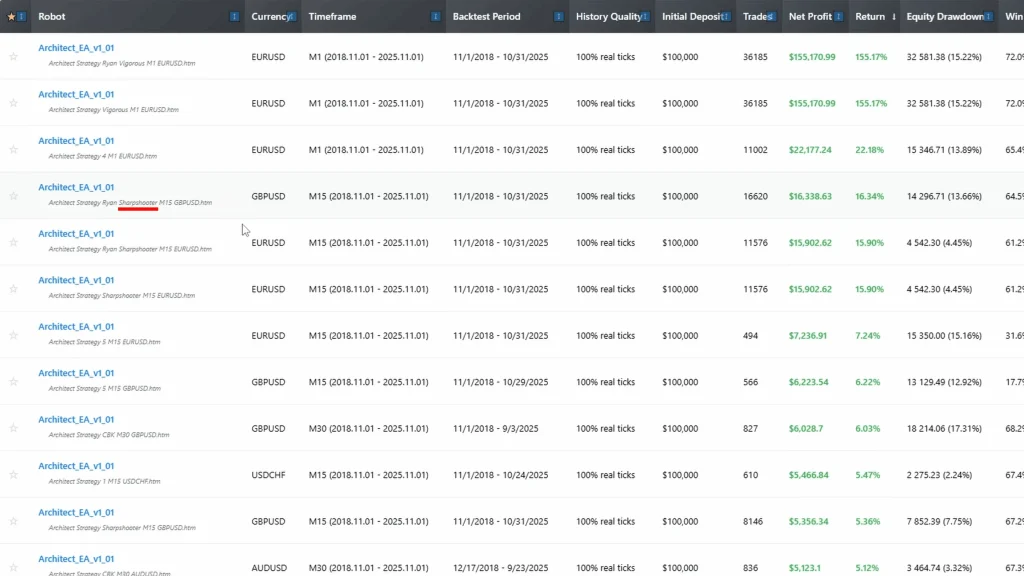
    I used the Backtest Manager tool from Algo Trading Space to analyze all the different strategy configurations. This tool imports results from MetaTrader’s strategy tester and displays them in a much more readable format with sorting, filtering, and comparison capabilities.

    After importing multiple backtest reports, I could sort strategies by return, drawdown, profit factor, or other metrics. This made it much easier to identify which configurations were worth testing live.

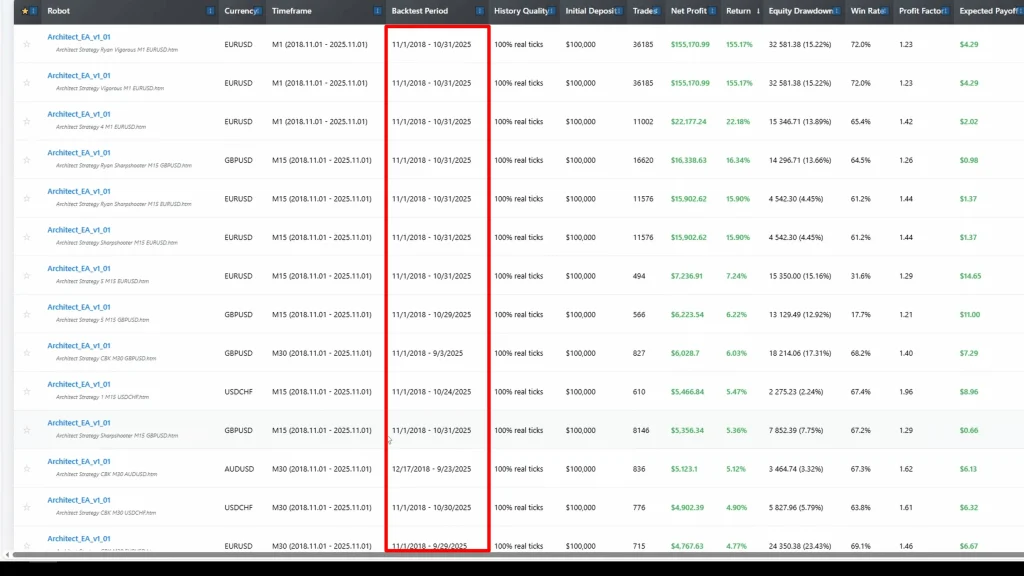
    One strategy that caught my attention was the EUR/USD M1 scalping approach. Running backtests from the beginning of my available Darwinex data through the end of October (to maintain equal exposure across all tests), the results showed:

    MetricValue
    Account Size$100,000
    Testing Period~7 years
    Total TradesHigh volume
    Win RateSolid percentage
    Profit FactorAbove 1.5
    Maximum Drawdown~14%

    That 14% drawdown over seven years is quite reasonable in my opinion, especially for a scalping system. The profit factor above 1.5 indicates wins substantially outweigh losses after costs.

    What I particularly liked was the average trade duration of around 13 hours. That’s important for Darwinex’s risk engine, which evaluates trading behavior. Extremely short-duration scalping can sometimes trigger concerns, but 13-hour average holds are well within acceptable ranges.

    The Configuration Complexity: Blessing and Curse

    Opening the Architect Algo inputs panel reveals just how customizable this system is. There are dozens, maybe over a hundred, configuration options available.

    You can adjust:

    • Magic number and strategy name (for tracking multiple instances)
    • Indicator signals and which indicators to use
    • Trend filter settings and parameters
    • Entry logic and timing
    • Position sizing and money management
    • Grid spacing and martingale multipliers
    • Take profit and stop loss configurations
    • Risk management limits
    • And much more

    This level of customization is powerful, but it’s also overwhelming. I spent more than a week going through the tutorial videos just to understand what each input does. Even then, I didn’t have time to create my own strategy from scratch, which was my original goal for this test.

    Instead, I focused on using and slightly modifying the pre-configured set files. That’s honestly what most traders will probably do, start with working templates and adjust from there rather than building from zero.

    Strategy Characteristics: Grid and Martingale Elements

    Looking at the order history on my Darwinex account, most of the Architect Algo strategies I’m testing employ grid trading with martingale position sizing. You’ll see position scaling where subsequent entries are larger than initial entries.

    This is consistent with other strategies from the Powerhouse bundle. The approach works by averaging into positions when the price moves against you, using larger lot sizes at better prices to lower the overall breakeven point.

    Grid and martingale systems require careful risk management. Without proper limits, they can deplete accounts during strong trending markets. The Architect Algo configurations include safeguards like maximum position limits and drawdown controls, but you still need sufficient capital to handle the position scaling.

    That’s another reason I chose Darwinex Zero for testing: the $100,000 equity gives comfortable room for these strategies to operate without immediately hitting margin constraints.

    Live Results So Far

    The account has been running for several weeks now, trading across seven different currency pairs with different strategy configurations. Looking at the current equity curve and trade history, performance has been steady without dramatic spikes or crashes.

    I’m seeing profitable trades across most pairs, with the occasional losing sequence that gets recovered through the grid mechanism. That’s expected behavior for these types of systems.

    Trade frequency varies by configuration. The M1 scalping strategy produces more frequent trades than the M15 approach. Different timeframes and different logic naturally create different trading patterns.

    Win rates appear solid across the configurations I selected, though I need more data before making definitive conclusions. A few weeks of forward testing isn’t enough to declare anything certain. I’m looking for at least a few months of live performance to confirm backtest projections.

    The Monthly Contest Feature

    One interesting aspect mentioned in the documentation is a planned monthly contest where users can create their own strategy configurations and compete against others. If your configuration meets certain performance criteria and follows the contest rules, you can win monetary rewards.

    Additionally, if your custom approach performs exceptionally well, it might get added to the official Powerhouse bundle of strategies. That’s a clever way to crowdsource strategy development while rewarding community members who contribute valuable configurations.

    This contest concept hasn’t fully launched yet, based on the timeline, but it suggests the developer is building a community around Architect Algo rather than just selling a product and moving on.

    Who This EA Is Actually For

    Architect Algo isn’t for everyone. Let me be direct about that.

    If you want a simple plug-and-play solution where you install an EA, press start, and forget about it, this probably isn’t your best choice. The learning curve is substantial, and understanding all the configuration options takes real time investment.

    However, if you fall into any of these categories, Architect Algo could be valuable:

    • Traders with specific strategy ideas: You have a particular approach in mind but lack coding skills to build it. Architect Algo might let you implement your concept through configuration.
    • Experienced algo traders: You understand algorithmic trading principles and want flexibility to test variations without rebuilding entire systems from scratch.
    • Learning-focused individuals: You’re willing to invest time studying the tutorials and documentation to expand your algorithmic trading knowledge.
    • Template modifiers: You’re comfortable starting with working configurations and making incremental adjustments rather than building from zero.

    If you’re completely new to algorithmic trading and don’t have a foundational understanding of indicators, risk management, and trading logic, the complexity will likely be frustrating rather than empowering.

    The 90-Video Documentation Library

    I mentioned earlier that there are almost 90 tutorial videos. I actually counted them. That’s an impressive amount of educational content covering different indicators, input parameters, strategy concepts, and implementation guides.

    The documentation quality is high, and the vendor clearly invested significant effort into making the system accessible despite its complexity. Videos explain specific inputs, demonstrate how different settings affect behavior, and walk through example configurations.

    Even with all this material, I still needed over a week to work through it. That’s not a criticism of the documentation; it’s just a reflection of how much there is to learn.

    For someone willing to invest that time, the knowledge gained extends beyond just using Architect Algo. You’ll understand algorithmic trading concepts more deeply, which applies to evaluating and building other trading systems.

    Pros and Cons Based on Real Testing

    After weeks of testing and analysis, here’s my honest assessment:

    What Works Well:

    • Extreme flexibility, you can implement almost any algorithmic approach
    • Excellent documentation with detailed video tutorials
    • Pre-configured strategies provide working starting points
    • Monthly contest creates community engagement and ongoing development
    • Compatible with real trading conditions (tested on Darwinex)

    The Challenges:

    • An overwhelming number of configuration options for beginners
    • Requires substantial time investment to understand fully
    • Not suitable for traders wanting simple turnkey solutions
    • Learning curve is steep, even with good documentation
    • Creating custom strategies from scratch demands algorithmic trading knowledge

    Perhaps the biggest limitation is time. I wanted to build a completely custom configuration for this review, but between studying the inputs, running backtests on provided strategies, and setting up the live test, I simply didn’t have bandwidth to also design something original.

    That might change as I become more familiar with the system, but initial implementation definitely requires dedicated effort.

    The Future Direction of Algorithmic Trading

    Architect Algo represents what I think is a growing trend in algorithmic trading, moving away from black-box systems toward configurable frameworks where traders maintain more control without needing programming expertise.

    Instead of choosing between “buy this specific EA” or “learn to code your own,” Architect Algo offers a middle path. You get the power of customization through a configuration interface rather than writing code.

    As the community develops more configurations and the monthly contests generate new approaches, the value of owning Architect Algo should increase over time. You’re not just buying a static product; you’re getting access to an evolving ecosystem of strategies.

    Whether that vision fully materializes depends on community adoption and ongoing vendor support, but the foundation seems solid based on what I’ve tested so far.

    Where to Access Architect Algo and Additional Resources

    Architect Algo EA is available through Algo Trading Space, which provides access to the system along with additional algorithmic trading resources and educational materials. Full disclosure: we may earn a small commission if you purchase through our links, though this doesn’t affect the price you pay or the honest assessment in this review.

    For traders serious about building and testing multiple strategies, the Algo Trading Space VIP club offers exclusive access to verified trading results across various EAs, early insights into new systems, and priority support. If you’re managing a portfolio of algorithmic strategies and want ongoing performance data and community access, it’s worth exploring.

    I’ll continue running Architect Algo on my Darwinex account with public tracking, so you can follow the results as they develop beyond this initial review period.

    Frequently Asked Questions

    Do I need programming knowledge to use Architect Algo EA effectively?

    No programming skills are required to use Architect Algo, but you do need an understanding of algorithmic trading concepts like indicators, trend filters, grid systems, and risk management. The EA works entirely through configuration; you adjust inputs rather than writing code.

    However, if you’re completely new to trading systems, the sheer number of options will be overwhelming. Starting with the pre-configured set files and gradually learning what each parameter does is the recommended approach for beginners.

    How long does it realistically take to create a custom approach from scratch?

    Creating a completely original configuration requires substantial time investment. After spending over a week studying the documentation and tutorial videos, I still hadn’t built a custom approach. I focused on testing the provided strategies instead. If you’re experienced with algorithmic trading, you might develop something custom within 10-20 hours of learning the system.

    For newcomers, expect several weeks of study before attempting original configurations. Most users will likely modify existing templates rather than build from scratch.

    Can Architect Algo work with any broker, or are there specific requirements?

    Architect Algo functions on standard MetaTrader 4 platforms, so it’s compatible with most brokers. However, strategies using grid and martingale elements require brokers with sufficient margin allowances and reasonable spreads.

    I chose Darwinex Zero specifically for quality execution and real trading conditions. Brokers with wide spreads or poor execution will degrade performance compared to backtests. Test any configuration on demo accounts with your specific broker before deploying real capital.

    What’s the difference between Architect Algo and the other Powerhouse bundle EAs?

    Architect Algo is a framework for building strategies, while other Powerhouse EAs like Sharpshooter and Vigorous are specific pre-built systems. With Architect Algo, you receive set files that can replicate those other EAs’ approaches, plus the ability to create entirely different configurations.

    Think of it as buying the engine that powers multiple cars versus buying one specific car. The tradeoff is complexity. Architect Algo requires more setup and understanding, while dedicated EAs work immediately out of the box.

    How much capital do I need to run Architect Algo safely, given the grid and martingale elements?

    Capital requirements depend entirely on which configuration you’re running and your risk settings. I’m testing on a $100,000 Darwinex account to comfortably handle grid position scaling without margin stress.

    For personal accounts, I’d suggest a minimum of $5,000-$10,000 if you’re running configurations with martingale elements, though you could operate on $2,000-$3,000 with very conservative lot sizing.

    The key is ensuring your margin can handle multiple scaled positions simultaneously. Always backtest your specific configuration with your intended account size before going live.

  • Market Master EA Review: Testing the Lowest Drawdown Robot We’ve Found In 2026

    Market Master EA Review: Testing the Lowest Drawdown Robot We’ve Found In 2026

    After testing hundreds of expert advisors over the years, finding one that genuinely stands out becomes increasingly rare. Market Master EA caught my attention for a specific reason: it produced a 20-year backtest with only 3.42% drawdown. I had to read that number twice. That’s not just low; it’s exceptional by any standard in automated trading.

    I’ve been running Market Master on both demo and funded accounts since February, and the live results are telling a story that aligns closely with those historical backtests. This isn’t another high-frequency scalper promising the moon. It’s a measured, selective system that prioritizes capital preservation over aggressive gains.

    Let me walk through what I’ve found, including the actual trade history, performance metrics, and whether this EA justifies the hype around its remarkably low drawdown.

    How Market Master Actually Trades

    Market Master doesn’t flood your account with trades. That became obvious within the first week of testing. From February 17th through May 20th, over three months, the demo account executed a relatively small number of positions compared to most EAs I run.

    But here’s what stood out: the win rate. Looking through the trade history, I counted predominantly winning trades with only occasional losses. When losses did occur, they were immediately followed by recovery trades that brought the account back to profit.

    One sequence I noticed: the EA opened a position at 0.25 lots, then added 0.5 lots, and the combined position closed profitably. That’s the grid recovery mechanism at work. It’s not randomly adding positions; there’s clear logic behind the scaling.

    Trade Pattern Analysis

    Examining the EUR/USD chart where most activity occurred, I started piecing together what triggers entries. The EA appears to use some form of price action analysis, possibly combined with Fibonacci retracements, though I can’t confirm the exact methodology since the code isn’t visible.

    What I could observe:

    • Long trades are often opened after support levels are broken and retested
    • Short trades triggered near resistance zones that had been breached
    • Position sizing followed a specific multiplier pattern
    • Take profit targets were consistently set at 12 pips

    The recent trading activity showed three short positions in succession, all closing profitably. Before that, multiple long trades hit their profit targets. The consistency is what impressed me more than any single large win.

    Default Settings and Grid Configuration

    I’m using Market Master with completely default settings. No optimization, no tweaking, just the configuration that ships with the EA. This matters because it eliminates the risk of curve-fitting parameters to historical data.

    The key settings include:

    ParameterDefault ValuePurpose
    Grid Step50 pipsDistance between additional positions
    Step Multiplier2Lot size increase per level
    Profit Target12 pipsTake profit distance
    Max Positions4Maximum recovery trades
    Initial Lot0.25Starting position size

    The grid step of 50 pips means that if the first trade goes against you, the next position opens 50 pips away. With a multiplier of 2, lot sizes double at each level: 0.25, then 0.5, then 1.0, then 2.0 lots maximum.

    That four-position limit is critical. Without it, a strong adverse move could deplete your margin completely. The developer clearly understood this risk and built in protection.

    Demo Account Performance: Three Months of Data

    My $10,000 demo account has been running since mid-February. The results show an average monthly return of around 1.9%, nearly 2% per month. That might sound modest compared to EAs promising 10-20% monthly, but context matters.

    A 2% monthly return with minimal drawdown compounds beautifully over time. More importantly, it’s sustainable. The profit factor on this demo account is exceptionally high, confirming that wins substantially outweigh losses even after accounting for the occasional grid recovery.

    Looking at individual trades, I saw sequences like this: profitable long, profitable long, profitable long, then a small loss of $171, followed by another small loss of $38, both recovered by a $424 win. The recovery mechanism worked exactly as designed.

    Recent trade history showed three consecutive short trades, all profitable. Before that, multiple longs hit their targets. The system adapts to market direction rather than fighting trends.

    The 20-Year Backtest That Changed My Perspective

    The vendor provided a backtest covering 2003 through April of this year, over two decades of data. The results aren’t just good; they’re exceptional by professional standards.

    Critical Metrics:

    • Total period: 2003-2025 (22 years)
    • Maximum drawdown: 3.42%
    • Return to drawdown ratio: 41.51
    • Profit factor: Exceptionally high
    • Monthly consistency: Steady across all time periods

    That return-to-drawdown ratio of 41.51 stopped me in my tracks. For reference, anything above 3.0 is considered good. Above 10.0 is excellent. Market Master achieved 41.51 over 22 years. I’ve tested hundreds of EAs and never seen a ratio that high across such a long timeframe.

    The monthly performance breakdown showed consistent profitability across different market conditions, the 2008 financial crisis, the 2010s trending markets, the 2020 pandemic volatility, and the recent inflation environments. The EA didn’t just survive these periods; it maintained steady returns.

    Moving to Funded Accounts: Trading.com Challenge

    Based on the demo performance and historical backtests, I deployed Market Master on a Trading.com funded account. These accounts start with $10,000 equity (though they cost $1,000 to purchase), require hitting a 20% profit target, and enforce a 10% maximum drawdown limit.

    Market Master’s low drawdown profile makes it ideal for this type of challenge. Most EAs I’ve tested would struggle with a 10% drawdown ceiling. With Market Master, I’m not worried about breaching that limit based on its historical performance.

    The account structure works like this:

    • Stage 1: Hit 20% profit target with max 10% drawdown
    • Upon success: Account doubles, you can withdraw 80% of profits
    • Subsequent stages: Profit split decreases, but account size grows
    • No time limit: Take as long as needed to hit targets

    I already have one account at Stage Four Trading, a different EA (Forex Gold Investor), where I’ve withdrawn around $20k in profits. However, that system’s performance has been inconsistent lately, which is why I’m spreading across multiple EAs and funded accounts.

    Putting Market Master on Trading.com made sense as a diversification play. It won’t hit the 20% target quickly, probably taking several months at 2% monthly returns, but the low drawdown means I can run it without constantly monitoring for margin issues.

    Current Live Results and Verification

    The Trading.com account is publicly tracked and already showing 3% gains since inception. That’s ahead of the expected 2% monthly pace, though it’s still early.

    The vendor also maintains a verified MyFXBook account, which adds credibility. They’ve paid for live update verification, a detail that matters more than you might think. Many vendors skip this $50-60 expense, which makes result manipulation easier. The fact that Market Master’s developer invested in verification suggests confidence in real performance.

    Their verified account started in November 2024 with $1,000 and currently sits at $1,700. Monthly breakdown shows:

    • November 2024: 8%
    • December 2024: 12%
    • January 2025: 10%
    • February 2025: 12%
    • March 2025: 4%
    • April 2025: 2%
    • May 2025: 5%

    That’s consistent with my testing. The EA produces steady returns without dramatic spikes or crashes. If the vendor had been using a Trading.com account, they would have already hit the 20% target and withdrawn $1,600 in profits.

    Strategy Speculation: What’s Under the Hood

    I can’t definitively say what trading logic Market Master uses since the code isn’t open-source. But based on chart observation and trade patterns, I think it’s primarily a price action system with possible Fibonacci integration.

    The entries often occur at significant support or resistance levels. Long positions frequently trigger after support breaks and retests. Shorts activate near breached resistance zones. That’s classic breakout-retest methodology.

    The 12-pip profit target is tight; this isn’t a system letting winners run indefinitely. It takes quick profits and moves on. Combined with the grid recovery mechanism, this creates a high win rate system where small, consistent gains accumulate over time.

    Perhaps there’s also some form of trend-following element, given how the EA flips between long and short positions based on market direction. I noticed it doesn’t stubbornly fight trends; when EUR/USD is moving down, it takes short positions rather than continuously buying dips.

    Risk Management and Position Sizing

    Starting with 0.25 lots on a $10,000 account represents conservative sizing. That’s 0.0025% risk per standard lot, which gives enormous breathing room for the grid to work without threatening the account.

    The doubling multiplier means potential exposure escalates quickly if all four grid levels activate:

    • Level 1: 0.25 lots
    • Level 2: 0.5 lots (cumulative 0.75)
    • Level 3: 1.0 lot (cumulative 1.75)
    • Level 4: 2.0 lots (cumulative 3.75)

    On a $10,000 account, that maximum exposure of 3.75 lots is manageable but significant. Each pip movement at the full grid represents $37.50. A 100-pip adverse move would be $3,750, 37.5% of the account. However, the 50-pip grid spacing and 12-pip profit target mean the EA typically exits long before reaching full grid deployment.

    I’ve seen the EA use two or three grid levels occasionally, but I haven’t witnessed a situation where all four levels were activated. That suggests the entry logic is selective enough to avoid completely wrong-sided trades most of the time.

    Comparing Funded vs Live Account Economics

    There’s an interesting calculation worth making. If you have $1,000 to invest in trading, should you:

    1. Open a standard live account with $1,000 capital, or
    2. Buy a $1,000 Trading.com challenge giving you $10,000 equity?

    With the live account, you keep 100% of profits but trade smaller position sizes due to lower capital. With Trading.com, you access 10x the capital but face the 10% drawdown restriction and give up 20% of profits (after stage one).

    Market Master’s low drawdown makes the funded account route attractive. You’re unlikely to breach the 10% limit based on historical performance. Once you hit the 20% target ($2,000 profit), you withdraw 80% ($1,600) while your account doubles for the next stage.

    On a standard $1,000 live account, earning $2,000 means 200% returns, possible but requiring much higher risk than Market Master’s conservative approach would typically deliver.

    The tradeoff is clear: funded accounts work best with low-drawdown systems. Aggressive EAs that might generate higher returns but with 20-30% drawdowns will repeatedly breach funded account limits.

    What Makes This Different From Other Grid Systems

    Grid-based EAs have a mixed reputation. Many blow accounts during strong trending markets because they keep adding positions against the trend until the margin runs out. Market Master avoids this through several mechanisms:

    • Position Limits: The hard cap of four positions prevents runaway grid deployment.
    • Selective Entry: Rather than trading constantly, the EA waits for setups that align with its logic. This reduces the frequency of deeply wrong-sided trades.
    • Quick Profit Targets: Taking 12 pips and exiting means the system isn’t exposed to reversals that could wipe out open profits.
    • Proper Spacing: 50-pip grid steps give each level room to breathe rather than cramming positions too close together.

    The combination creates a grid system that retains the recovery benefits without the typical catastrophic risk. That’s reflected in the 3.42% maximum drawdown over 22 years, a number that simply wouldn’t exist if the grid management were flawed.

    30-Day Money Back Guarantee and Vendor Credibility

    Market Master comes with a 30-day refund policy, which provides some downside protection. If you purchase, test for a month, and find performance doesn’t match expectations, you can request your money back.

    Not all EA vendors offer this, and those who do are generally more confident in their products. It eliminates the biggest risk, paying for software that immediately underperforms.

    The verified MyFXBook tracking adds another credibility layer. Results are updated live and can’t be manipulated without detection. Combined with the money-back guarantee, the vendor demonstrates more transparency than average in this market.

    Where to Access Market Master and Additional Resources

    Market Master EA is available through Algo Trading Space, which provides access to the system along with additional trading resources and performance data. Full disclosure: we may earn a small commission if you purchase through our links, though this doesn’t affect the price you pay or the honest assessment in this review.

    For serious automated traders, the Algo Trading Space VIP club offers exclusive access to live trading results across multiple EAs, early insights into new systems, and priority support. If you’re building a portfolio of expert advisors and want ongoing verified performance data beyond individual reviews, it’s worth exploring.

    I’ll continue running Market Master on both demo and funded accounts, with all results publicly tracked. Transparency matters in this space, and I maintain that standard across everything I test.

    Frequently Asked Questions

    Market Master appears to address trending market risk through multiple safeguards. The four-position maximum prevents unlimited grid expansion, while the 50-pip spacing and selective entry logic reduce exposure to deeply wrong-sided trades.

    Based on the 22-year backtest covering various trending periods, including 2008-2009 and 2014-2015, the system maintained its low drawdown even during strong directional moves. The 12-pip profit target also means positions exit quickly rather than remaining exposed to trend continuation that could reverse gains.

    What account size do I realistically need to run Market Master safely with default settings?

    The default configuration uses a 0.25 initial lot size, which works well on a $10,000 account as demonstrated in my testing. For smaller accounts, you’d need to adjust lot sizing proportionally, perhaps 0.02-0.05 lots on a $1,000 account.

    The critical factor isn’t just account size but ensuring sufficient margin to handle all four grid levels if they activate. I’d recommend minimum of $5,000 for conservative 0.15-0.20 lot sizing, or $2,000-3,000 if you’re willing to start with 0.05-0.10 lots and accept slightly higher relative risk.

    Does Market Master work on multiple currency pairs, or is it optimized specifically for EUR/USD?

    Based on my testing, Market Master primarily trades EUR/USD, where I’ve seen the majority of activity and the strongest performance. The vendor’s materials don’t explicitly mention multi-pair capability, and my observation suggests the price action logic is specifically tuned for EUR/USD characteristics. Attempting to run it on other pairs without proper backtesting could produce different results.

    If you want to trade additional pairs, I’d recommend thorough independent testing first rather than assuming the same parameters work universally.

    How does the grid recovery mechanism actually work when trades go against the initial position?

    When the first position moves 50 pips against you, Market Master opens a second position double the size (0.5 lots vs the initial 0.25). If price continues to be adverse, a third position opens another 50 pips away at 1.0 lot, then potentially a fourth at 2.0 lots.

    All positions share a combined profit target; when the total unrealized P&L reaches the equivalent of 12 pips on the combined position size, everything closes. This averaging approach means you don’t need the price to return to your original entry; you just need enough reversal to hit the collective profit target.

    What’s the realistic monthly return expectation, and how does that compare to more aggressive EAs?

    Market Master targets around 2% monthly based on both my demo testing and the vendor’s verified account history. That’s conservative compared to EAs promising 10-20% monthly, but those systems typically carry 15-30% drawdown risk. The tradeoff with Market Master is lower returns in exchange for exceptional capital preservation (3.42% max drawdown historically).

    For funded account challenges with strict drawdown limits, this profile is actually advantageous. For personal accounts where you prioritize steady compounding over quick gains, 2% monthly with minimal drawdown can outperform aggressive systems over multi-year timeframes.

  • Dark Titan EA Review: Backtesting vs Live Results After 330+ Trades

    Dark Titan EA Review: Backtesting vs Live Results After 330+ Trades

    I’ve been running Dark Titan EA on a live demo account for several months now, and the results are worth discussing. This isn’t just another backtest showcase; I’m comparing seven years of historical data against real trading performance with over 330 executed trades. That’s enough data to say something meaningful about whether this EA actually works.

    Dark Titan comes from the same developer behind several other popular Dark EAs, and it’s positioned as an affordable option at $99 for a single license or $149 if you need additional licenses. That’s a one-time payment, which stands out in a market where monthly subscriptions are becoming the norm.

    Let me walk you through what I’ve found, including some decisions I made that differ from the developer’s recommendations.

    What Dark Titan Trades and How It Operates

    Dark Titan is designed to trade three currency pairs: AUD/CAD, AUD/NZD, and NZD/CAD. The developer provides settings for all three, and the backtests look solid across the board.

    Here’s where I deviated from the plan: I’m only trading two of those pairs. The AUD/CAD and AUD/NZD backtests were exceptional, while the NZD/CAD results, though profitable, didn’t impress me as much. So I made the call to skip it for now. Perhaps I’ll add it later once I’ve got more confidence in the other two pairs on live accounts.

    The EA operates on the M1 timeframe, which means it’s making decisions based on one-minute candles. That might sound overly aggressive, but the strategy actually produces a high volume of trades without being reckless. Most trades close quickly, within a day or two, though occasionally you’ll see positions held slightly longer.

    Trading Style at a Glance

    • Timeframe: M1 (one-minute charts)
    • Primary pairs: AUD/CAD, AUD/NZD (NZD/CAD optional)
    • Trade frequency: High volume, quick exits
    • Strategy type: High win rate scalping approach
    • Magic numbers: 160000 (AUD/CAD), 170000 (AUD/NZD)

    I’m using magic numbers to track each pair separately in my FX Blue stats, which makes performance analysis much cleaner. If you’re running multiple EAs or testing different pairs, this organizational step saves headaches later.

    Seven Years of Backtesting: What the Data Shows

    I ran complete backtests covering seven years of historical data for both pairs. The results align closely with what the developer shows on their website, which is always a good sign. When vendor backtests match independent testing, it suggests the settings aren’t cherry-picked for a specific time period.

    The equity curves showed steady growth with manageable drawdowns. Nothing alarming jumped out. Both pairs demonstrated consistent profitability across different market conditions, including periods of market trend and high volatility.

    What stood out was the win rate. Dark Titan consistently hit around 80% winning trades in backtests. That’s unusually high, and it immediately raised a question: would live trading maintain that percentage, or would slippage and real-world execution erode it?

    Live Results: 183 and 150 Trades Respectively

    I’ve been tracking Dark Titan through FX Blue on a third-party EA demo account. The AUD/CAD pair has executed 183 trades so far. The AUD/NZD has completed 150 trades. Combined, that’s 333 trades, enough to start drawing conclusions.

    First, let’s talk win rate. Both pairs are hovering right around 80%, matching the backtests almost exactly. The AUD/CAD is showing roughly 80%, and the AUD/NZD is similar. That consistency between historical testing and live execution is rare and encouraging.

    Profit factor tells another part of the story. The combined profit factor sits at 1.43, with individual pairs showing 2.7 and 1.25, respectively. Those are solid numbers. A profit factor above 1.5 is generally considered good; above 2.0 is excellent. The variation between pairs is normal; different currency relationships behave differently.

    Performance Metrics Comparison

    MetricAUD/CADAUD/NZDCombined
    Total Trades183150333
    Win Rate~80%~80%~80%
    Profit Factor2.71.251.43
    Equity CurveLinear growthLinear growthStable upward

    The equity curves on both pairs show relatively linear growth. The AUD/CAD had a stagnant period mid-way through testing, then resumed its upward trajectory. The AUD/NZD performed even better, almost a straight line upward with minimal flat periods.

    Watching Dark Titan Trade in Real Time

    Observing the EA on the M1 charts gives you a sense of how it operates. I’ve seen it take short positions that close for profit within hours. Then it might flip to a long position and do the same thing. The speed of execution is impressive.

    Not every trade wins, obviously. I’ve watched it take losses, but they’re typically smaller than the wins. That’s how you maintain an 80% win rate: cut losses quickly when the setup doesn’t play out, let winners run just enough to secure profit.

    One sequence I noticed: five consecutive profitable trades in a single day. Long, profit. Long, profit. Short, profit. Long, profit. Short, profit. Then a losing trade, but the loss was contained. This pattern repeats frequently, strings of wins punctuated by occasional small losses.

    The trade frequency is higher than many EAs I’ve tested. You’re not waiting days between positions. Dark Titan stays active, constantly scanning for setups on that M1 timeframe.

    Price Point Analysis: Is $99 Worth It?

    At $99 for a lifetime license, Dark Titan sits at the budget end of the EA market. Compare that to systems charging $300-$500 or more, and it’s clearly positioned for accessibility.

    You also get a trading indicator included, though I haven’t used it extensively. The main value is the EA itself.

    The developer offers set files, and here’s something important: I’m using the vendor’s default settings. No optimization, no tweaking, just the configurations provided with purchase. This reduces the risk of over-optimization, where settings work perfectly on historical data but fail in live markets.

    When an EA performs well on default settings, it’s a stronger indicator of genuine edge versus curve-fitting.

    The Third Pair Question: Why I Skipped NZD/CAD

    The developer recommends trading all three pairs, but I made a judgment call to exclude NZD/CAD from my live testing. The backtest was profitable, sure, but not as compelling as the other two pairs.

    My thinking: why dilute results with a marginal performer when I’ve got two strong pairs already? If the AUD/CAD and AUD/NZD continue producing consistent profits, I might revisit NZD/CAD later. For now, I’m comfortable focusing on what shows the strongest historical and live performance.

    This kind of discretionary decision-making is part of EA trading. Just because the developer includes a pair doesn’t mean you’re obligated to trade it. Your capital, your rules.

    Moving From Demo to Live: Next Steps

    The demo results have convinced me that Dark Titan deserves live capital. The next phase is transitioning to a real money account, and I’ve chosen Eightcap as the broker for this test.

    Why Eightcap? They’re well-regulated with solid trading conditions, competitive spreads, reliable execution, and good customer support. For minor pairs like AUD/NZD, broker selection matters more than with major pairs. You need tight spreads and fast execution to avoid eating into the EA’s edge.

    I’m planning a $1,000 live account as part of ongoing EA testing. That’s real money, not demo funds. The pressure changes when it’s your own capital on the line, and I want to see if Dark Titan handles that transition smoothly.

    Some EAs crumble when you move from demo to live, slippage hits harder, spreads widen at inconvenient times, and psychological pressure affects decision-making (even with automated systems, you still have to resist the urge to intervene). Dark Titan’s performance will either hold up or it won’t.

    How This Fits Into Broader EA Testing

    I’m running Dark Titan alongside several other expert advisors as part of a larger testing project. The goal is to identify which systems genuinely work and which ones only look good in backtests.

    FX Blue verification provides transparency. Anyone can check my results; there’s no hiding losses or cherry-picking winning periods. Every trade, every drawdown, every profit is visible.

    The magic number system lets me isolate Dark Titan’s performance from other EAs running on the same account. When you’re testing multiple systems simultaneously, this organizational clarity is essential. Otherwise, you can’t tell which EA is responsible for which results.

    Over time, patterns emerge. Some EAs thrive in trending markets but struggle in ranges. Others are the opposite. Dark Titan seems relatively market-neutral so far; it’s performed consistently regardless of whether the pairs are trending or consolidating.

    What the Statistics Actually Mean

    An 80% win rate sounds great, but context matters. If your average loss is twice your average win, an 80% win rate still produces net losses. That’s why profit factor is equally important; it tells you whether wins are big enough to compensate for losses.
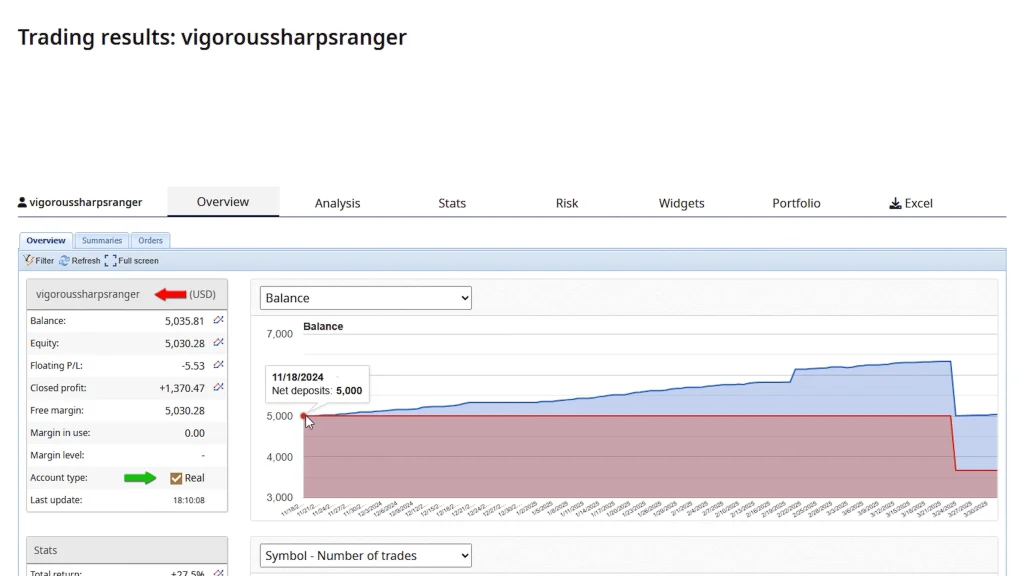
    Dark Titan’s profit factors of 2.7 and 1.25 on individual pairs indicate that, yes, the wins are outweighing the losses sufficiently. The combined 1.43 profit factor across both pairs confirms this system is net profitable after accounting for spread, slippage, and all real-world trading costs.

    Trade volume matters too. With 333 combined trades, we’re past the point where a few lucky wins can skew the statistics. This is a statistically meaningful sample. If Dark Titan had only executed 20 trades, I’d be far more cautious about drawing conclusions.

    Linear equity growth is what you want to see. Erratic, jagged equity curves suggest the EA is taking big risks or getting lucky intermittently. Smooth, steady growth indicates a system with a consistent edge that’s being exploited repeatedly.

    Settings and Configuration Approach

    I mentioned using default vendor settings, and that’s worth expanding on. Many traders immediately start tweaking parameters, trying to squeeze extra performance. Sometimes that works. Often it leads to over-optimization.

    The default settings have been tested by the developer across multiple market conditions. They’re designed to work broadly, not just on one specific historical period. When I backtest with those settings and then run them live, I’m testing the system as intended.

    If performance degrades significantly from backtest to live with default settings, that’s a red flag about the EA itself, not about my configuration choices. Conversely, if it performs well, I know the system has a genuine edge that doesn’t depend on parameter tweaking.

    Later, if I identify specific improvements through careful testing, I might adjust settings. But starting with defaults establishes a baseline.

    Broker Selection for Minor Pairs

    Trading AUD/CAD and AUD/NZD requires broker capabilities that go beyond the basics. These aren’t EUR/USD or GBP/USD; they’re minor pairs with wider spreads and sometimes lower liquidity.

    Eightcap offers the execution quality needed for this type of trading. Their spreads on minor pairs are competitive, and their servers handle high-frequency EA trading without constant requotes or rejections.

    I’ve tested other brokers where minor pair spreads made profitable EA trading nearly impossible. The theoretical edge gets consumed by trading costs. That’s why broker research matters before deploying capital.

    Where to Access Dark Titan and Additional Resources

    Dark Titan is available through the developer’s website and also through Algo Trading Space. The Algo Trading Space platform provides access to various EAs along with testing resources and trading insights. Full disclosure: we may earn a small commission if you purchase through our links, though this doesn’t affect the price you pay or the honest assessment in this review.

    For traders serious about EA testing and live results, the Algo Trading Space VIP club offers exclusive access to verified trading results, early insights on new systems, and priority support. It’s worth exploring if you’re building a portfolio of automated strategies and want ongoing performance data beyond individual reviews.

    I’ll continue tracking Dark Titan’s performance as it transitions to live trading. The FX Blue account remains public, so you can follow along with real results rather than relying solely on my analysis.

    Frequently Asked Questions

    What makes Dark Titan different from other high-frequency EAs that trade on M1 timeframes?

    Dark Titan distinguishes itself through its unusually high win rate of around 80% while maintaining solid profit factors above 1.4. Many M1 EAs sacrifice win rate for larger occasional wins, or they maintain high win rates with poor risk-reward ratios.

    Dark Titan manages to balance both frequent wins that are individually large enough to overcome the smaller losses. The seven-year backtest stability also suggests the strategy isn’t optimized for one specific market condition but adapts across various environments.
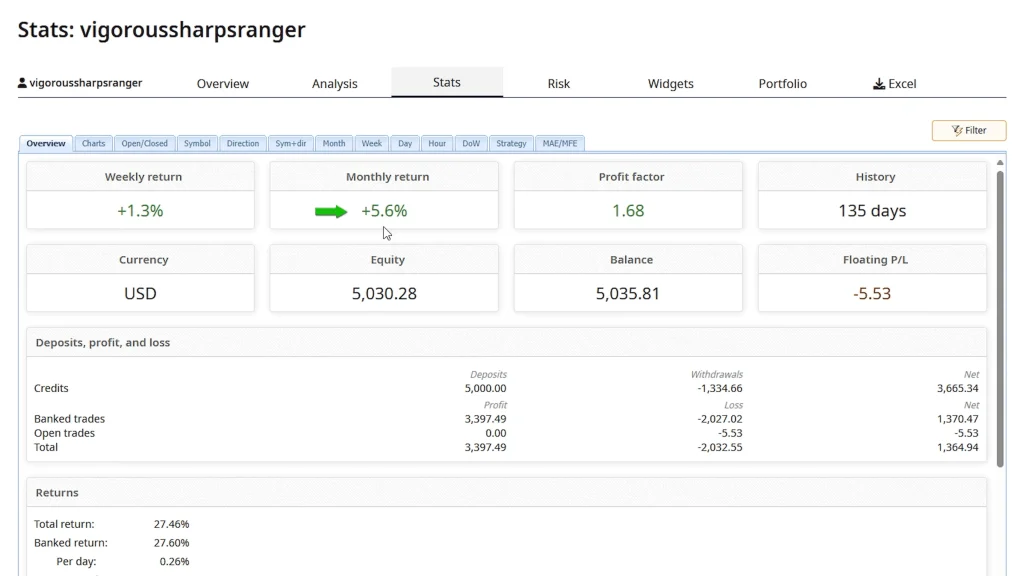
    Can I trade Dark Titan on all three pairs simultaneously, or should I start with just one or two?

    You can run all three pairs if your backtesting confirms solid performance across AUD/CAD, AUD/NZD, and NZD/CAD. However, based on my testing, I recommend starting with the two strongest performers in your own backtests rather than automatically trading all three.

    Not every pair will perform equally well with every broker’s spreads and execution. Test each independently, compare results, then decide which combinations make sense for your account size and risk tolerance.

    How much capital do I need to run Dark Titan safely without risking margin calls?

    The minimum depends on your risk settings and lot sizes, but I’d suggest starting with at least $1,000 per pair if you’re trading conservatively. If running both AUD/CAD and AUD/NZD together, a $2,000 account gives you comfortable breathing room.

    The M1 timeframe means frequent trading, so you want sufficient margin to handle multiple simultaneous positions without stress. Smaller accounts around $500 might work with very low lot sizes, but they leave little room for drawdown periods.

    Does Dark Titan require constant monitoring, or can it run completely hands-off on a VPS?

    Dark Titan operates autonomously once configured on a VPS with a stable internet connection. The M1 timeframe means it’s constantly scanning for setups, but it doesn’t need manual intervention. I check my FX Blue stats weekly to monitor overall performance trends, but daily monitoring isn’t necessary.

    The EA handles entries, exits, and trade management automatically. That said, any EA benefits from periodic oversight to ensure it’s functioning correctly and performing within expected parameters.

    What’s the typical drawdown range I should expect with Dark Titan based on your testing?

    My testing showed relatively modest drawdowns compared to many high-frequency systems. The equity curves demonstrate occasional flat periods rather than deep dips, suggesting drawdowns typically stay in the 10-15% range during normal market conditions.

    However, unexpected volatility events or news releases on AUD or NZD currencies could temporarily push drawdowns higher. The 80% win rate helps the EA recover quickly from drawdown periods, usually within days rather than weeks.

  • Testing The Dark Nova Forex Robot: Performance, Strategy & Honest Insights In 2026

    Testing The Dark Nova Forex Robot: Performance, Strategy & Honest Insights In 2026

    When a new expert advisor hits the market from a developer with a solid track record, it’s worth paying attention. Dark Nova represents the latest offering from Marco, the developer behind several popular Dark EAs, and I’ve had the chance to test it firsthand. This isn’t some theoretical analysis. I’m running Dark Nova on a live $1,000 account with IC Markets, and the early results have been promising.

    Before we go further, let me be clear about what this review covers. I’m sharing actual performance data, discussing the technical setup, and walking through what you need to know before putting real money on the line. Trading robots always carry risk, and while Dark Nova shows potential, no EA guarantees profits.

    What Makes Dark Nova Different From Other Dark EAs

    Dark Nova trades three specific currency pairs: AUD/CAD, AUD/NZD, and NZD/CAD. That’s a narrower focus than some other EAs, which I actually see as a positive. The developer has clearly optimized this robot for these specific pairs rather than trying to make it a jack-of-all-trades.

    The pricing structure offers two options: $499 for five flexible licenses or $699 for ten licenses. Those are real-money prices in USD, and honestly, they’re positioned at the premium end of the market. You’ll need to decide if the performance justifies that cost.

    Here’s something interesting: Dark Nova isn’t available on the MQL5 marketplace. You can only purchase it directly from the Dark website. Marco’s other products appear on MQL5, but this one remains exclusive to his site. Perhaps that’s intentional scarcity, or maybe it’s just a different distribution strategy.

    The robot comes with preset files included, which saved me considerable setup time. For traders in the United States, there’s a FIFO compliance option built into the settings. That’s a thoughtful touch that shows the developer understands regulatory requirements across different markets.

    Key Features at a Glance

    • Three-pair trading system (AUD/CAD, AUD/NZD, NZD/CAD)
    • Grid trading capability (can be enabled or disabled)
    • FIFO compliance option for US traders
    • Preset configuration files included
    • Exclusive availability through the Dark website

    Track Record Analysis: What the Numbers Actually Show

    Marco’s live account shows approximately 250% returns over roughly six months of trading. That’s a real account, not a demo, running on 1:500 leverage. Before you get too excited, context matters here.

    The account has experienced several drawdowns during this period. I noticed at least three visible dips in the equity curve. None were catastrophic, but they happened. This isn’t a smooth, steady climb; it’s typical EA performance with ups and downs.

    What I find more telling is the consistency of recovery. After each drawdown, the account bounced back. That resilience suggests the underlying logic handles adverse conditions reasonably well, though six months isn’t enough time to declare anything definitive.

    My Live Account Setup and Initial Results

    I placed Dark Nova on a live IC Markets account on June 11th. Starting balance: $1,000. I’m being conservative here; this is real money, and I wanted to see how the EA performs before scaling up.

    Initially, I’m only trading NZD/CAD. I plan to add the other pairs later, but starting with one pair gives me a clearer picture of performance without too many variables. Within the first day, Dark Nova executed two trades. Both were profitable, though admittedly small gains given my low risk settings.

    My lot size is set to 0.01. No money management automation for now, I prefer manual control during the testing phase. On a $1,000 account, that’s extremely conservative, but I’m prioritizing data collection over immediate profits.

    Configuration Choices I Made

    I kept most default settings from the provided preset files. The grid function is enabled, though I’ve had success disabling it on other Dark EAs (particularly Dark Gold, where turning off the grid improved results). For this test, I’m following the developer’s recommended approach first.

    Time frame is M15. Leverage is set to 1:100 for this account, which is lower than Marco’s 1:500 setup. I’m comfortable with that difference; higher leverage amplifies both gains and losses, and I’d rather err on the side of caution.

    Latency settings in my backtest were set to 10 milliseconds. That’s realistic for IC Markets’ execution speeds through the Equinix data center.

    Backtest Results: 18 Months of Historical Data

    I ran a complete backtest covering from the start of last year through June 11th, roughly 18 months of data. Testing was done on NZD/CAD with the exact settings I’m using live.

    The results:

    MetricValue
    Total Net Profit31%
    Testing Period18 months
    Average Monthly Return2.5-3%
    Maximum Drawdown11.8%
    Account Size$1,000
    Leverage1:100

    That drawdown figure is what really caught my attention. Just under 12% is manageable. I typically draw my line at 20%, so this gives me comfortable breathing room. The monthly returns are modest but steady, exactly the kind of performance I look for when evaluating long-term viability.

    The equity curve showed gradual growth with occasional small pullbacks. Each time, the EA recovered and continued upward. That pattern aligns with Marco’s live account performance, which builds my confidence in the backtest accuracy.

    Could Performance Be Better?

    Probably. I think there’s room to optimize settings for higher returns. If I adjusted risk parameters, I could likely push monthly gains above 3%. The trade-off would be a higher drawdown, maybe 15-17%, but that’s still within my acceptable range.

    For now, though, I’m leaving settings as they are. The current configuration produces results I’m happy with, and changing variables mid-test would muddy the data.

    Why Broker Selection Matters for Dark Nova

    Trading minor currency pairs like NZD/CAD requires specific broker capabilities. Not all brokers offer tight spreads on these pairs, and execution quality varies significantly.

    I chose IC Markets for several reasons. They’re one of the largest brokers globally, processing roughly 500,000 trades daily. Their servers are located in the Equinix data center, which matters for algorithmic trading where milliseconds count.

    Here’s what stood out: approximately 60% of IC Markets’ trading volume comes from algorithmic traders. That tells me their infrastructure is built to handle automated systems effectively. Spreads start from zero pips on major pairs, and they offer institutional-grade execution.

    IC Markets Platform Options

    • MetaTrader 4 and 5 (desktop, web, mobile)
    • cTrader with multiple account types
    • TradingView integration for manual traders
    • Leverage up to 1:1000 (location-dependent)
    • Full range of instruments: forex, commodities, indices, bonds, cryptocurrencies, stocks, futures

    The platform diversity is helpful. While I’m using MT4 for Dark Nova, having options means I can test across different environments if needed.

    Grid Trading: Enabled or Disabled?

    Dark Nova includes grid functionality that can be toggled on or off. Grid strategies work by placing multiple orders at set intervals, which can amplify profits during trending markets but increase exposure during ranging conditions.

    I’ve had positive experiences disabling the grid on Dark Gold EA. That configuration produced cleaner results with lower drawdown. However, for this Dark Nova test, I’m keeping the grid enabled to match the developer’s intended design.

    Grid trading isn’t inherently good or bad; it depends on market conditions and risk tolerance. The advantage of Dark Nova is flexibility. If grid-enabled performance doesn’t meet expectations, I can disable it and retest without changing anything else.

    Real-Time Performance Tracking

    I’m tracking this test through an FX Blue account that’s publicly accessible. You can verify every trade, every profit, every loss. That transparency matters, especially with YMYL content, where people are making financial decisions based on information they read.

    My experience with Marco’s other EAs (Dark Algo, Dark Rear, Dark Moon) has been generally positive. That history influences my willingness to test Dark Nova with real money rather than starting with demo accounts. But past performance, whether mine or the developer’s, doesn’t predict future results.

    I’ve been reviewing trading robots and sharing set files for other Dark EAs for my audience. This review follows the same methodology: real money, real broker, real results shared publicly.

    What I’m Monitoring Going Forward

    • Weekly equity curve progression
    • Drawdown depth and recovery time
    • Win rate and average trade duration
    • Performance across all three pairs once I expand beyond NZD/CAD
    • Correlation between backtest projections and live results

    Potential Concerns and Realistic Expectations

    Let’s address some obvious questions. Six months of developer track records isn’t a long-term proof of concept. Markets change, and what worked in the first half of the year might struggle in the second half.

    The pricing is high compared to many EAs on MQL5. You’re paying for exclusivity and presumably for the developer’s reputation, but $499-$699 is real money that needs to be justified through performance.

    Grid trading, even when optimized, can lead to larger drawdowns during unexpected market volatility. The 11.8% drawdown in backtests might increase under different conditions.

    I’m also only testing on one pair so far. While my early results are positive, NZD/CAD might perform differently from AUD/CAD or AUD/NZD. A comprehensive evaluation requires testing all three pairs simultaneously.

    Should You Consider Dark Nova?

    If you’re already using other Dark EAs successfully, Dark Nova fits naturally into that ecosystem. The developer’s approach remains consistent across products, so there’s familiarity in how it operates.

    For traders new to Marco’s work, I’d suggest starting with one of the free Dark EAs to get a feel for the development style before investing $499-$699. Dark Venus, for instance, gives you a no-cost entry point to evaluate the methodology.

    Risk tolerance is personal. My 11.8% drawdown ceiling won’t match everyone’s comfort level. Some traders accept 25-30% drawdowns; others get nervous above 5%. Know where you stand before activating any EA.

    The three-pair limitation means Dark Nova won’t diversify your portfolio as broadly as some multi-pair systems. That’s not necessarily negative; focused optimization often beats scattered generalization, but it’s a structural consideration.

    Where to Access Dark Nova and Additional Resources

    Dark Nova is available exclusively through the Dark website. Algo Trading Space provides access to the EA along with additional trading insights and tools. Full disclosure: we may earn a small commission if you purchase through our links, though this doesn’t affect the price you pay or the honest assessment in this review.

    If you’re serious about algorithmic trading, consider checking out the Algo Trading Space VIP club. Members get exclusive access to trading results, early insights into new developments, and priority support. It’s worth exploring if you’re building a portfolio of automated trading systems.

    I’ll continue updating my FX Blue tracking account as Dark Nova accumulates more live trading data. That ongoing transparency gives you real-world performance beyond this initial review.

    Frequently Asked Questions

    What currency pairs does Dark Nova EA trade, and can I add more pairs to the system?

    Dark Nova trades three specific pairs: AUD/CAD, AUD/NZD, and NZD/CAD. These aren’t customizable; the EA is optimized specifically for these minor currency pairs. The developer designed the system around these pairs’ characteristics, so adding others isn’t recommended and likely wouldn’t perform as intended.

    If you need broader currency exposure, you’d want to combine Dark Nova with other EAs rather than modifying its core pairs.

    How does Dark Nova’s grid trading feature work, and should I keep it enabled?

    The grid feature places multiple orders at predetermined intervals, creating a grid of positions that can profit from both trending and ranging markets. It’s enabled by default in the preset files.

    Testing with grid disabled on other Dark EAs has sometimes produced better results with lower drawdown, but for Dark Nova, the developer’s optimization assumes grid functionality. I recommend starting with it enabled as designed, then experimenting with disabling it only after collecting substantial live data with default settings.

    While Dark Nova can technically run on accounts as small as $500, I started with $1,000 for conservative risk management. Given the 11.8% maximum drawdown seen in backtests, you’d want enough capital to withstand potential equity dips without hitting margin calls.

    For comfort and sustainability, I’d suggest $1,000 minimum if trading one pair, and $2,000-$3,000 if you plan to trade all three pairs simultaneously with reasonable lot sizes.

    Is Dark Nova suitable for beginners, or does it require advanced trading knowledge?

    Dark Nova is relatively beginner-friendly since it comes with preset configuration files that handle most technical decisions. You don’t need deep forex knowledge to activate the EA and let it run. However, you should understand basic concepts like lot sizing, leverage, drawdown, and risk management before putting real money at stake.

    The EA automates execution, but you’re still responsible for monitoring performance and making strategic decisions about when to continue, pause, or adjust the system.

    How does Dark Nova compare to other EAs from the same developer, like Dark Algo or Dark Moon?

    Dark Nova focuses on a smaller set of minor currency pairs compared to some other Dark EAs, which suggests more specialized optimization. The grid functionality is present in several Dark products, so the core methodology feels familiar if you’ve used them before.

    Based on my testing across multiple Dark EAs, each seems designed for specific market conditions. Dark Nova appears targeted at minor pair traders willing to accept moderate drawdowns for steady monthly returns. Performance varies by product and market environment, so direct comparisons are difficult without running them all simultaneously.

  • Prime Scalper EA Tested In Live Markets: Scalping Execution And Observed Trade Behaviour

    Prime Scalper EA Tested In Live Markets: Scalping Execution And Observed Trade Behaviour

    For just $99, I found a scalping EA that’s actually making profits on a $200 account. That sentence alone probably triggers skepticism; I know it did for me. Budget-priced EAs often mean budget-quality results, and scalping systems working profitably on small accounts? Even rarer.

    But here’s what caught my attention about Prime Scalper EA: it doesn’t use any of those dangerous martingale or grid strategies that eventually blow up accounts. Instead, it uses proper stop losses, holds positions for mere seconds (literally 10-42 seconds in most cases), and has generated approximately 2% profit in just a couple of weeks on my $200 live account with IC Markets.

    Is 2% in two weeks earth-shattering? No. But when you consider this is a $200 account, small enough that most serious traders wouldn’t bother with it, and the EA achieved this with minimal drawdown while trading multiple currency pairs, including gold, it becomes interesting.

    I’ve been testing Prime Scalper EA across both demo and live environments, analyzing its performance through detailed spreadsheet breakdowns, backtesting different configurations, and monitoring how it behaves under real market conditions with actual slippage and spreads. The results have been encouraging enough that I’m expanding my testing to additional currency pairs.

    This review will show you the actual live account performance, explain how this ultra-fast scalping strategy operates, break down the extensive demo testing I conducted, discuss why broker selection is absolutely critical for this EA, and help you assess whether Prime Scalper EA deserves a spot in your automated trading portfolio.

    Live Account Performance: $200 Real Money Test

    Let me start with what matters most, real money results on a live account where every pip of slippage, every cent of spread, and every millisecond of execution delay impacts profitability.

    The Setup

    I opened a $200 account with IC Markets specifically for testing Prime Scalper EA. Why IC Markets? Because scalping systems have extremely strict requirements for trading conditions, IC Markets provides:

    • Very tight spreads (critical for second-long trades)
    • Fast execution speeds (essential when holding 10-42 seconds)
    • Raw Spread account type (ideal for high-frequency strategies)
    • Low-latency connection to their servers

    Three Weeks of Results

    The account started at the beginning of October, and after just a couple of weeks of trading, here’s what happened:

    • Gross profit: $4.51 
    • After commissions: $3.79 net profit 
    • Return percentage: Approximately 2% 
    • Testing duration: 20 trading days

    Now, $3.79 doesn’t sound impressive in absolute terms. But on a $200 starting balance, that’s nearly 2% return in less than three weeks. Annualized (though I’m cautious about such extrapolations), that pace would represent substantial returns.

    The FX Blue Statistics

    Looking at the transparent FX Blue tracking, the account shows:

    • Average monthly return: 3.3% at current pace
    • Profit factor: 1.58
    • Initial drawdown: The account started with small losses before recovering

    That profit factor of 1.58 means that for every dollar lost, the EA made $1.58 in profits. It’s not spectacular (above 2.0 is excellent), but it’s solidly profitable, and importantly, it’s achieved with real broker conditions, not idealized backtest assumptions.

    The Balance Line Story

    The FX Blue balance chart tells an honest story. The account started in early October, experienced some initial losses (which is normal, no strategy wins continuously from day one), then recovered and moved into profit territory.

    This drawdown-then-recovery pattern actually increases my confidence rather than decreasing it. Systems that show perfectly smooth equity curves from day one often either got lucky with timing or are hiding something. Real trading involves losses, recoveries, and gradual accumulation over time.

    Testing Summary: Key Metrics

    Account TypeCapitalDurationProfitReturnMonthly PaceStatus
    Live (IC Markets)$2002-3 weeks$3.79~2%3.3%Active
    Demo (Multi-EA)$100,0006-7 weeks$27,00027%Higher (aggressive settings)Ongoing
    Vendor Backtest$5,0007-8 yearsSubstantialN/A2.4% max drawdownHistorical

    How Prime Scalper EA Actually Trades

    After analyzing the trade history and watching the EA operate on my VPS, I can explain exactly how this ultra-fast scalping approach works.

    Extreme Short Hold Times

    Looking at the MetaTrader terminal history, the trade durations are remarkable:

    • First trade: Opened and closed 42 seconds later
    • Second trade: Opened and closed just 10 seconds later
    • Typical pattern: Most trades resolve within seconds, rarely lasting even a couple of minutes

    This is true scalping in its purest form. The EA isn’t trying to capture entire market moves or ride trends; it’s grabbing tiny price inefficiencies that exist for literal seconds before market conditions normalize.

    Stop Loss Protection (No Martingale)

    Every single trade includes a stop loss from the moment it opens. This is critically important and differentiates Prime Scalper EA from dangerous systems that average down without protection.

    When I examine the trade history, I can see losing trades clearly marked. The EA doesn’t double position sizes after losses, doesn’t add multiple positions hoping for recovery, and doesn’t use grid systems. Each trade stands on its own with a defined maximum risk.

    This approach means slower recovery from drawdown periods, but it also means the account won’t catastrophically fail during adverse market conditions.

    Trailing Stop Functionality

    The EA implements trailing stops that adjust dynamically as trades move into profit. If market conditions become unfavorable, the trailing stop protects accumulated gains or reduces potential losses.
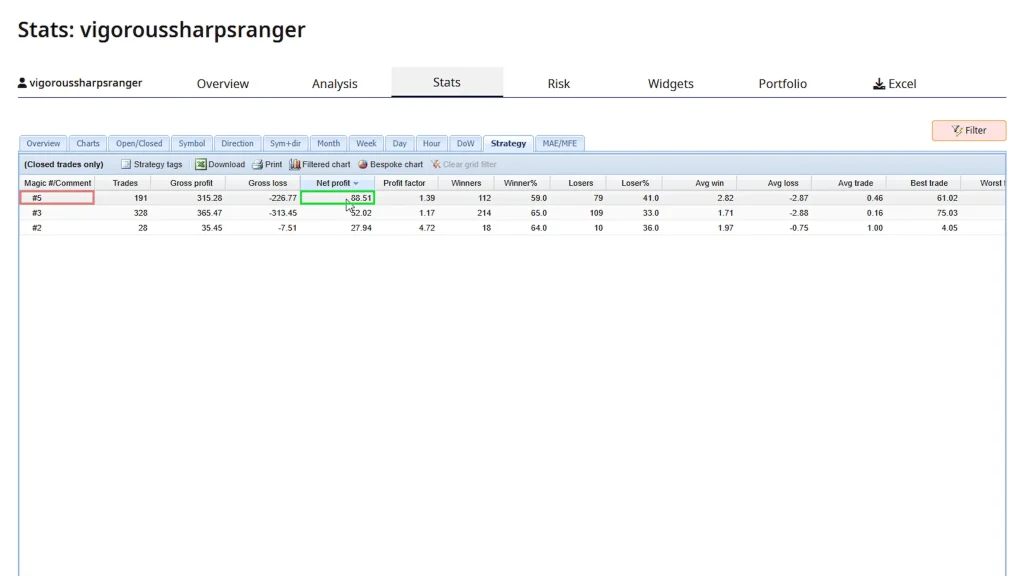
    Looking at closed trades, some show profits smaller than the initial take profit target, suggesting the trailing stop locked in gains when the price reversed before hitting the full target. This protective mechanism helps preserve capital during choppy or reversing market conditions.

    News Filter Integration

    Prime Scalper EA includes a built-in news filter that allows it to avoid trading during high-impact economic releases. Scalping during major news events is incredibly risky, spreads widen dramatically, slippage increases, and price movements become erratic.

    The news filter automatically pauses trading around scheduled events, resuming only when market conditions normalize. This reduces exposure to the exact scenarios where scalping strategies typically fail.

    Live Account Trade Analysis

    Trade MetricValueSignificance
    Account Size$200Small account testing
    Net Profit$3.79After commissions
    Gross Profit$4.51Before costs
    Return~2%In 2-3 weeks
    Trading Days20Active trading period
    Average Monthly3.3%Projected at the current pace
    Profit Factor1.58Solidly profitable
    BrokerIC MarketsRaw Spread account
    Primary AssetXAU/USD (Gold)Also, forex pairsare  available

    Demo Account Testing: Months of Validation

    Before committing real money to Prime Scalper EA, I conducted extensive demo testing, which is exactly what I recommend everyone do with any new EA.

    I created a large $100,000 demo account and placed multiple EAs from MeAlgo (Prime Scalper’s developer) on it simultaneously. This allows me to test different systems, compare their performance, and identify which strategies and assets work best.

    On this demo account, Prime Scalper EA has been running since the end of August, giving us approximately 6-7 weeks of forward testing data before I moved to live.

    Performance Isolation Through Data Analysis

    With multiple EAs running on one account, how do I isolate Prime Scalper’s specific performance? Through spreadsheet analysis.

    I download the complete trade history from FX Blue as a CSV file, import it into Google Sheets, and use pivot tables to filter and analyze data by:

    • EA name (order comment field)
    • Currency pair (symbol)
    • Trade type
    • Net profit per combination

    This analytical approach lets me see exactly which EA is profitable on which assets, even when they’re all trading simultaneously on the same account.

    The Gold Version Performance

    After filtering the data to show only Prime Scalper EA trades on gold (XAU/USD), the results are striking:

    • Demo period: End of August to October 13th 
    • Net profit: $27,000 
    • Account size: $100,000 
    • Return: 27%

    Now, the demo is trading with larger position sizes than my live account (higher risk settings), which explains the more aggressive returns. But even accounting for that, the performance over 6-7 weeks is impressive, and importantly, it’s forward testing, not optimized backtest results.

    Why I Chose Gold for Live Testing

    The spreadsheet analysis clearly showed gold as the standout asset for Prime Scalper EA. While the forex versions (trading EUR/USD, GBP/USD, etc.) were also profitable, gold delivered superior risk-adjusted returns with the demo settings I tested.

    That’s why when I moved to live trading with a small $200 account, I configured Prime Scalper specifically for XAU/USD rather than spreading across multiple pairs on such limited capital.

    Backtest Validation: 7-8 Years of Historical Data

    Demo testing and live results are critical, but backtests provide additional historical context. Here’s what the backtesting revealed.

    The Vendor’s Backtest

    MeAlgo provides a vendor backtest showing Prime Scalper EA’s performance over 7-8 years of historical data. What initially attracted me wasn’t the impressive balance curve; it was the remarkably low equity drawdown.

    • Maximum equity drawdown: 2.4% 
    • Testing period: 7-8 years 
    • Starting capital: $5,000

    A 2.4% maximum drawdown over nearly a decade is exceptional. Most profitable systems experience 10-20% drawdowns periodically. This low drawdown characteristic makes Prime Scalper particularly suitable for prop firm challenges where strict drawdown limits apply.

    My Custom Backtest

    I took the vendor’s settings and ran my own backtest on a $200 account (matching my live testing conditions) over the last five years.

    The results showed:

    • Stable performance across the entire 5-year period
    • Very active trading (high trade frequency)
    • Consistent returns without catastrophic drawdown periods
    • Balance curve steadily ascending without massive volatility spikes

    The backtest confirmed what the vendor showed, this strategy has demonstrated robustness across different market conditions spanning multiple years.

    Backtest Caveats

    Of course, backtests never perfectly predict live performance. They don’t account for:

    • Real broker slippage
    • Actual spread variations during news events
    • VPS latency issues
    • Order rejection scenarios
    • Liquidity constraints at certain price levels

    That’s why I never rely on backtests alone. The combination of backtest validation, extended demo testing, and live account confirmation provides much stronger evidence than any single testing method.

    Broker Requirements: Why IC Markets?

    Prime Scalper EA has extremely strict infrastructure requirements. Using the wrong broker will turn a profitable system into a losing one, and I’m not exaggerating.

    The Spread Requirement

    According to the vendor’s recommendations, Prime Scalper needs spreads below 5 points (pips) on EUR/USD. For gold, similarly tight spreads are essential.

    When trades last 10-42 seconds, every fraction of a pip in spread matters. If Broker A has 3-pip spreads and Broker B has 8-pip spreads, that 5-pip difference must be overcome on every single trade before you even start profiting.

    Multiply that across hundreds or thousands of trades, and spread differences alone can mean the difference between profitable and unprofitable performance.

    IC Markets Trading Conditions

    I chose IC Markets specifically because:

    • Raw Spread Account: This account type offers some of the tightest spreads in the retail forex industry. You pay a small commission per trade, but the spread savings more than compensate.
    • Fast Execution: IC Markets routes orders quickly with minimal delay between when the EA sends the order and when it fills. For strategies holding positions for mere seconds, execution speed directly impacts profitability.
    • VPS Availability: IC Markets offers VPS services under certain conditions, which solves the latency issue. Running Prime Scalper EA from your home computer on another continent from the broker’s servers would add unacceptable latency.
    • Regulatory Compliance: IC Markets is properly regulated, which provides security for client funds and ensures operational standards.

    The Latency Factor

    VPS latency, the time delay between your trading server and the broker’s order matching engine, is crucial for scalping systems. Prime Scalper’s vendor explicitly states that low latency is essential.

    I’m running the EA on a VPS located physically close to IC Markets’ servers, minimizing latency to just a few milliseconds. Running it from a home computer or distant VPS would add 50-200+ milliseconds of delay, which could prevent trades from executing at intended prices.

    MeAlgo: The Developer Behind Prime Scalper

    Understanding who develops an EA provides important context for evaluating its quality and ongoing support.

    Company Background

    Prime Scalper EA is developed by MeAlgo LLC, a company with over 14 years of experience in algorithmic trading and MetaTrader development. That’s substantial tenure in an industry where many vendors disappear after a few years.

    Product Ecosystem

    MeAlgo doesn’t just sell one EA, they maintain an entire ecosystem of trading tools:

    • Scalping Robots: Prime Scalper, Asian Scalper, and others 
    • General Trading Robots: Various strategy approaches 
    • Copy Trading Tools: Software for copying trades between platforms 
    • Zone Recovery EA: One of their best-selling products 
    • Trade Copiers: MetaTrader to DXTrade, cTrader, and other platforms

    The Lifetime Membership Offer

    What particularly interested me was MeAlgo’s lifetime access deal. For a one-time payment, you get:

    • Access to all current products
    • All future product releases
    • Lifetime updates to existing tools
    • No recurring subscription fees

    This model provides significant value if you’re planning to test multiple EAs or need trade copying capabilities for prop firm accounts. The lifetime membership cost is higher upfront but eliminates ongoing fees.

    Asian Scalper: Worth Watching

    While reviewing Prime Scalper, I noticed another MeAlgo EA, Asian Scalper, also showing strong performance in my demo testing. I haven’t fully evaluated it yet, but the preliminary results suggest it’s worth dedicated testing in the future.

    This pattern of multiple profitable EAs from the same developer increases confidence in their overall development methodology and testing processes.

    Settings Complexity: Powerful But Overwhelming

    Prime Scalper EA offers extensive customization options, which is both a strength and a challenge.

    The Configuration Options

    Looking at the expert advisor properties, you’ll find settings for:

    • Position sizing (fixed lots or balance-based)
    • Time configuration (specific trading hours)
    • Day selection (which days to trade)
    • News filter parameters
    • Stop loss and take profit rules
    • Trailing stop behavior
    • Risk management controls
    • Multiple strategy variations

    For experienced traders, this flexibility allows fine-tuning the EA to specific market conditions, broker characteristics, and risk preferences.

    The Beginner’s Dilemma

    For newer traders, the sheer volume of settings can be overwhelming. Which parameters should you adjust? How do different settings interact? What values are safe versus dangerous?

    This is where vendor-provided set files become valuable. MeAlgo provides multiple configuration files for different assets and risk levels on its website, giving you tested starting points rather than forcing you to optimize from scratch.

    My Live Account Configuration

    On my $200 live account, I made a specific configuration choice. The default setting bases lot sizing on balance (0.01 lots per $100 of balance), which would mean 0.02 lots on my account.

    Instead, I configured it for fixed lot sizing at 0.01 lots. Why? Because on a small $200 account trading gold, I wanted to control risk tightly while the EA proves itself. As the account grows, I can adjust position sizing accordingly.

    Configuration Comparison: Demo vs. Live

    SettingDemo AccountLive AccountReasoning
    Account Size$100,000$200Testing at different scales
    Lot SizingBalance-based (higher risk)Fixed 0.01 lotsConservative on small capital
    Primary AssetGold (XAU/USD)Gold (XAU/USD)Demo showed the best performance
    Risk LevelAggressiveConservativeProving strategy before scaling
    BrokerDemo environmentIC Markets Raw SpreadReal conditions matter
    Testing Duration6-7 weeks2-3 weeksDemo longer for validation

    Pros and Cons Assessment

    After several weeks of testing across demo and live environments, here’s my honest evaluation.

    What Works Well

    • Affordable entry point: At $99, Prime Scalper EA is accessible even for traders with limited budgets. Compare that to EAs costing $300-$1,000, and the value proposition becomes clear.
    • Multiple asset capability: The EA can trade several forex pairs (EUR/USD, GBP/USD, others) and gold. This versatility means you’re not locked into a single market.
    • No martingale or grid: Every trade uses proper stop losses. There’s no dangerous position averaging or sizing escalation that characterizes account-destroying systems.

    • Low drawdown characteristics: The vendor backtest shows 2.4% maximum drawdown over 7-8 years, and my testing confirms controlled drawdown behavior.
    • Built-in news filter: Automatically avoiding volatile news periods reduces exposure to scenarios where scalping typically fails.
    • Lifetime membership option: If you buy into MeAlgo’s ecosystem, you get access to all its tools permanently, which provides ongoing value.
    • Works on small accounts: Unlike many EAs requiring $5,000-$10,000 minimum, Prime Scalper functions on accounts as small as $200 (though $500-$1,000 is more comfortable).

    The Challenges

    • Infrastructure demands: This is perhaps the biggest limitation. Prime Scalper absolutely requires tight spreads and low latency. Using the wrong broker or an inadequate VPS will sabotage performance completely.
    • Configuration complexity: The extensive settings offer power but create confusion. Beginners will struggle to optimize without guidance or access to tested set files.
    • Trade hold times create execution risk: Holding positions for only 10-42 seconds means any slippage, delay, or spread widening has an outsized impact on profitability.
    • Limited testing duration: My live account has only three weeks of data. While encouraging, this isn’t enough to declare long-term viability across all market conditions.
    • Scalping scrutiny: Some brokers don’t allow true scalping or penalize accounts that use such strategies. Verify your broker’s policies before deploying this EA.

    Frequently Asked Questions

    Can Prime Scalper EA really work on a $200 account long-term?

    Yes, Prime Scalper EA technically functions on $200 accounts as demonstrated by my live testing, but I’d recommend $500-$1,000 for more comfortable operation. The $200 account uses fixed 0.01 lot sizing, which limits absolute profit potential even when percentage returns are good. Larger accounts allow proper balance-based position sizing that scales as the account grows.

    The primary constraint isn’t the EA’s capability but rather that broker commissions and spreads consume a larger percentage of profits on tiny accounts. Additionally, a $200 account provides almost no buffer for drawdown periods; one or two bad trading days could significantly impact the account. For serious long-term trading, start with at least $500 to give the strategy adequate breathing room.

    Why does broker selection matter so much for Prime Scalper EA?

    Prime Scalper EA holds positions for literally 10-42 seconds on average, making it an ultra-fast scalping system. When trades resolve this quickly, every pip of spread and millisecond of execution delay directly impacts profitability. If Broker A has 3-pip gold spreads and Broker B has 8-pip spreads, that 5-pip difference must be overcome before profit begins; multiply that across thousands of trades, and it determines success versus failure.

    Additionally, execution speed matters enormously; even 100-200 milliseconds of delay can mean orders fill at worse prices than intended. IC Markets provides the tight spreads and fast execution essential for Prime Scalper’s strategy. Using inferior broker conditions will turn this profitable EA into a losing one despite identical settings and strategy.

    Is Prime Scalper EA suitable for prop firm challenge accounts?

    Prime Scalper EA has characteristics that work well for prop challenges: low drawdown (vendor backtest shows 2.4% maximum over 7-8 years), stop-loss protection on every trade, and no dangerous martingale/grid strategies. However, there’s a critical consideration, some prop firms prohibit or restrict true scalping strategies, particularly those holding positions under one minute.

    Before deploying Prime Scalper on any challenge, carefully read the prop firm’s terms regarding scalping, execution frequency, and holding times. Additionally, verify the challenge platform uses broker infrastructure with spreads tight enough for scalping profitability. My testing shows good performance on demo, but challenge/funded account infrastructure may differ from retail broker conditions, potentially impacting results.

    How complex is Prime Scalper EA to set up for beginners?

    Prime Scalper EA is moderately complex due to extensive configuration options covering position sizing, time filters, news avoidance, stop-loss behavior, trailing stops, and multiple strategy variations. Beginners will likely feel overwhelmed choosing appropriate settings without guidance. However, MeAlgo provides vendor-supplied set files for different assets and risk levels on their website, offering tested starting configurations.

    My recommendation: start with vendor set files exactly as provided, run on demo for 4-6 weeks, monitor results through FX Blue tracking, then only adjust settings if you understand what each parameter controls. Don’t attempt optimization without understanding the strategy. Consider joining educational communities or VIP groups where experienced traders share working configurations and settings based on actual testing.

    What VPS specifications does Prime Scalper EA require?

    Prime Scalper EA requires a VPS with very low latency to your broker’s servers, ideally under 5-10 milliseconds. This typically means choosing VPS hosting geographically near your broker’s data centers. For IC Markets, that’s servers in New York or London, depending on account type.

    Standard residential internet from your home adds 50-200+ milliseconds of latency, which is unacceptable for strategies holding positions 10-42 seconds. VPS costs typically run $15-30 monthly from providers like ForexVPS, BeeksFX, or directly from brokers.

    Some brokers, including IC Markets, offer free VPS under certain conditions (account size, monthly trading volume). The VPS investment is mandatory, not optional; attempting to run Prime Scalper from home internet will sabotage performance through delayed order execution and missed price levels.

    Does the $99 price include updates and support?

    The $99 price provides the Prime Scalper EA license with standard updates and support from MeAlgo. However, if you want access to their entire product ecosystem (all current and future EAs, trade copiers, and tools), consider the lifetime membership program instead. Lifetime membership costs more upfront but eliminates recurring fees while providing access to all MeAlgo products permanently.

    This becomes valuable if you plan to test multiple EAs, need trade copying functionality for prop firms, or want to experiment with different strategies across various markets. Standard $99 purchase is fine for traders focused solely on Prime Scalper; lifetime membership suits those building diversified automated trading portfolios. Both options include technical support and bug fixes.

    Where to Learn More

    If you’re interested in exploring Prime Scalper EA further or want to see current pricing and the lifetime membership options, I’ve compiled resources on Algo Trading Space.

    Find everything here: algotradingspace.com/robots/commodities/prime-scalper-ea

    The page includes links to MeAlgo’s official website, where you can purchase Prime Scalper EA, information about the lifetime access program, and access to my ongoing transparent tracking so you can monitor continued performance.

    Full transparency: purchases through that page provide a commission supporting ongoing independent testing and honest reporting. But whether you buy through my link or directly, please test extensively on the demo first, and critically, verify your broker can support true scalping strategies before committing real capital.

    I’ll continue running Prime Scalper EA on my live account, expanding testing to additional currency pairs, and updating results publicly so you can see exactly how it performs over the coming months as we gather more data.

    For traders interested in deeper insights, Algo Trading Space offers a VIP Club that provides exclusive access to our complete trading results dashboard, priority support, and early intelligence on high-performing EAs before they become public knowledge. Members also get downloadable set files, access to our private Discord community, and our full course library. 

    Testing Transparency Statement

    This review reflects approximately 2-3 weeks of live testing on a $200 IC Markets account ($3.79 profit, ~2% return) and 6-7 weeks of demo testing on a $100,000 multi-EA account ($27,000 profit from Prime Scalper gold version only). All performance is tracked transparently via FX Blue. Testing duration is relatively short; long-term viability requires extended validation. Prime Scalper EA is an ultra-fast scalping system with extreme infrastructure sensitivity; broker spread/execution conditions dramatically impact results. 

    The EA uses stop losses on every trade with no martingale/grid strategies, providing a controlled risk profile. Vendor backtest shows 2.4% maximum drawdown over 7-8 years, supporting low-risk characteristics. Configuration complexity may overwhelm beginners despite powerful customization options. Always conduct extensive demo testing with your specific broker/VPS setup before live trading.

    Past performance never guarantees future results. Scalping strategies face execution risks that can transform profitable backtests into unprofitable live trading if the infrastructure is inadequate.

  • Forex Gold Investor Tested On Gold Markets: Strategy Execution And Observed Results

    Forex Gold Investor Tested On Gold Markets: Strategy Execution And Observed Results

    When I first heard about Forex Gold Investor EA and its claim of achieving 1% daily returns, my immediate reaction was skepticism. Not dismissal, but healthy doubt. After all, 1% per day compounds to roughly 30% monthly, which sounds modest until you realize that’s 360% annually if performance holds steady.

    For context, I consider any robot capable of delivering 6% monthly to be excellent. Why? Because 6% per month doubles your account in a year through compounding. So if Forex Gold Investor can genuinely achieve even half of that “1% daily” marketing claim, it would still be a standout performer.

    Rather than trusting vendor claims or impressive-looking track records on their website, I decided to test this EA myself across three different account types: a $500 live account with Eightcap, a $15,000 challenge account, and a funded Darwinex account. Each platform has different trading conditions, spreads, and execution characteristics, which provide a realistic picture of how this robot performs under varying circumstances.

    After nearly a month of testing, here’s what I found: the live account generated $154.77 profit on that $500 starting balance, about 31% return. That’s nowhere near 1% daily, but it’s still impressive for less than 30 days. The challenge and funded accounts showed more modest results, which tells you something important about how broker conditions impact performance.

    This review will show you the actual results from all three accounts, explain how the EA’s dual-strategy system works, discuss why spread and execution speed matter enormously for this scalping-style robot, and help you determine whether it’s suitable for your trading objectives.

    What Is Forex Gold Investor EA?

    Forex Gold Investor is a product from FX Automater, a vendor that specializes in automated trading systems. When you visit their website and click through to the Forex Gold Investor page, it opens in a separate domain with its own branding and sales materials.

    The Prop Firm Angle

    One of the first things you’ll notice on the sales page is the emphasis on prop firm suitability. The EA is specifically marketed as appropriate for challenge accounts and funded trading programs, which immediately tells you something about its risk profile and drawdown characteristics.

    Looking at the available settings, you can see features designed specifically for prop firm requirements:

    • Drawdown protection: Configurable maximum drawdown limits
    • Max daily loss: Set your maximum acceptable daily loss
    • Max daily drawdown: Define how much equity can drop in a single day

    These controls are essential for prop trading, where exceeding drawdown limits means instant account termination and loss of your evaluation fees or funding. The fact that Forex Gold Investor includes these features suggests the developer understands the prop firm environment.

    Vendor Track Record Claims

    The vendor displays a track record showing nearly 192% gain on one account. As you might expect, I don’t automatically trust vendor-provided track records. They could be cherry-picked from dozens of accounts, heavily optimized to show the best possible historical performance, or run with risk settings that aren’t sustainable long-term.

    That’s precisely why I test EAs myself with my own capital, on my own accounts, with full public transparency. Vendor claims provide a starting point for investigation, not evidence of expected performance.

    Purchase Considerations

    Something important before we go further: if you decide to purchase the Forex Gold Investor EA, always buy from the official FX Automater website. I’ll provide the link at the end of this review.

    Be extremely careful with cracked or pirated versions. Beyond the ethical issues, cracked EAs often contain modified code that could:

    • Send your account credentials to third parties
    • Execute unauthorized trades
    • Simply does not work as intended
    • Lacks proper updates and support

    The small savings from a cracked version aren’t worth the risk of account compromise or poor performance from tampered code.

    Live Account Testing: $500 to $654 in Less Than a Month

    Let me walk you through my primary testing account, a $500 live account with Eightcap, where I’ve been running Forex Gold Investor since early December.

    Starting Point and Timeline

    I opened this account on December 2nd with an initial deposit of $500.91. At the time I recorded my detailed review, the account had been running for less than one month, which means we’re looking at approximately 3-4 weeks of real trading data.

    The Profit Numbers

    Looking at the account history in MetaTrader, the closed trades show:

    • Gross profit: $162.80
    • After costs (spreads, commissions): $154.77
    • Return percentage: Approximately 31% on the starting balance

    That $154.77 might not sound like a fortune in absolute terms, but it represents massive percentage gains in less than a month. If I could sustain even half that pace over a year, the compounding would be extraordinary.

    Trade Distribution and Win Rate

    Scrolling through the account history, you’ll notice there are losing trades mixed in with the winners. This isn’t a 100% win rate system; it takes losses, which is actually more realistic than EAs claiming perfect track records.

    The key is that wins outpace losses significantly enough that overall profitability remains strong. Looking at individual trades, some closed at small losses while others captured decent profits, creating positive net results.

    FX Blue Tracking for Transparency

    Examining raw MetaTrader history makes it difficult to properly assess performance characteristics, so I connect all my testing accounts to FX Blue for transparent public tracking.

    The FX Blue chart for this account shows:

    • Initial period with some stagnation (consolidation phase)
    • More pronounced profits are emerging in late December
    • Balance line showing a steady upward trajectory

    Switching from balance view to equity view reveals something important: the equity line stays relatively close to the balance line throughout. There are no massive gaps indicating huge floating losses being held for extended periods.

    This behavior confirms what the vendor claims: Forex Gold Investor is not a martingale EA. It’s not averaging down with doubled position sizes, trying to force recovery from losing trades.

    Three-Account Performance Comparison

    Account TypeBrokerStarting BalanceStart DateProfitReturnMonthly ReturnProfit Factor
    Live AccountEightcap$500Dec 2$154.77~31%14.3% (from Dec 12)1.69
    ChallengeNot specified$15,000Dec 13$140~0.93%1.4%1.27
    Funded (Darwinex)Darwinex~€100,000Dec 12~$2,000~2%3%1.26

    Note: Monthly return calculations standardized from the December 12th start date for fair comparison

    How Forex Gold Investor Actually Trades

    After analyzing hundreds of trades across three accounts, I can explain how this EA approaches the gold market.

    The Scalping Nature

    Forex Gold Investor operates as a scalping-style expert advisor, though not in the pure high-frequency sense. It takes relatively quick trades on XAU/USD, capturing smaller price movements rather than waiting for extended trends.

    Looking at the chart patterns, you’ll see sequences like:

    • Long trade closed at a loss
    • Immediately followed by another long trade closing profitably
    • Another long trade capturing profits at the top of the move

    The EA isn’t afraid to re-enter quickly after a losing trade if market conditions still appear favorable. This persistence allows it to recover from losses relatively fast when the setup improves.

    Position Averaging (But Controlled)

    Sometimes, Forex Gold Investor will add to existing positions, but, and this is crucial, usually only once. You won’t see it doubling and re-doubling position sizes the way dangerous martingale systems do.

    Example sequence I observed:

    1. Opens long trade
    2. Price moves against the position
    3. Opens second long trade at worst price (averaging entry)
    4. Eventually, both close together when the price recovers

    At the same time, there might be a short trade open from the second strategy system. This brings us to an important feature: the dual-strategy approach.

    Two Strategies Running Simultaneously

    In the expert advisor properties, you’ll notice there are two systems:

    • System One (magic number varies)
    • System Two (different magic number)

    Each system can have different risk management parameters, lot sizing, and operational settings. They run independently but can be active on the same account simultaneously.

    Why does this matter? Because you can analyze which system performs better under current market conditions by filtering the account history by a magic number.

    Strategy Performance Breakdown

    When I connect my account to FX Blue and examine stats by strategy (using the magic number filter), here’s what I see:

    Magic Number 30002 (System One or Two):

    • Profit: $149
    • Significantly more profitable
    • Lower trade count

    The Other System:

    • Profit: $5.66
    • Much more active (more trades)
    • Contributes less to overall profitability

    This disparity raises an obvious question: why run both systems if one clearly outperforms the other?

    My philosophy is risk diversification. Different systems may perform better during different market regimes, trending vs. ranging, volatile vs. quiet, etc. By running both simultaneously, I’m not putting all eggs in one basket.

    However, if over extended periods one system consistently loses or dramatically underperforms, I’ll disable it and trade only the profitable system. For now, both are net positive, so both remain active.

    Challenge Account: The Reality Check

    The $15,000 challenge account provides an interesting contrast to the live account’s performance.

    Later Start, Similar Conditions

    This account started trading on December 13th, about a week and a half after the live account. The testing duration is therefore shorter, but we can still extract meaningful comparisons.

    The Results: Much More Modest

    Account history shows a profit of approximately $140, which represents less than 1% return on the $15,000 starting balance. That’s dramatically different from the 31% achieved on the live account over a similar timeframe.

    Why the Difference?

    Several factors could explain the performance gap:

    • Broker infrastructure: Challenge platforms use different broker servers with potentially wider spreads, slower execution, or different liquidity providers.
    • Risk settings: I might be trading more conservatively on the challenge to ensure I don’t violate drawdown limits.
    • Timing differences: The extra week of trading the live account experienced might have captured particularly favorable market conditions.
    • Statistical variance: With relatively short testing periods, random variance plays a larger role in outcomes.

    Looking at FX Blue tracking for this account, you’ll notice it actually went into a drawdown below the starting balance before recovering and beginning to generate new profits. That drawdown pattern is visible and concerning, but it did recover rather than spiraling into deeper losses.
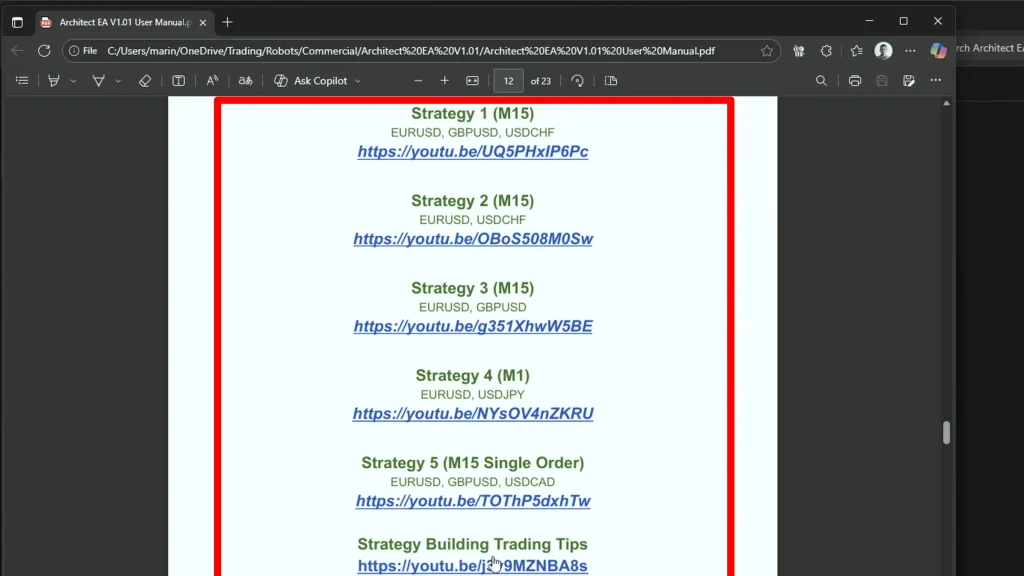
    Funded Darwinex Account: Conservative Success

    The third testing account is a funded Darwinex account, which represents a different use case and objective compared to challenges or personal live trading.

    Darwinex Context

    Darwinex provides trader funding through a unique model where your trading strategy becomes investable by their investor network. Your goal is to demonstrate consistent, controlled performance that attracts allocation rather than maximizing short-term percentage gains.

    Performance Results

    Starting December 12th (nearly simultaneous with the challenge account), this Darwinex account has generated approximately $2,000 profit. On a €100,000 account, that represents roughly 2% return.

    Compared to the live account’s 31%, this seems underwhelming. But remember: Darwinex accounts require conservative trading. The 2% return with controlled risk is exactly what Darwinex evaluates positively.

    The Shared Drawdown Experience

    Examining the FX Blue chart for the Darwinex account alongside the challenge account reveals they both experienced similar drawdown patterns during the same timeframe. Both dipped below the starting balance, then recovered and moved into profit.

    Interestingly, if I had started the live account on December 12th instead of December 2nd, it likely would have experienced that same drawdown. The earlier start date meant the live account had already moved through whatever market conditions triggered those losses on the other two accounts.

    This synchronization of drawdown timing across different platforms actually provides confidence; it suggests the EA responds consistently to market conditions rather than performing randomly differently across brokers.

    Why Broker Selection Matters Enormously

    One of the most important findings from testing Forex Gold Investor across multiple platforms: broker trading conditions dramatically impact results.

    The Eightcap Advantage

    I specifically chose Eightcap for my live account testing, and the results justify that decision. Looking at their trading conditions page and filtering for “most popular” instruments, you’ll see gold (XAU/USD) listed with extremely competitive spreads.

    At the time I checked during testing, the spread on gold was around 17 points (or 17 dollar cents in gold pricing terms). That’s exceptionally tight for a retail broker.

    Understanding Spread Impact

    For beginners reading this: spread is the difference between the bid price (where you can sell) and the ask price (where you must buy). We always buy at the higher ask price and sell at the lower bid price, so every single trade starts with an immediate small loss equal to the spread.

    This is how brokers profit from your trading; they don’t need to trade against you or manipulate prices, they simply collect the spread on every transaction.

    Why Spread Matters for Scalping

    Forex Gold Investor operates as a scalping-style EA, taking relatively quick trades with modest profit targets. When you’re capturing small price movements, the spread represents a significant percentage of potential profit.

    Example calculation:

    • Target profit: $5 per trade
    • Broker A spread: 17 cents
    • Broker B spread: 50 cents

    With Broker A, you need a price to move 17 cents in your favor just to break even, then another $5 to hit the profit target. Total movement needed: $5.17

    With Broker B, you need 50 cents just to break even, then another $5. Total movement needed: $5.50

    That 33-cent difference might seem tiny, but multiply it across hundreds of trades per month and it becomes the difference between profitability and break-even performance.

    Execution Speed Considerations

    Beyond spread, execution speed matters for scalping systems. Forex Gold Investor places orders that need to fill quickly at intended prices. Slow execution or significant slippage erodes profitability even if spreads are competitive.

    Eightcap provides fast execution with minimal slippage in my experience, which contributes to the strong performance on my live account compared to the challenge and funded accounts that likely use different execution infrastructure.

    Regulation and Security

    Finally, Eightcap is fully regulated, which provides legal protection and operational oversight. When testing EAs with real money, using regulated brokers reduces the risk of broker fraud, manipulation, or sudden disappearance with client funds.

    I always verify regulation status before committing capital to any broker, and I recommend you do the same.

    Comparative Analysis: What the Numbers Really Mean

    Let me synthesize the three-account results into actionable insights.

    The Profit Factor Story

    Profit factor is a critical metric; it represents total gross profit divided by total gross loss. A profit factor above 1.0 means the strategy is profitable. Above 2.0 is excellent. Above 3.0 is exceptional.

    Looking at my three accounts:

    • Live (Eightcap): 1.69 profit factor
    • Challenge: 1.27 profit factor
    • Funded (Darwinex): 1.26 profit factor

    The live account’s significantly higher profit factor confirms superior trading conditions. The challenge and funded accounts with nearly identical profit factors (1.27 vs 1.26) suggest they experienced similar execution environments despite being different platforms.

    Monthly Return Expectations

    When I standardize all three accounts to the December 12th start date for fair comparison:

    • Live: 14.3% monthly return
    • Challenge: 1.4% monthly return
    • Funded: 3% monthly return

    These massive differences from the same EA with similar settings emphasize how crucial broker selection is for scalping systems. The live account’s 14.3% monthly is roughly 10x better than the challenge account’s 1.4%; that’s not variance, that’s infrastructure differences.

    What About That “1% Daily” Claim?

    The marketing claim of 1% daily would translate to approximately 30% monthly. My live account achieved 14.3% monthly (from the standardized start date), which is impressive but only about half the claimed rate.

    Is the vendor lying? Not necessarily. They might be:

    • Showing optimized historical backtests rather than forward results
    • Using the absolute best broker conditions available
    • Cherry-picking their best-performing period
    • Running with higher risk settings than I’m using

    The important point: don’t expect 1% daily in real trading. If you achieve 10-15% monthly consistently, consider that excellent performance.

    System Configuration and Risk Management

    Forex Gold Investor includes several important configuration options that deserve attention.

    The Dual-Strategy Setup

    As mentioned earlier, the EA runs two systems simultaneously with different magic numbers. In the expert properties, you can configure:

    • Risk management parameters for each system
    • Position sizing approaches
    • Entry criteria adjustments
    • Maximum trades or positions

    This flexibility allows you to run one system conservatively and another more aggressively, or disable one entirely if it’s not performing.

    Prop Firm Protection Features

    The drawdown protection settings make this EA practical for challenge and funded accounts:

    • Max Daily Loss: Set the maximum dollar amount you’re willing to lose in a single day. Exceeding this triggers automatic position closure and trading suspension.
    • Max Daily Drawdown: Define maximum equity decline from the day’s high point. If intraday drawdown hits this threshold, the EA protects remaining capital.

    These controls help you stay within prop firm rules that typically impose 5-10% daily loss limits and 10% maximum drawdown overall.

    Position Sizing Approaches

    The EA offers flexible position sizing:

    • Fixed lot sizes
    • Percentage-based sizing
    • Balance-based scaling
    • Equity-based adjustments

    I’m using relatively moderate position sizing across all accounts. You could increase aggression for faster profits at the cost of larger drawdowns, or decrease for capital preservation at the cost of slower growth.

    Drawdown Behavior and Recovery

    One aspect worth examining closely: how Forex Gold Investor handles drawdown periods.

    Normal Drawdowns Without Martingale

    Both the challenge and funded accounts experienced drawdowns below the starting balance during the same December timeframe. This is completely normal for trading systems that don’t use grid or martingale recovery approaches.

    Dangerous recovery systems like martingale can show smoother equity curves, until they catastrophically fail and blow accounts entirely. Forex Gold Investor accepts that drawdowns occur and relies on positive expectancy over time rather than forced recovery through position sizing escalation.

    Recovery Pattern

    The important observation: both accounts that experienced drawdowns subsequently recovered and moved into profit. They didn’t spiral deeper into losses or require manual intervention to stop bleeding.

    This recovery capability suggests the underlying strategy has positive expectancy; over time, wins outpace losses sufficiently to overcome temporary adverse periods.

    Equity vs. Balance Relationship

    Across all three accounts, the equity line stays relatively close to the balance line on FX Blue charts. This indicates:

    • Positions close relatively quickly (no extended holds)
    • Floating losses don’t accumulate excessively
    • The EA isn’t relying on “hope” that losing trades will reverse

    When equity diverges significantly from balance, it means large floating losses are being held, a warning sign of dangerous trading approaches. Forex Gold Investor doesn’t exhibit this behavior in my testing.

    Frequently Asked Questions

    Can Forex Gold Investor really achieve 1% daily as advertised?

    Based on my testing across three accounts over nearly a month, no, the system hasn’t achieved 1% daily consistently. My live account with optimal conditions (Eightcap’s tight spreads and fast execution) achieved approximately 14.3% monthly return when standardized from December 12th, which is excellent but roughly half the 30% monthly implied by “1% daily.”

    Challenge and funded accounts showed 1.4% and 3% monthly, respectively. The vendor’s claim likely represents backtested optimization or cherry-picked best periods. Realistic expectations should be 10-15% monthly under good conditions, which is still an impressive performance. Don’t purchase based on the 1% daily marketing; base decisions on independent third-party results like this review.

    Why does the live account perform so much better than the challenge and funded accounts?

    Broker trading conditions, particularly spread and execution speed, dramatically impact scalping system performance. My Eightcap live account enjoys approximately 17-point spreads on gold with fast order fills, creating favorable conditions for the EA’s quick scalping trades. Challenge and funded accounts use different broker infrastructure with potentially wider spreads, slower execution, or inferior liquidity.

    The live account’s 14.3% monthly return versus 1.4-3% on other accounts demonstrates this infrastructure dependency. Forex Gold Investor isn’t broker-agnostic; you need excellent execution conditions to replicate strong results. Always demo test with your specific broker before live trading any scalping EA to verify it performs acceptably under your conditions.

    Is Forex Gold Investor safe for prop firm challenge accounts?

    Yes, with appropriate configuration. The EA includes specific features designed for prop firm requirements: max daily loss settings, max daily drawdown controls, and drawdown protection that helps you stay within typical 5-10% limits. However, my challenge account results (1.4% monthly) suggest it won’t rapidly hit profit targets the way my live account did (14.3% monthly).

    The conservative performance on the challenge infrastructure means passing evaluations will take longer than expected based on live account results. For funded accounts post-challenge, the 3% monthly return I achieved on Darwinex demonstrates sustainable profitability without violating strict drawdown rules. Just don’t expect explosive growth on challenge platforms.

    Does Forex Gold Investor use martingale or grid trading strategies?

    No, Forex Gold Investor does not use martingale position sizing where lots double after losses. Looking at my account histories, position sizes remain consistent rather than escalating. The EA does occasionally add to positions (averaging entry price), but typically only once, not repeatedly. This controlled averaging is fundamentally different from dangerous martingale systems that continue doubling until recovery or account destruction.
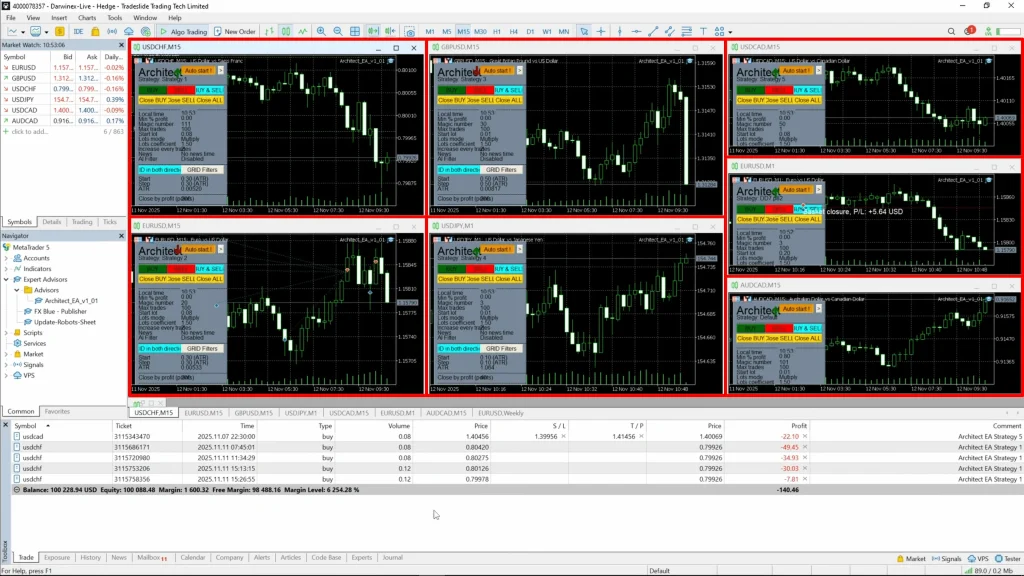
    The equity curves across my accounts show normal drawdowns rather than the initially smooth, then catastrophic patterns typical of martingale systems. This makes Forex Gold Investor safer for capital preservation, though it also means recovery from drawdowns takes longer than forced martingale recoveries, assuming those martingale systems recover at all before failing.
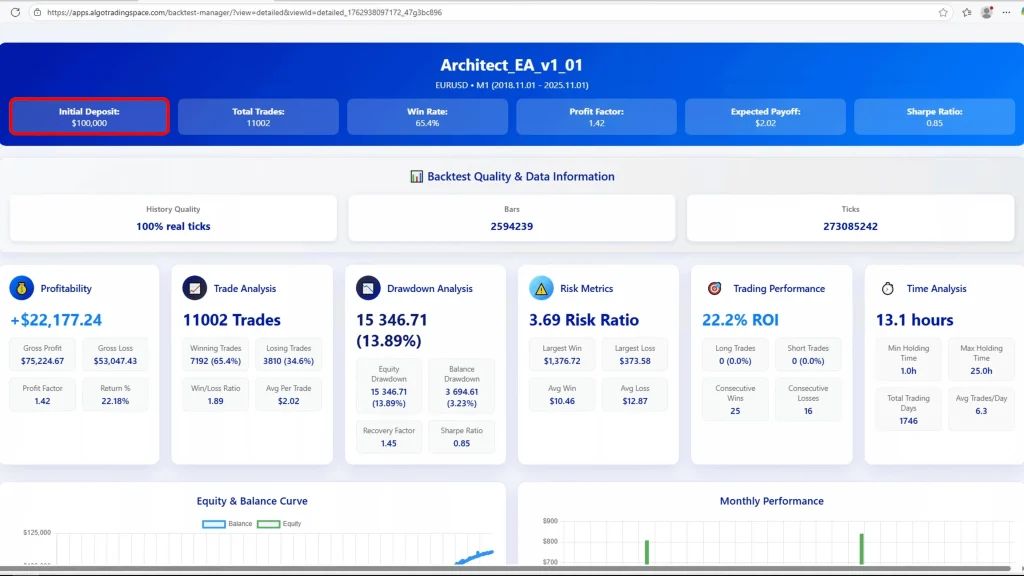
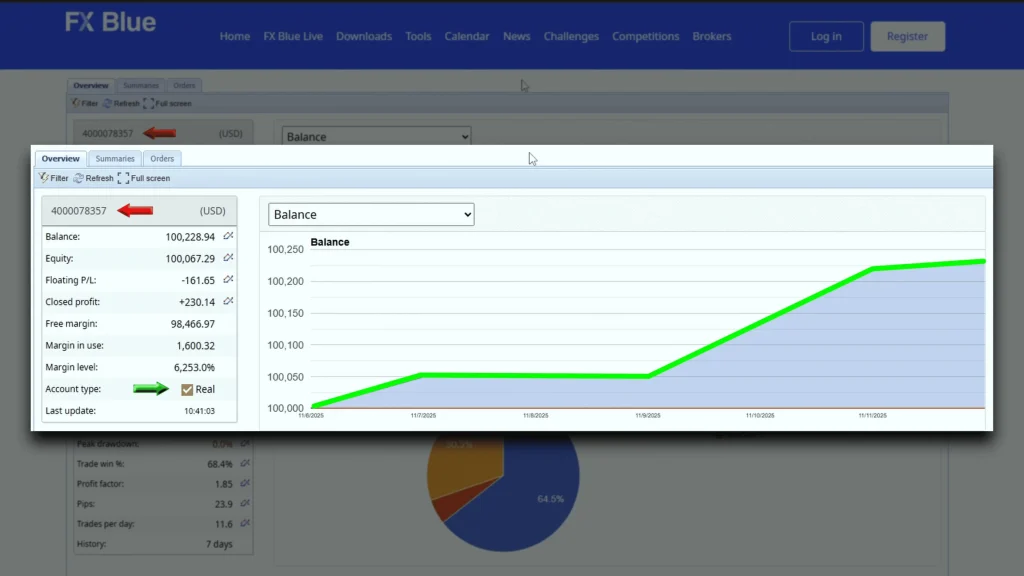
    What’s the minimum account size needed to run Forex Gold Investor safely?

    I successfully tested Forex Gold Investor on a $500 live account, generating 31% profit in less than a month. This suggests $500 is technically viable as a minimum, though I’d recommend $1,000-$2,000 for more comfortable operation with standard settings. The EA’s position sizing is configurable, so you can adjust lots based on account size. For challenge accounts, the minimum size depends on the challenge provider.

    I used a $15,000 challenge successfully despite modest returns. For Darwinex-style funded accounts with €100,000 allocations, capital isn’t a constraint. Remember that smaller accounts require proportionally smaller position sizes, which means lower absolute profits even if percentage returns remain acceptable. Budget for proper capitalization rather than minimum viable amounts.

    Should I run both System One and System Two, or disable one?

    My testing approach runs both systems simultaneously for risk diversification. Analyzing performance by magic number showed one system generated $149 profit while the other contributed only $5.66, suggesting significant performance disparity.

    However, different systems may excel under different market conditions, trending vs ranging, volatile vs quiet.

    Running both provides diversification at the cost of slightly increased complexity. I recommend starting with both active as designed, then monitoring individual system performance through FX Blue’s strategy filtering. If over 2-3 months one system consistently loses or dramatically underperforms, disable it and trade only the profitable system.

    Short-term performance differences don’t necessarily indicate long-term unsuitability; give both systems adequate testing time before making removal decisions.

    Where to Learn More

    If you’re interested in exploring Forex Gold Investor EA further or want to see current pricing and promotional offers, I’ve compiled resources on Algo Trading Space.

    Find everything here: algotradingspace.com/robots/commodities/forex-gold-investor-ea

    The page includes links to FX Automater’s official website, where you can purchase the EA, information about current sales or discounts, and access to my ongoing transparent tracking across all three accounts so you can monitor continued performance.

    Full transparency: purchases through that page provide a commission supporting ongoing independent testing and honest reporting. But whether you buy through my link or directly, please test extensively on the demo first, particularly with your specific broker’s infrastructure, before committing real money.

    I’ll continue running Forex Gold Investor across multiple accounts, updating results publicly so you can see exactly how it performs over the coming months as we gather more data across different market conditions.

    For traders interested in deeper insights, Algo Trading Space offers aVIP Club that provides exclusive access to our complete trading results dashboard, priority support, and early intelligence on high-performing EAs before they become public knowledge.

    Members also get downloadable set files, access to our private Discord community, and our full course library. 

    Testing Transparency Disclaimer

    This review reflects approximately one month of testing across three distinct account types: a $500 live account with Eightcap (started December 2nd, $154.77 profit, ~31% return), a $15,000 challenge account (started December 13th, $140 profit, ~0.93% return), and a funded Darwinex account (started December 12th, ~$2,000 profit, ~2% return). 

    All accounts are tracked publicly via FX Blue with transparent access. Testing duration is relatively short, limiting long-term performance conclusions. Broker conditions dramatically impact results; live accounts with tight spreads and fast execution significantly outperformed challenge and funded accounts.

    The vendor’s “1% daily” claim has not materialized in independent testing; realistic expectations are 10-15% monthly under optimal conditions, less under typical prop firm infrastructure. Forex Gold Investor is not a martingale system but does occasionally average positions. 

    Past performance never guarantees future results. Always conduct extensive demo testing with your specific broker before live trading. All profit figures are gross profits; actual results may vary based on individual broker costs, slippage, and execution quality.